


Blog
Build vs Buy AI: A Framework for Enterprise AI Decision-Making

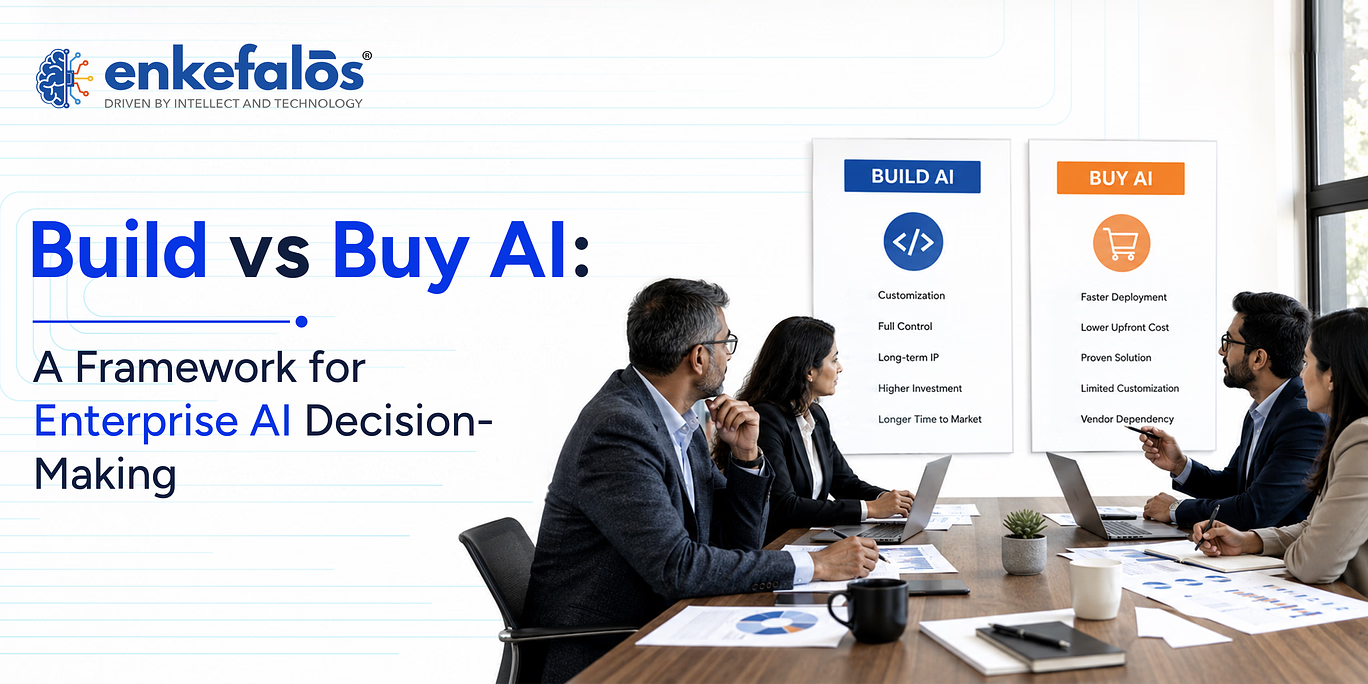
Enterprise AI decisions rarely begin with a simple technology question. A company may need an AI system for customer service, claims processing, internal knowledge retrieval, fraud detection, software development, document analysis, or another business workflow. The more important question is how much of that capability the enterprise should own, customize, and operate itself.
Building can provide greater control over data, models, workflows, intellectual property, and system behavior, but it also creates responsibility for engineering, evaluation, infrastructure, security, monitoring, and continuous improvement. Buying can accelerate deployment by using existing pravite AI platforms, but enterprises must evaluate integration, data handling, customization, pricing, vendor dependency, and governance.
Increasingly, the decision is not simply build vs buy AI. Gartner describes enterprise AI as moving toward combinations of packaged AI, enterprise-built capabilities, and blended approaches. The right decision therefore depends on the strategic importance of the use case, available internal capabilities, data sensitivity, differentiation required, deployment speed, economics, and long-term operating model.
Why Build vs Buy Is an Important AI Decision
AI differs from conventional software because deployment is not the end of the lifecycle.
An enterprise AI system may require ongoing:
- Model evaluation
- Data management
- Prompt and retrieval changes
- Guardrails
- Security controls
- Human review
- Model updates
- Performance monitoring
- Cost optimization
- Regulatory documentation
A solution that is inexpensive to launch may become expensive to operate. Conversely, building a sophisticated internal platform for a common use case may consume resources without creating meaningful competitive differentiation.
Gartner’s 2026 guidance also highlights hidden AI costs such as data integration, governance, ongoing tuning, operations, renewals, and vendor lock-in.
The decision should therefore consider total lifecycle value, not just initial license fees or development costs.
What Does “Build AI” Actually Mean?
“Build AI” does not necessarily mean training a foundation model from scratch.
Enterprise building can occur at several levels:
- Building an AI-enabled application around an existing model
- Creating a Retrieval-Augmented Generation (RAG) system using enterprise knowledge
- Building AI agents that interact with internal systems and tools
- Fine-tuning an existing model with domain-specific data
- Hosting and operating an open or proprietary model privately
- Developing specialized models for proprietary business problems
- Building model evaluation, governance, monitoring, and deployment infrastructure
- AWS similarly distinguishes between consuming third-party AI applications and building applications on pretrained models, with increasing ownership as organizations move deeper into the AI stack.
The central question is therefore which layers need to be proprietary, not whether every AI component must be created internally.
What Does “Buy AI” Mean?
Buying AI generally means obtaining an existing AI capability from an external provider rather than developing the complete system internally.
This may include:
- AI functionality embedded within existing enterprise software
- SaaS AI applications
- AI assistants
- Industry-specific AI platforms
- Managed foundation-model APIs
- AI development platforms
- Managed agent platforms
- Vendor-operated analytics or automation tools
- Buying can reduce development time because infrastructure, models, interfaces, or workflows already exist.
However, purchasing AI does not eliminate enterprise responsibility. Organizations still need to evaluate how the solution handles data, integrates with internal systems, performs their use case, manages access, responds to errors, and meets governance requirements.
NIST’s AI Risk Management Framework specifically includes acquired AI systems and third-party technologies within organizational AI risk management.
Build vs Buy AI: Key Decision Factors
The right sourcing model depends on several interconnected factors.
|
Decision Factor |
Build May Be Stronger When |
Buy May Be Stronger When |
|
Strategic differentiation |
AI capability is central to competitive advantage |
Capability is relatively standard |
|
Customization |
Workflow requires substantial domain-specific behavior |
Standard configuration meets requirements |
|
Data sensitivity |
Strict control over data and deployment is required |
Vendor controls satisfy requirements |
|
Time to value |
Longer development is acceptable |
Rapid deployment is important |
|
Internal expertise |
Strong AI, data and engineering teams exist |
Specialist capabilities are limited |
|
Integration |
Deep integration with proprietary systems is required |
Standard connectors are sufficient |
|
Governance |
Enterprise requires extensive internal control | Vendor governance can meet required controls |
|
Scale |
Capability will be reused across many workflows |
Requirement is narrow or departmental |
|
Cost model |
Internal economics improve at expected scale |
Subscription economics are more attractive |
|
IP ownership |
Models, data pipelines or workflows are strategic assets |
Ownership provides limited differentiation |
A strong decision considers these factors together rather than allowing one criterion, such as speed or cost, to dominate.
10 Questions to Ask Before Choosing Build or Buy
Before selecting an approach, enterprise teams should answer:
1. Is this AI capability strategically differentiating?
If competitors can purchase exactly the same capability, building may only be justified if customization creates additional business value.
2. How proprietary is the required data?
Sensitive customer, financial, operational, healthcare, or intellectual-property data may require stronger deployment and data-control requirements.
3. How much customization is genuinely necessary?
Separate essential domain requirements from features teams merely prefer.
4. Can an existing solution meet most requirements?
An existing solution that meets most of the essential requirements may be more economical than building everything internally.
5. What internal AI capabilities do already exist?
Assess data engineering, machine learning, MLOps, security, product management, evaluation, and governance expertise.
6. What is the required time for production?
A rapidly changing business problem may favor buying or blending rather than a long internal build.
7. What is the five-year total cost of ownership?
Include development, compute, licenses, integration, model usage, data preparation, evaluation, monitoring, security, staffing, and maintenance.
8. What happens if the model or vendor changes?
Test portability, model substitution, data export, contractual rights, and switching costs.
9. How will the AI system be governed after launch?
Define evaluation, monitoring, human oversight, incident handling, audit trails, and change management.
10. How will success be measured?
Establish measurable outcomes such as reduced processing time, improved productivity, increased conversion, lower operating cost, or improved decision quality.
Build, Buy or Blend? Assess the Right AI Strategy
Evaluate strategic differentiation, data sensitivity, internal capability, integration, governance, time to production, and lifecycle cost before committing to an AI sourcing model.
When Should Enterprises Build AI?
Building becomes more compelling when AI itself is part of the organization’s competitive capability.
Enterprises may favor building when:
- Proprietary data creates meaningful differentiation
- Workflows are highly organization-specific
- AI must integrate deeply with internal systems
- Data cannot leave controlled infrastructure
- Model behavior requires extensive customization
- The capability will support multiple products or departments
- Ownership of models, data pipelines, or IP is strategically important
- Existing products cannot satisfy operational requirements
For example, an insurer developing an AI capability around proprietary underwriting rules and years of internal claims data may require considerably more customization than a company purchasing a general meeting-summary tool.
Building should still be justified economically. Technical uniqueness alone does not guarantee business value.
When Should Enterprises Buy AI?
Buying can be effective when the underlying problem is already well served by mature products.
Examples may include:
- Productivity assistance
- Standard document extraction
- Generic transcription
- Commodity customer-support features
- Common analytics functionality
- AI capabilities already embedded in enterprise applications
Buying is particularly attractive when:
- Deployment speed matters
- The use case is not strategically differentiating
- Internal AI expertise is limited
- Integration requirements are relatively standard
- The vendor already provides required infrastructure
- Operating the technology internally would add little value
The enterprise should still test vendor performance using its own data and workflows rather than assuming advertised benchmark performance will translate directly into production results.
When a Hybrid AI Strategy Makes More Sense
For many enterprises, hybrid, or blend, is the most practical approach.
The organisation may buy foundation models and infrastructure while building its own:
- Data layer
- RAG system
- Business rules
- Workflow orchestration
- Agent logic
- Evaluation framework
- Guardrails
- User experience
For example, a bank might use a commercial foundation model but keep customer data, retrieval, policy enforcement, evaluation, and application workflows inside its controlled environment.
Modern AI platforms increasingly support this approach by allowing enterprises to choose among multiple models while adding custom training, orchestration, and deployment capabilities.
Hybrid architecture can provide faster access to advanced AI while preserving ownership of the components that create business differentiation.
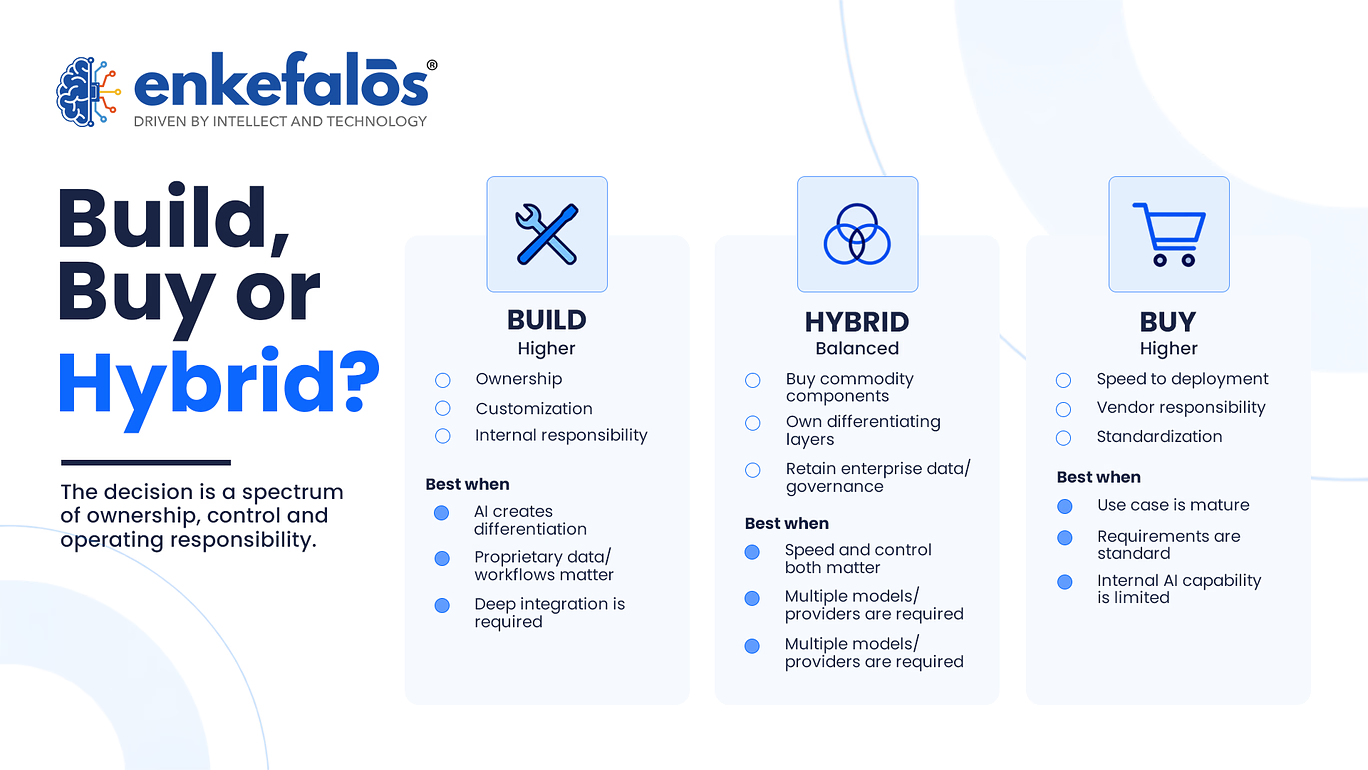
Figure 1: Build, buy, and hybrid approaches differ primarily in how enterprises balance strategic ownership, customization, speed, vendor dependency, and operational responsibility.
Build vs Buy AI Decision Matrix
A build vs buy AI decision matrix helps enterprises compare sourcing approaches against factors such as customization, speed, data sensitivity, internal capabilities, and strategic value.
|
Business Requirement |
Build | Buy |
Hybrid |
|
Standard business use case |
✓ |
✓ |
|
|
Need rapid deployment |
✓ |
✓ |
|
|
Highly proprietary workflow |
✓ |
✓ |
|
|
Sensitive enterprise data |
✓ | Depends on vendor |
✓ |
|
Significant customization |
✓ |
✓ |
|
|
Limited AI engineering resources |
✓ |
✓ |
|
|
Strong internal AI capability |
✓ | ✓ |
✓ |
|
Need model flexibility |
✓ | Depends |
✓ |
|
Strategic AI intellectual property |
✓ |
✓ |
|
|
Mix of standard and proprietary needs |
✓ |
The matrix should support discussion rather than automatically determine the answer. Enterprise architecture, security, finance, legal, data, and business teams should evaluate the decision together.
Build vs Buy for Regulated Industries
The build-or-buy decision becomes more complex in sectors such as financial services, insurance, healthcare, government, and critical infrastructure.
The organisation may need to evaluate:
- Data residency
- Personal and confidential information
- Model explainability
- Human oversight
- Auditability
- Decision traceability
- Vendor access to data
- Model updates
- Third-party dependencies
- Record retention
- Incident response
NIST’s AI RMF explicitly addresses risks from third-party AI technologies and calls for policies covering third-party systems, supply-chain issues, and contingency processes for failures. ISO/IEC 42001 likewise establishes an AI management-system framework for organisations that develop or use AI systems, reinforcing the need for lifecycle governance regardless of whether technology is internally built or purchased.
Regulatory responsibility also cannot always be transferred to a vendor. Under the EU AI Act, for example, certain obligations apply separately to AI providers and deployers, including requirements around transparency and, for applicable high-risk systems, monitoring and human oversight.
For regulated enterprises, the question is therefore not simply “Can we buy this?” but “Can we operate and govern it within our regulatory obligations?”
A Practical Build vs Buy AI Decision Framework
Enterprise teams can structure the decision in six stages.
Step 1: Define the Business Outcome
Start with the measurable problem, not the model.
Define what should improve, who uses the system, and what economic value successful deployment creates.
Step 2: Determine Strategic Differentiation
Ask whether the AI capability itself creates a competitive advantage.
Commodity capability generally favours buying. Proprietary intelligence may justify deeper internal ownership.
Step 3: Map Data and Risk Requirements
Classify the data involved and determine:
- Where it can be processed
- Who can access it
- Required auditability
- Regulatory constraints
- Human-oversight requirements
Step 4: Test the Market
Evaluate existing products before committing to an internal build.
Use enterprise data and realistic scenarios rather than vendor demonstrations alone.
Step 5: Compare Total Lifecycle Economics
Calculate:
Build cost = development + infrastructure + people + integration + governance + ongoing operations
against:
Buy cost = licences/usage + integration + customization + governance + vendor management + switching costs
The cheapest pilot is not necessarily the lowest-cost production architecture.
Step 6: Choose Build, Buy or Hybrid, and Revisit It
Make the decision at the component level.
An enterprise may buy the model, build the workflow, retain its data layer, and use a third-party infrastructure platform. As models, economics, and regulations evolve, these decisions should be reassessed.
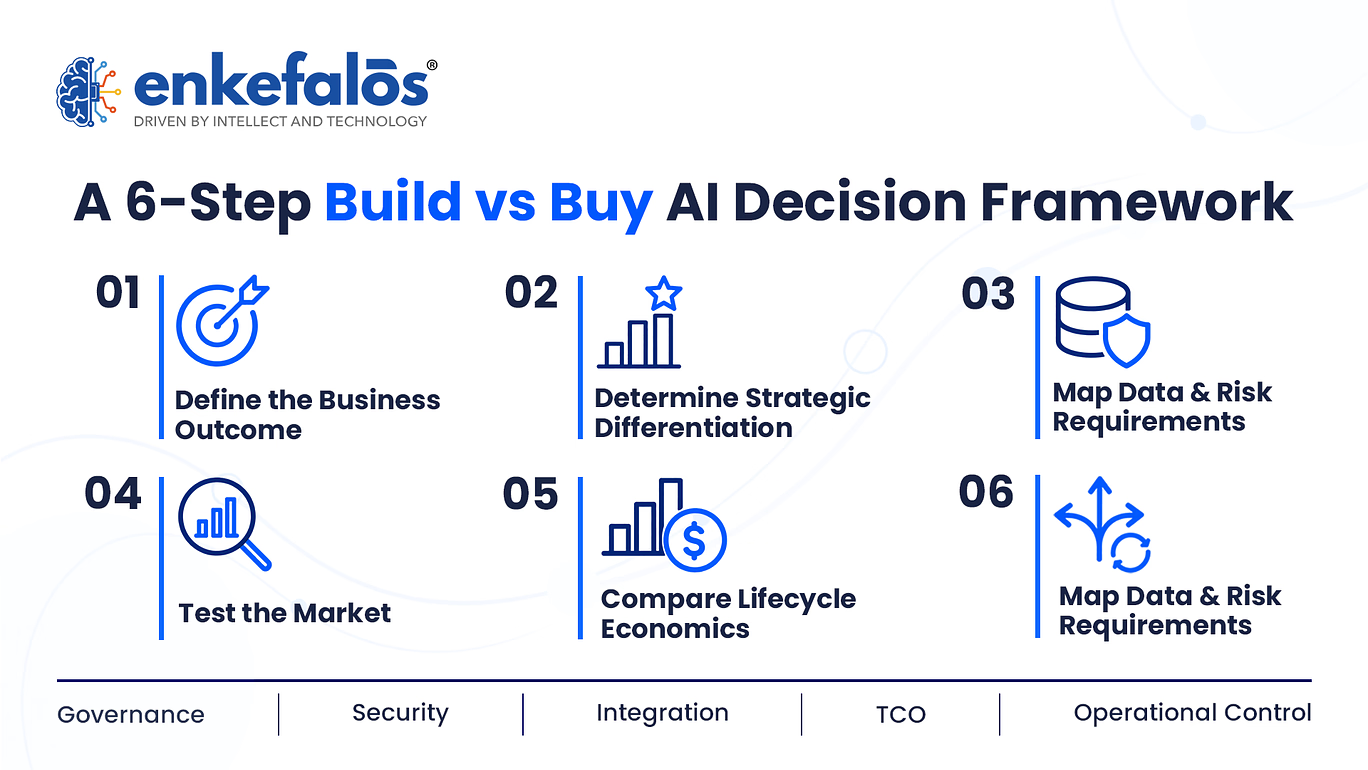
Enterprise AI sourcing decisions should begin with business value and progress through differentiation, data and risk, market testing, lifecycle economics, and the appropriate mix of build, buy, or hybrid ownership.
How Enkefalos Helps Enterprises Make AI Production-Ready
The build-versus-buy decision is only the beginning. Once an enterprise selects models, data sources, applications, and workflows, those components still need to operate consistently in production.
Enkefalos positions GenAI Foundry as a private AI control plane designed to support the AI lifecycle across data preparation, model training and Reinforcement Learning from Human Feedback (RLHF), evaluation, deployment, runtime guardrails, RAG and enterprise knowledge, and reusable prompt management.
The platform supports on-premises, private-cloud, and hybrid deployment environments and is designed around enterprise ownership of data, models, and intellectual property.
For organisations using a hybrid strategy, this type of control layer can help connect externally sourced or internally developed AI components with:
- Controlled enterprise data
- Evaluation before deployment
- Version-controlled releases
- Runtime guardrails
- Human-supervised learning
- Audit trails
- Governed RAG
- Production monitoring and improvement
The objective is to move the conversation beyond which model was built or purchased toward whether the complete AI system can be governed, evaluated, operated, and improved in production.
Build, Buy or Blend? Assess the Right AI Strategy
Evaluate strategic differentiation, data sensitivity, internal capability, integration, governance, time to production, and lifecycle cost before committing to an AI sourcing model.
Assess Your AI Strategy
Conclusion
Build vs buy AI should be treated as a business, architecture, and operating-model decision rather than a one-time technology procurement choice.
Enterprises should build where proprietary data, specialised workflows, strategic differentiation, or control justify deeper ownership. They should buy where mature products can solve standard problems faster and more economically. And they should use hybrid approaches when existing models or platforms can provide the foundation while proprietary data, workflows, governance, and domain intelligence remain under enterprise control.
The strongest AI strategy is therefore not automatically the one that builds the most or buys the least. It is the one that creates measurable business value while giving the enterprise the right level of control, flexibility, governance, and ownership for each layer of its AI architecture.
FAQs: Build vs Buy AI
1. What does Build vs Buy AI mean for enterprises?
Build vs Buy AI refers to deciding whether an enterprise should develop an AI capability internally, acquire an existing solution, or combine purchased technology with internally developed components.
2. Should enterprises build their own AI solutions or buy existing AI platforms?
The decision depends on strategic differentiation, data requirements, customization, internal capabilities, deployment speed, cost, governance, and long-term ownership. Many enterprises use a combination of both approaches.
3. When should an enterprise build an AI solution instead of buying one?
Building can make sense when the AI capability uses proprietary data, requires substantial customization, creates competitive differentiation, needs deep system integration, or requires greater control over deployment and intellectual property.
4. When is buying an AI solution better than building one internally?
Buying can be more practical for mature, standardised use cases where an existing solution meets business requirements, deployment speed matters, and building equivalent infrastructure internally would provide limited additional value.
5. What factors should enterprises consider when making a Build vs Buy AI decision?
Key factors include business value, strategic differentiation, data sensitivity, customization, internal expertise, integration, deployment speed, total cost of ownership, governance, scalability, vendor dependency, and IP requirements.
6. Is it cheaper to build or buy an AI solution?
Neither approach is always cheaper. Buying may reduce initial development costs, while building can become economical when proprietary capability is reused at scale. Enterprises should compare the full lifecycle cost of development, infrastructure, licences, integration, governance, staffing, monitoring, and maintenance.
7. What is a hybrid AI strategy?
A hybrid AI strategy combines externally sourced AI models, platforms, or infrastructure with enterprise-owned data, workflows, integrations, governance, or domain-specific capabilities. It allows organizations to buy standard components while retaining control over the areas that create business differentiation.
8. How should regulated enterprises approach Build vs Buy AI?
Regulated enterprises should consider data residency, privacy, model explainability, auditability, human oversight, vendor dependencies, regulatory obligations, and ongoing monitoring alongside cost, speed, and technical capability.