


Blog
AI Control Plane vs AI Platform: What’s the Difference?

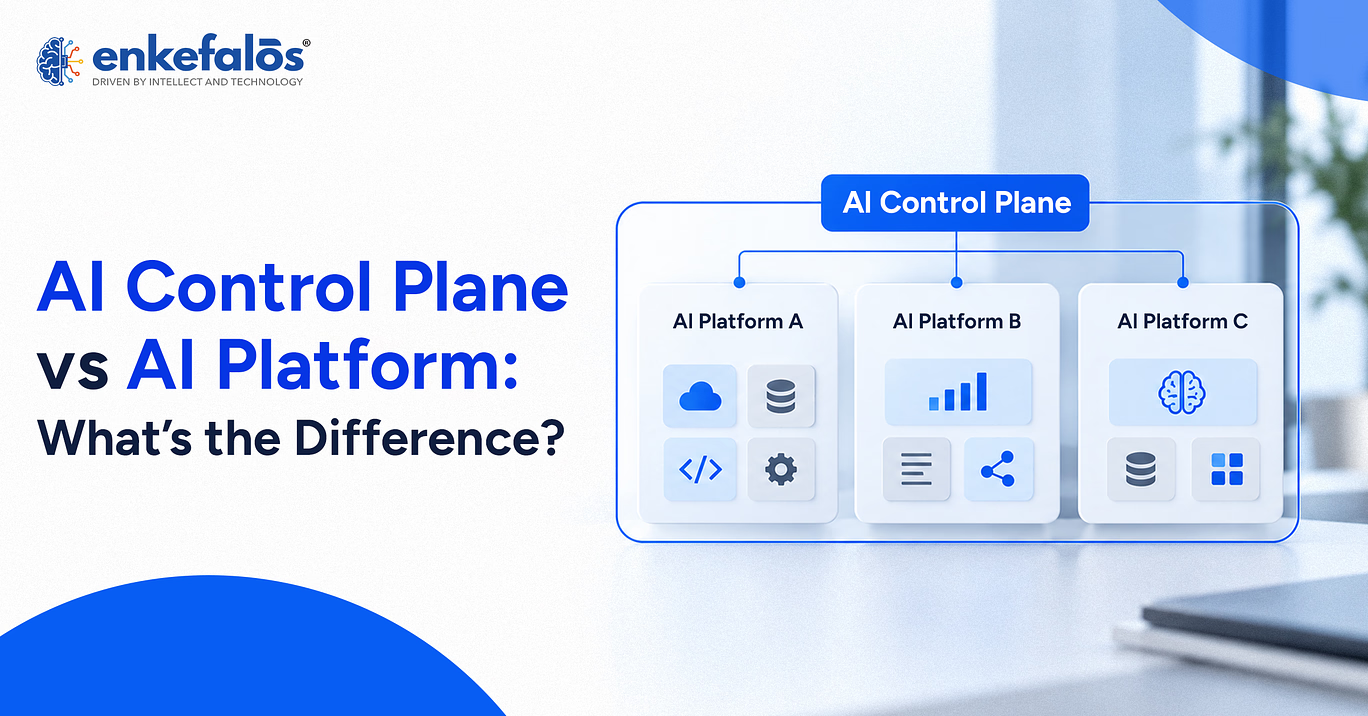
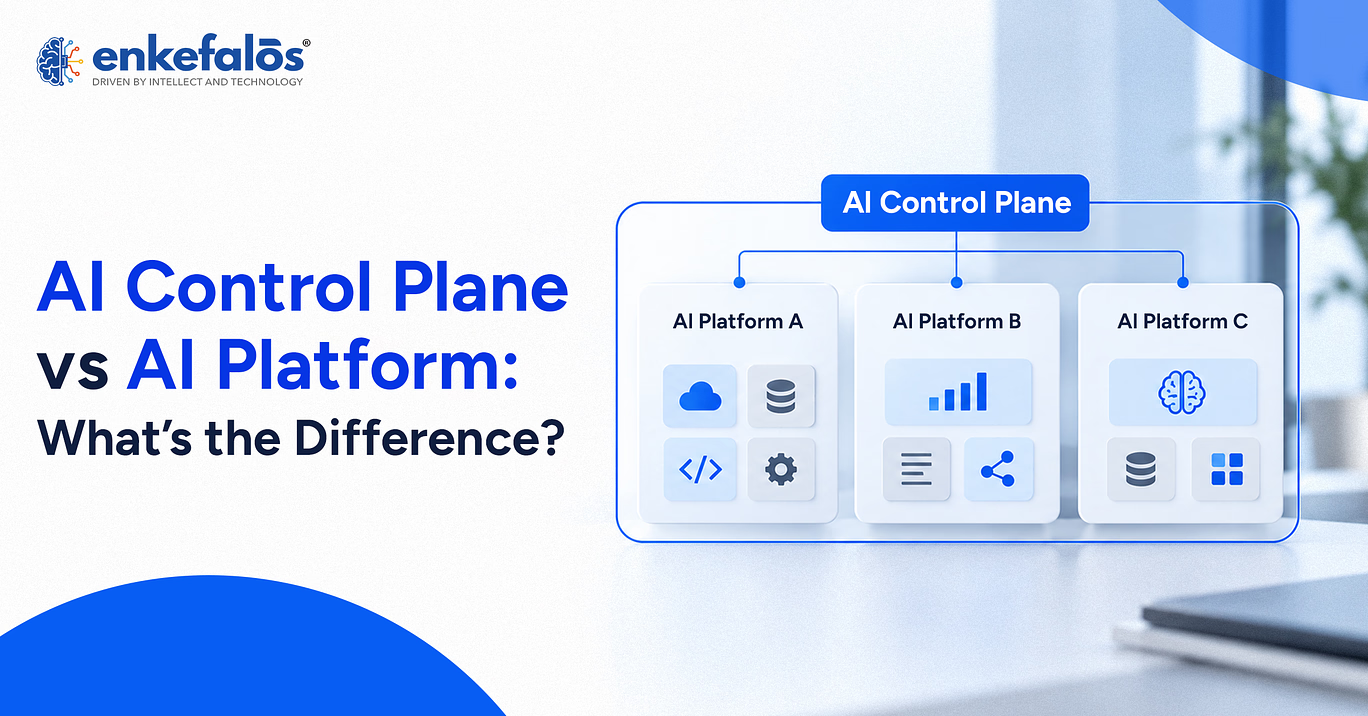
Enterprises are moving from isolated AI experiments to environments that may include multiple models, retrieval systems, AI applications, agents, data sources, and deployment locations. As this environment grows, teams need tools not only to build AI but also to control how AI systems operate across the organization.
This is where the distinction between an AI platform and an AI control plane becomes important. An AI platform usually provides capabilities for developing, deploying, and operating AI workloads. An AI control plane is better understood as a management and governance layer that coordinates policies, access, models, agents, tools, and observability across AI environments. The term is still evolving and is not a formal regulatory category, so implementations can differ across vendors and architectures.
What Is an AI Platform?
An AI platform provides the technical environment teams use to build, customize, deploy, and operate AI models and AI-powered applications. Modern enterprise AI platforms can support predictive AI, generative AI, inference, fine-tuning, agents, and production deployment across cloud or hybrid infrastructure. Red Hat, for example, describes its AI platform as supporting model development, tuning, inference, application development, and production management across hybrid environments.
An AI platform may include:
- Model development and experimentation
- Model training and fine-tuning
- Prompt and application development
- Retrieval-augmented generation
- Model serving and inference
- Agent development
- Monitoring
- Data and model integration
- Compute and storage management
- Deployment workflows
- The primary purpose is usually to provide builders and platform teams with the capabilities needed to create and run AI systems.
What Is an AI Control Plane?
An AI control plane is a centralized management layer used to coordinate and govern AI systems across environments. Rather than performing the AI workload itself, it defines and enforces how models, agents, tools, data, and workflows are allowed to operate.
The idea follows the broader control-plane concept used in distributed computing, where the control plane manages configuration and policy while the underlying runtime executes the actual work. Current enterprise AI implementations extend this concept to model access, agent identity, permissions, tool usage, governance, observability, lifecycle controls, and auditability.
An AI control plane may manage:
- Model and agent registration
- Identity and permissions
- Model routing
- Tool and API access
- Data-access policies
- Runtime guardrails
- Human approval requirements
- Evaluations
- Observability and tracing
- Usage and cost controls
- Versioning
- Audit records
The exact scope varies because there is no single industry definition that every vendor follows.
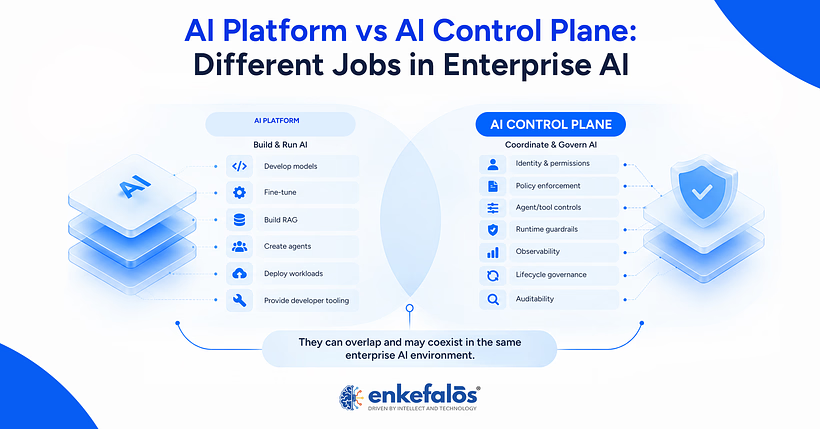
AI platforms primarily help teams build and operate AI workloads, while AI control planes focus on coordinating governance, policies, access, observability, and lifecycle control across AI environments.
AI Control Plane vs AI Platform: Key Differences
An AI platform and an AI control plane may overlap, but they usually solve different layers of the enterprise AI problem.
|
Factor |
AI Platform |
AI Control Plane |
|
Primary Purpose |
Build, deploy, and operate AI |
Govern and coordinate AI across environments |
|
Main Users |
Developers, data scientists, ML engineers |
Platform, governance, security, operations teams |
|
Primary Focus |
AI development and runtime capabilities |
Policy, oversight, coordination, lifecycle control |
|
Model Management |
Develops, tunes, serves models |
Controls which models can be used and under what conditions |
|
Agent Management |
Builds and runs agents |
Governs identities, permissions, tools, and actions |
|
Infrastructure Scope |
Often tied to supported deployment environments |
Can span multiple platforms and environments |
|
Governance |
May include built-in governance features |
Governance is usually a core architectural purpose |
|
Observability |
Monitors platform workloads |
Provides cross-system visibility and auditability |
The boundary is not always strict. Some AI platforms now include governance, agent management, lifecycle controls, and observability that resemble control-plane capabilities.
AI Control Plane vs AI Platform: Are They Competing Technologies?
An AI control plane and an AI platform should not automatically be viewed as competing technologies.
An enterprise may use an AI platform to develop and deploy applications while using a control-plane layer to enforce common policies across that platform and other AI environments.
For example, different business teams may build AI applications using separate clouds, model providers, agent frameworks, or development platforms. A centralized control layer can provide consistent identity, access, monitoring, policy enforcement, and lifecycle management across those systems.
This becomes increasingly relevant when AI deployments are distributed rather than standardized in one environment. Deloitte describes the emerging control-plane concept as a layer for coordinating models, agents, workloads, decisions, identity, and policy across enterprise systems.
Why AI Control Planes Matter for Enterprise AI
Managing one AI application is different from managing hundreds of models, agents, and workflows across departments.
Without centralized controls, each AI project may develop its own:
- Model credentials
- Access policies
- Guardrails
- Logging
- Evaluation process
- Human approval rules
- Monitoring
- Tool permissions
- This creates fragmentation and makes it harder to understand what AI systems exist, what they can access, and what actions they can take.
An AI control plane can create shared governance across these systems. This aligns with broader AI risk-management principles such as NIST’s Govern, Map, Measure, and Manage functions, which emphasize continuous governance and risk management throughout the AI lifecycle.
When Should an Enterprise Consider an AI Control Plane?
Not every organization needs a separate control plane from the beginning. A small number of AI applications running within one governed platform may be manageable using that platform’s native controls.
A dedicated or broader control-plane approach becomes more relevant when an enterprise has:
- Multiple AI platforms or model providers
- AI across cloud, on-premises, and edge environments
- Growing numbers of autonomous agents
- Sensitive enterprise data
- Multiple business units developing AI independently
- Complex tool and API access
- Regulatory or audit requirements
- Inconsistent monitoring across projects
- A need for centralized model or agent inventory
- Cross-enterprise cost and usage controls
The trigger is usually increasing complexity, not simply the number of models.
Is Enterprise AI Becoming Harder to Control?
Assess whether fragmented models, agents, platforms, permissions, and monitoring are creating the need for a shared enterprise AI control layer.
AI Control Plane Use Cases
An AI control plane can support several enterprise AI management scenarios.
- Multi-model management: Route workloads between approved models based on policy, capability, latency, cost, or data requirements.
- Agent governance: Define which agents can access data, call tools, initiate workflows, or take actions without human approval.
- Policy enforcement: Apply enterprise requirements consistently across different AI applications.
- Observability: Track model calls, agent activity, latency, errors, tool use, and outcomes through common monitoring.
- Cost management: Set usage limits, budgets, or routing rules across model providers.
- Private AI: Apply centralized controls while models, data, and applications remain within approved private or hybrid environments.
- Lifecycle management: Register models and agents, track versions, evaluate changes, and manage production approval.
IBM and other enterprise vendors increasingly describe agent control planes as centralized systems for deploying, operating, monitoring, and governing agents across organizational environments.
AI Control Plane Architecture
There is no universal AI control plane architecture, but enterprise implementations commonly include several layers.
- Identity and access layer: Establishes identities for users, applications, models, and agents and determines what they can access.
- Model and agent registry: Tracks approved models, agents, versions, owners, and deployment status.
- Policy engine: Applies rules for model use, data access, tool execution, human approval, and risk controls.
- Model and tool gateways: Broker access to language models, APIs, databases, and enterprise tools.
- Evaluation and guardrail layer: Tests outputs, monitors behavior, and applies defined safety or quality controls.
- Observability layer: Collects logs, traces, metrics, usage, and operational events.
- Audit and governance layer: Records decisions, approvals, versions, and policy enforcement for review.
Agent-oriented control planes increasingly extend these capabilities to runtime tool permissions and action controls, not just model access.
AI Control Plane vs AI Platform vs AI Infrastructure
These three concepts operate in different layers.
|
Layer |
Primary Role |
Examples of Capabilities |
|
AI Infrastructure |
Provides computing foundation |
GPUs, CPUs, storage, networking, clusters |
|
AI Platform |
Builds and runs AI workloads |
Training, tuning, inference, RAG, agents, deployment |
|
AI Control Plane |
Coordinates and governs AI |
Policy, identity, routing, observability, approvals, audit |
AI infrastructure provides resources
The AI platform provides a development and operational environment.
The AI control plane provides consistent control across models, applications, agents, platforms, and infrastructure.
In practice, one product may include capabilities from more than one layer.
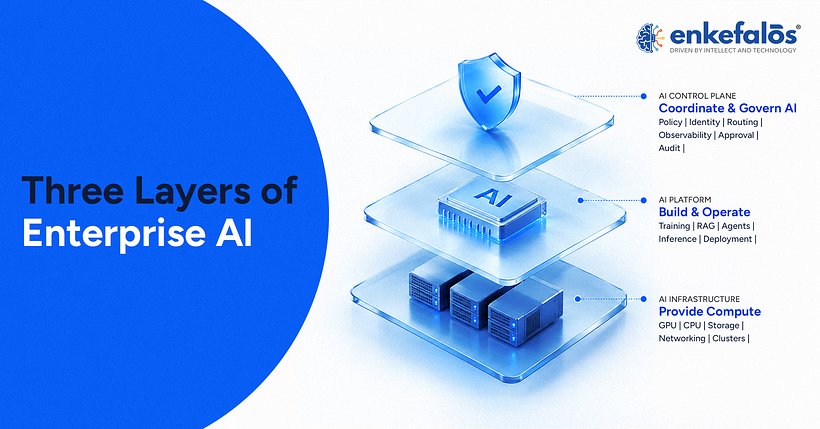
AI infrastructure provides the computing foundation; AI platforms provide the environment for building and operating workloads, and AI control planes coordinate governance and control across the broader AI environment.
How to Choose Between an AI Platform and an AI Control Plane
The choice should begin with the problem the enterprise needs to solve.
Choose or expand an AI platform when the primary requirement is to:
- Develop AI applications
- Train or fine-tune models
- Deploy inference
- Build RAG systems
- Create agents
- Provide developer tooling
- Standardize AI deployment
Consider an AI control plane when the primary requirement is to:
- Govern AI across multiple platforms
- Enforce shared runtime policies
- Manage multiple models and agents
- Control access to tools and enterprise data
- Centralize observability
- Track AI assets and versions
- Coordinate human approvals
- Improve auditability
Many larger organizations will ultimately need both capabilities, although they may be delivered through one integrated technology stack rather than two separate products.
How Enkefalos Approaches Enterprise AI Control
Enkefalos addresses the AI control-plane challenge through GenAI Foundry, its private AI control plane for enterprises building and operating production AI. The platform is designed to provide control across the AI lifecycle, from preparing enterprise data and evaluating models to deployment, runtime operation, monitoring, and controlled improvement.
Rather than managing each stage through separate tools and governance processes, GenAI Foundry brings together capabilities such as AI Data Studio, Training and Reinforcement Learning from Human Feedback (RLHF), model evaluation, version-controlled deployment, governed RAG, reusable prompt management, runtime guardrails, and human review. This creates a more consistent operating model for how AI is built, approved, released, and monitored in production.
The control-plane approach also helps enterprises maintain traceability as models, prompts, retrieval configurations, and production versions change. Evaluation can continue before and after deployment, while guardrails and monitoring provide visibility into runtime behavior and policy events.
This becomes particularly relevant when organizations operate multiple models, private AI environments, enterprise knowledge sources, and domain-specific AI workflows. GenAI Foundry supports on-premises, private-cloud, and hybrid-ready environments, allowing enterprises to apply a common control model while retaining greater control over their data, models, intellectual property, and AI operations.
The Future of Enterprise AI Management
Enterprise AI is moving beyond isolated models toward interconnected systems of models, agents, data sources, APIs, and business applications.
As this happens, governance must move closer to runtime execution. Policies cannot exist only in documents if agents are dynamically selecting models, retrieving enterprise data, and calling business tools.
Recent enterprise architecture guidance increasingly emphasizes centralized control for identity, lifecycle management, observability, policy enforcement, and agent activity. Microsoft, for example, identifies control-plane governance as part of organization-wide AI agent governance, while NIST emphasizes governance as a cross-cutting function throughout AI risk management.
This suggests that AI control-plane capabilities are likely to become an important part of enterprise AI architecture, whether they appear as standalone systems or are built into broader AI platforms.
Bring Consistent Control Across Enterprise AI
Connect models, agents, enterprise knowledge, deployment, evaluation, and runtime governance through a shared control layer for production AI.
Conclusion
The difference between an AI control plane vs AI platform comes down to purpose. An AI platform primarily helps enterprises build, deploy, and operate AI. An AI control plane provides a management layer for governing how models, agents, tools, data, and workflows operate across the enterprise.
They are not necessarily alternatives. An organization may use an AI platform for development and deployment while relying on control-plane capabilities for policy enforcement, identity, observability, model routing, agent governance, and auditability.
As enterprise AI becomes more distributed and agentic, the ability to coordinate AI across multiple environments may become as important as the ability to build AI itself.
Frequently Asked Questions
1. What is an AI control plane?
An AI control plane is a centralized management and governance layer that coordinates models, agents, tools, policies, identities, and AI workloads across enterprise environments.
2. What is an AI platform?
An AI platform provides tools and infrastructure for developing, deploying, managing, and operating AI models and AI-powered applications.
3. Is an AI control plane the same as an AI platform?
No. An AI platform primarily enables AI development and deployment, while an AI control plane focuses on coordination, governance, policy enforcement, and enterprise-wide management. Some platforms include both types of capabilities.
4. Do enterprises need both an AI platform and an AI control plane?
Not always. Smaller or standardized environments may rely on an AI platform’s built-in controls. Enterprises using multiple platforms, models, agents, and deployment environments may benefit from a broader control-plane layer.
5. What does an AI control plane manage?
It can manage model and agent identities, access policies, tool permissions, model routing, lifecycle controls, observability, evaluations, approvals, cost controls, and audit records.
6. How does an AI control plane improve AI governance?
It can centralize policies and apply them consistently across AI workloads rather than requiring every application team to implement governance separately. This can also improve visibility, auditability, and lifecycle oversight.
7. Can an AI control plane manage multiple AI models?
Yes. Multi-model environments are a common use case. A control plane can register approved models, govern access, route requests, monitor usage, and apply policy across different providers or deployment environments.
8. How does an AI control plane support private AI?
A control plane can enforce data-access rules, model policies, identity controls, observability, and deployment restrictions while AI workloads operate within private cloud, on-premises, sovereign, or hybrid environments. Private deployment alone does not provide complete AI governance.
9. What is the difference between an AI control plane and AI infrastructure?
AI infrastructure provides computing resources such as accelerators, servers, storage, and networking. An AI control plane sits at a management layer above those resources and helps govern how AI models, agents, tools, and workloads are allowed to operate.
10. When should an enterprise consider an AI control plane?
An AI control plane becomes more relevant when an organization uses multiple models, platforms, agents, data sources, or deployment environments and needs consistent policies, access controls, monitoring, lifecycle management, and auditability across them.