


Blog
Private AI for Healthcare: Protecting Sensitive Data While Scaling AI

Healthcare organizations are adopting AI for documentation, knowledge retrieval, research, and operational workflows. But healthcare AI often works with highly sensitive information, including medical records, diagnoses, laboratory results, insurance data, and patient communications.
That makes healthcare AI different from a general workplace assistant. Organizations need to know where patient data is processed, who can access it, whether it is retained, and how the system is monitored.
Private AI addresses these concerns by giving organizations greater control over data, models, infrastructure, retrieval, access, and governance. However, private deployment alone does not make AI compliant or clinically safe. Healthcare organizations still need safeguards, risk assessments, human oversight, validation, vendor controls, and lifecycle monitoring.
Why Healthcare Needs a Different Approach to AI
Healthcare AI can affect patients, clinicians, operations, and regulated information. An incorrect administrative answer may cause inconvenience, while an incorrect output used in a clinical workflow can have more serious consequences.
Key risks include:
- Exposure of protected health information
- Hallucinated or unsupported outputs
- Bias and uneven model performance
- Excessive data access
- Weak audit trails
- Uncontrolled model or prompt changes
- Third-party data handling
- Performance changes after deployment
- NIST and WHO guidance emphasize managing AI risk throughout the lifecycle, not only at approval.
What Is Private AI in Healthcare?
Private AI is an architecture and operating model in which an organization keeps greater control over the data, models, infrastructure, and AI workflows it uses.
It can include on-premises or private-cloud deployment, enterprise-controlled data stores, private Retrieval-Augmented Generation (RAG), restricted model access, governed connections to Electronic Health Record (EHR) systems, internal evaluation, runtime guardrails, audit logging, and human review.
Private AI does not mean every model must be built internally. A healthcare organization may use a third-party model while keeping patient data, retrieval, evaluation, and auditing inside its controlled environment.
The Role of Private AI in Protecting Patient Data
Private AI can reduce unnecessary movement of sensitive information by limiting where patient data is processed and which users, models, or applications can access it.
Important controls include:
- Data minimization: Give the AI only the information required for the task.
- Access control: Restrict data according to user role and approved purpose.
- Controlled retention: Define whether prompts, outputs, embeddings, logs, or retrieved records are stored and for how long.
- De-identification: Use appropriately de-identified data where patient identity is unnecessary.
- Third-party controls: Assess how vendors process, retain, or access health information.
Under HIPAA in the United States, organizations handling electronic protected health information must use appropriate administrative, physical, and technical safeguards. Where an external provider handles ePHI, contractual and risk-management requirements may also apply.
How Private AI Supports Healthcare Data Governance
Healthcare data governance determines what information AI can use, for which purpose, under whose authority, and with what controls.
A private AI environment can define:
- Which datasets a model can access
- Which departments can use particular applications
- Whether patient data can be used for training
- Which workflows are approved
- Which outputs require human review
- How long interactions are retained
- Which model versions may run in production
- What happens when an AI system fails evaluation
This makes governance part of AI execution rather than a policy document outside the technology.
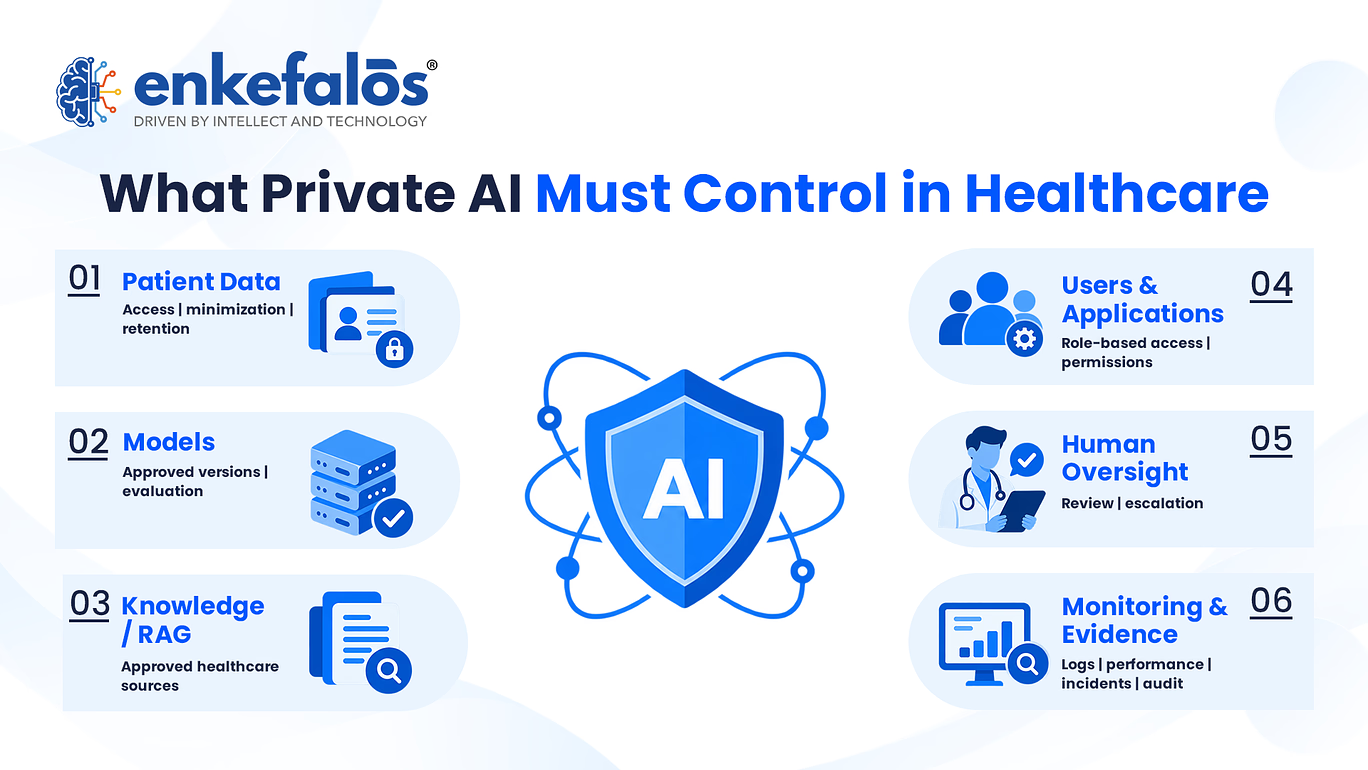
Figure 1: Private AI in healthcare requires control across patient data, model access, approved knowledge, user permissions, human oversight, and continuous monitoring throughout AI operations.
Healthcare AI Use Cases for Private AI
Private AI can support operational and clinical-adjacent workflows.
|
Use Case |
How Private AI Can Help |
|
Clinical documentation |
Draft or summarize notes inside controlled workflows |
|
Knowledge search |
Retrieve policies, protocols, and approved references through governed RAG |
|
Medical coding support |
Analyze documents and support coding workflows subject to review |
|
Prior authorization |
Extract and organize relevant clinical and administrative information |
|
Patient communication |
Draft educational or administrative responses with controlled data access |
|
Research support |
Analyze governed or de-identified datasets |
|
Operations |
Support scheduling, procurement, capacity planning, and analysis |
| Clinical decision support | Assist qualified professionals with stronger validation and human oversight |
Higher-risk clinical use cases require additional caution. If an AI function falls within medical-device regulation, lifecycle risk management, performance evaluation, documentation, and monitoring may be required. Private deployment does not remove those responsibilities.
Is Your Healthcare AI Environment Ready for Private AI?
Assess whether your AI workflows have the data controls, governance, human oversight, validation, and monitoring required to work with sensitive healthcare information.
Scaling AI Without Losing Control
Governance becomes harder when healthcare organizations move from one pilot to many AI use cases. Different teams may start using different models, APIs, prompts, datasets, and applications, creating inconsistent evaluation, uncontrolled access, and limited visibility.
A scalable approach establishes common controls for model approval, data access, identity, RAG sources, evaluation, human review, deployment, runtime monitoring, audit evidence, and model retirement.
The goal is for new applications to inherit shared governance.
Key Governance Challenges Healthcare Organizations Must Address
Healthcare AI governance requires organizations to manage patient privacy, model accuracy, bias, accountability, and human oversight throughout the AI lifecycle. These challenges become more important as AI moves from isolated pilots into clinical and operational workflows.
- Patient privacy: Identify whether PHI or other regulated data enters the workflow and whether its use is permitted.
- Model accuracy: Evaluate outputs against representative healthcare tasks and trusted reference information.
- Bias: Test whether performance differs across patient groups or data populations.
- Explainability: Higher-impact use cases may require users to understand evidence supporting an output.
- Human oversight: Define where AI can automate and where qualified review is required.
- Model and vendor changes: Use version control and regression testing when models, prompts, or retrieval logic change.
- Accountability: Every production system should have an owner responsible for intended use, risk, monitoring, and retirement.
Private AI vs Externally Managed AI
The practical distinction is between an enterprise-controlled private environment and a more externally managed AI service.
|
Area |
Private AI |
Externally Managed AI |
|
Data location |
Enterprise-controlled |
Often provider-managed |
|
Deployment |
On-prem, private cloud, or hybrid |
Primarily vendor-managed |
|
Data access |
Enterprise-defined |
Depends on vendor controls |
|
Customization |
Greater |
Often limited to provider capabilities |
|
Model changes |
Can be version-controlled internally |
May follow vendor release cycle |
|
Auditability |
Designed around internal requirements |
Depends on provider telemetry |
|
Governance |
Enterprise-led |
Shared with provider |
|
Operational effort |
Higher |
Often lower |
Private AI provides more control, but also more responsibility for security, evaluation, and maintenance.
How to Build a Private AI Strategy for Healthcare
A strong strategy begins with the use case, not the model.
- Classify use cases by risk: Separate administrative automation from higher-impact clinical applications.
- Map the data: Identify EHRs, imaging, claims, laboratory systems, and other sources.
- Define the privacy boundary: Decide where sensitive information can be processed and who can access it.
- Set governance requirements: Define evaluation, human oversight, retention, auditability, and incident handling.
- Choose the deployment model: Select on-premises, private cloud, dedicated infrastructure, or hybrid.
- Validate before production: Test representative tasks and expected failure scenarios.
- Monitor continuously: Track performance, policy violations, feedback, and system changes.
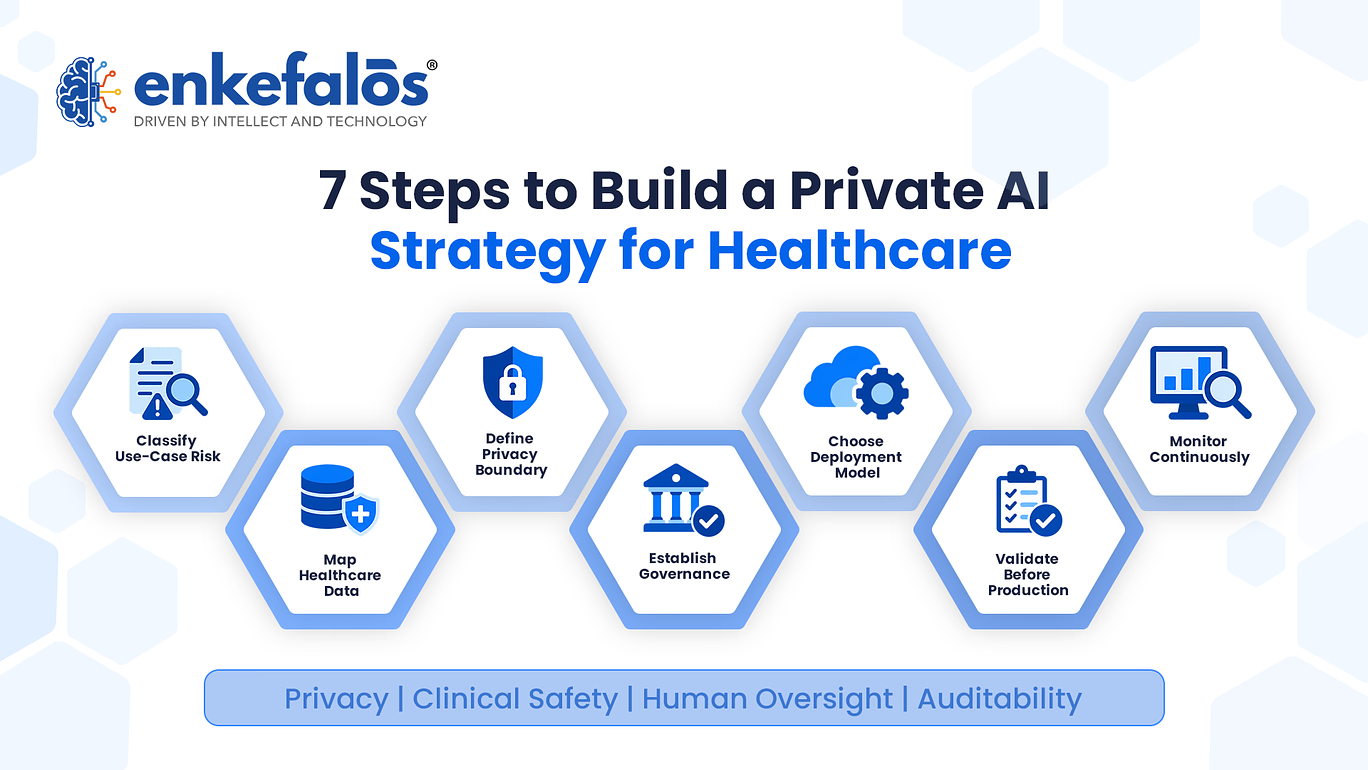
Figure 2: A healthcare Private AI strategy should progress from use-case risk and data mapping through privacy boundaries, governance, deployment, pre-production validation, and continuous monitoring.
Private AI Architecture for Healthcare
A practical architecture can be organized into seven layers:
- Healthcare data sources: EHRs, clinical notes, imaging, claims, laboratory, and operational systems.
- Governed data layer: Access control, classification, retention, de-identification, and data-quality controls.
- AI/model layer: Foundation models, domain models, embeddings, and model routing.
- Knowledge and tool layer: RAG, approved references, APIs, and controlled integrations.
- Evaluation and guardrail layer: Privacy rules, hallucination checks, domain testing, human review, and release gates.
- Application layer: Documentation, knowledge assistants, research tools, and approved workflows.
- Monitoring and audit layer: Model versions, evidence, access logs, feedback, incidents, and lifecycle records.
What Healthcare Leaders Should Evaluate Before Adopting Private AI
Before moving from pilot to production, leaders should evaluate:
- Data control: Where is patient information stored and processed? Can vendors use it for training? Can derived data be deleted or exported?
- Clinical and operational risk: What happens if the AI is wrong, and what level of review is required?
- Governance and auditability: Can the organization trace which model, prompt, data source, and retrieval context produced an output?
- Integration: Can AI work with existing systems without creating uncontrolled copies of sensitive data?
- Lifecycle responsibility: Who approves changes, monitors performance, handles incidents, and retires outdated systems?
How Enkefalos Helps Healthcare Organizations Scale Secure AI
Enkefalos positions GenAI Foundry as a private AI control plane for regulated enterprises, including healthcare. It supports on-premises, private-cloud, and hybrid deployment models and is designed to keep models, data, and workflows within controlled infrastructure.
Current capabilities include data preparation, supervised fine-tuning and RLHF, model evaluation with SME review, version-controlled deployment, runtime guardrails, PII exposure detection, governed RAG, prompt management, human-supervised learning, audit trails, and continuous monitoring.
For healthcare organizations, these capabilities can support private documentation, governed knowledge retrieval, and controlled deployment where data control and traceability matter.
A private platform can support HIPAA-related requirements, but it does not automatically make an organization compliant. Compliance depends on the use case, safeguards, contracts, risk analysis, policies, and ongoing operation.
The Future of Private AI in Healthcare
Healthcare AI is likely to expand across clinical, administrative, research, and patient-facing workflows. As adoption grows, organizations will need tighter control over model access and permitted actions.
Important developments include smaller domain-specific models, private and hybrid deployment, governed AI agents, evidence-grounded RAG, continuous evaluation, human-supervised improvement, model and prompt versioning, privacy-aware data pipelines, and centralized AI governance.
The regulatory environment will also continue to evolve, making adaptable architecture and lifecycle governance increasingly important.
Scale Healthcare AI Without Losing Data Control
Bring private deployment, governed data access, model evaluation, human oversight, runtime controls, and continuous monitoring into one enterprise AI operating environment.
Conclusion
Private AI can help healthcare organizations scale AI while retaining greater control over patient data, enterprise knowledge, model behavior, and operational governance. Its value comes not only from where the model runs, but from how data access, evaluation, human oversight, deployment, monitoring, and accountability are managed throughout the lifecycle.
A strong healthcare AI strategy classifies use cases by risk, controls sensitive data, validates model performance, and maintains oversight after deployment. Private AI can provide the technical foundation, but privacy, compliance, and clinical safety still depend on how the complete system is designed and operated.
FAQs: Private AI for Healthcare
1. What is Private AI in healthcare?
Private AI in healthcare is an approach in which AI models, healthcare data, applications, and governance controls operate within infrastructure controlled or specifically approved by the healthcare organization.
2. Why is Private AI important for healthcare organizations?
It can provide greater control over sensitive data, model access, deployment, retention, evaluation, and auditability while allowing AI use cases to scale.
3. How does Private AI protect sensitive patient data?
It can reduce unnecessary external data movement and support access controls, data minimization, private processing, governed retrieval, audit logging, and retention policies.
4. What is the difference between Private AI and Public AI in healthcare?
Private AI generally operates in enterprise-controlled or dedicated infrastructure, while public AI services are more externally managed. The main distinction is the level of control over data, models, deployment, and governance.
5. Can Private AI help healthcare organizations meet data privacy requirements?
Yes. Private AI can support privacy requirements by improving control over data location, access, use, retention, and auditability. However, private deployment alone does not establish compliance; organizations must still meet applicable legal, contractual, security, and governance requirements.
6. Does Private AI make healthcare AI HIPAA compliant?
No. Private AI can support greater control over healthcare data, deployment, access, retention, and auditing, but HIPAA compliance depends on the organization’s safeguards, risk analysis, policies, contracts, technical configuration, and ongoing operations.
7. What healthcare AI use cases are suitable for Private AI?
Private AI can support healthcare use cases such as clinical documentation, governed knowledge search, medical coding support, prior authorization, research, administrative workflows, patient communications, and selected clinical decision-support applications where appropriate validation and human oversight are maintained.