


Blog
AI Governance for Enterprises: Why Governed AI Is Essential for Enterprise AI Operations

Artificial intelligence is becoming a core part of enterprise operations. Organizations are using AI for customer service, document analysis, software development, fraud detection, marketing, forecasting, decision support, and business process automation. As AI moves from isolated experiments into mission-critical workflows, enterprises face a new challenge: how to make AI useful without losing control over data, decisions, security, compliance, and accountability.
This is where AI governance for enterprises becomes essential.
Enterprise AI governance provides the policies, controls, processes, responsibilities, and technical safeguards needed to manage AI systems throughout their lifecycle. It helps organizations determine which AI applications can be deployed, what data they can access, how outputs should be evaluated, when humans must intervene, and how systems should be monitored after deployment.
Governed AI is therefore not simply a compliance function. It is an operational foundation for scaling AI responsibly. A strong governance strategy allows enterprises to move from uncontrolled AI experimentation toward secure, measurable, transparent, and accountable enterprise AI operations.
What Is AI Governance for Enterprises?
AI governance for enterprises is the structured approach an organization uses to control how artificial intelligence is developed, purchased, deployed, monitored, and retired.
It defines the rules and responsibilities surrounding enterprise AI. These may include:
- Data access and privacy requirements
- AI model approval processes
- Security and access controls
- Risk classification
- Human oversight requirements
- Model testing and validation
- Performance monitoring
- Audit trails and documentation
- Regulatory compliance
- Third-party AI vendor management
- Incident response and remediation
AI governance answers practical questions such as: Who owns an AI system? What data can be used? What happens if its output is incorrect? Who approves deployment? How is performance monitored? When should the system be suspended?
A mature governance program connects people, processes, policies, and technology so that AI can operate within clearly defined organizational boundaries.
Why AI Governance Is Essential for Enterprise AI Operations
Enterprise AI differs from consumer AI because it frequently interacts with sensitive business information, operational systems, employees, customers, and high-impact decisions.
Without governance, organizations can quickly lose visibility into how AI is being used.
Governance creates a controlled operating environment by establishing common standards for AI systems. It can help enterprises:
- Reduce operational risk: Organizations can identify high-risk AI applications before deployment and establish appropriate controls.
- Protect business data: Governance policies can restrict access to confidential, personal, financial, or proprietary information.
- Improve accountability: Clearly defined ownership makes it easier to determine who is responsible for an AI system and its outcomes.
- Support compliance: Documented controls and audit processes help organizations demonstrate that AI systems are being managed according to applicable requirements.
- Increase trust: Employees, customers, and business leaders are more likely to adopt AI when its behavior, limitations, and safeguards are understood.
- Scale AI consistently: Instead of creating separate rules for every AI project, enterprises can establish reusable governance standards.
The goal is not to slow innovation. Effective governance enables organizations to innovate within controlled boundaries.
The Risks of Ungoverned AI in Enterprises
Ungoverned AI can introduce risks across technology, data, operations, compliance, and reputation.
One major concern is data leakage. Employees may unintentionally provide confidential information to an AI application that is not approved for enterprise use. Sensitive documents, customer information, source code, or intellectual property could therefore be exposed.
Another concern is inaccurate or unreliable AI output. Generative AI systems can produce incorrect information, outdated answers, or fabricated references. If these outputs enter business processes without validation, they can influence decisions and create operational problems.
Other risks include:
- Unauthorized AI applications or “shadow AI”
- Bias and unfair outcomes
- Weak identity and access controls
- Lack of explainability
- Model drift and performance degradation
- Regulatory violations
- Intellectual property concerns
- Third-party vendor risks
- Inadequate documentation
- Unclear accountability
- Automated decisions without appropriate human review
The risk becomes greater when AI is connected directly to enterprise applications. An inaccurate answer is one problem; an AI agent incorrectly executing a financial, customer service, or operational action can be significantly more serious.
Key Components of Enterprise AI Governance
An effective enterprise AI governance framework typically includes several interconnected components.
AI Policies and Standards
Organizations should establish policies covering acceptable AI use, prohibited activities, data handling, model development, procurement, deployment, monitoring, and incident management.
AI Risk Management
AI systems should be classified according to their potential impact. High-impact applications may require stronger validation, human oversight, documentation, and monitoring than low-risk productivity tools.
Data Governance
AI governance must connect closely with data governance. Enterprises need rules for data quality, ownership, classification, retention, access, privacy, and usage.
Model Governance
Organizations should maintain information about models, including their purpose, version, training or source data, limitations, evaluation results, owners, and deployment status.
Security and Access Controls
Only authorized users and systems should be able to access AI models, data, tools, and APIs. Role-based access, authentication, encryption, logging, and monitoring can help reduce unauthorized use.
Human Oversight
Governance should define when human review is mandatory. High-impact decisions should not automatically be delegated to AI simply because automation is technically possible.
Monitoring and Auditing
AI systems should be monitored for accuracy, security, bias, unusual behavior, policy violations, and performance changes. Audit records should provide evidence of how systems are being used and managed.
How Governed AI Supports Enterprise AI Operations
Governed AI turns AI from an isolated technology capability into a manageable operational resource.
For example, consider an enterprise AI search system that answers questions using internal documents. Governance can define which repositories the system may access, which employees can view specific information, how answers are generated, how sources are cited, and how user activity is logged.
Similarly, an AI customer-service agent can be governed through predefined permissions, escalation rules, approved knowledge sources, response monitoring, and human handoffs.
This creates a controlled AI operating model where automation has clear boundaries.
Governance also improves operational visibility. Enterprise leaders can maintain inventories of AI applications, understand where AI is being used, identify high-risk systems, and measure whether deployed models meet organizational requirements.
AI Governance Framework for Enterprises
A practical enterprise AI governance framework can be organized around six stages:
- Discover:Create an inventory of AI models, applications, vendors, agents, and use cases.
- Classify:Assign risk levels based on data sensitivity, business impact, autonomy, and potential consequences.
- Approve:Evaluate AI systems against security, privacy, performance, legal, ethical, and operational requirements before deployment.
- Control:Applyappropriate access restrictions, data policies, human oversight, security controls, and usage limitations.
- Monitor:Continuously evaluate performance, behavior, data access, incidents, and compliance.
- Improve or Retire:Update, retrain, restrict, replace, or deactivate AI systems when they no longer meet requirements.
This lifecycle approach prevents governance from becoming a one-time approval exercise.
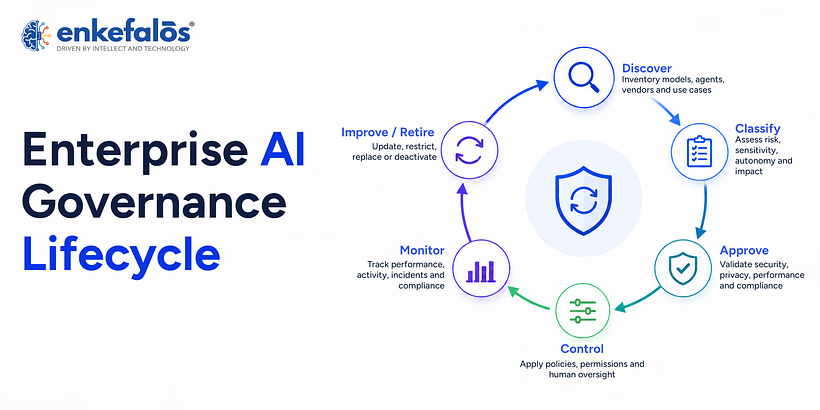
Enterprise AI governance operates as a continuous lifecycle, from discovering and classifying AI systems through approval, control, monitoring, improvement, and retirement.
AI Governance Across the AI Lifecycle
AI governance should begin before an AI system is deployed.
- During planning and development, teams should identify intended use, data sources, risks, success criteria, and ownership.
- During testing, organizations should evaluate accuracy, robustness, security, bias, privacy, and failure scenarios.
- During deployment, governance controls should ensure that only approved users, data, models, and workflows are connected.
- During operation, continuous monitoring should detect performance changes, unusual activity, policy violations, and emerging risks.
- During retirement, organizations should manage data retention, access removal, model decommissioning, documentation, and replacement.
This lifecycle approach is particularly important for generative AI and autonomous AI agents because their behavior and dependencies can change as models, prompts, tools, data, and workflows evolve.
Challenges in Implementing Enterprise AI Governance
Building enterprise AI governance is not always straightforward.
One challenge is fragmented AI adoption. Different departments may use different AI tools, making it difficult to maintain centralized visibility.
Another challenge is the speed of AI development. New models, AI agents, APIs, and applications are introduced rapidly, while governance processes may move more slowly.
Organizations can also struggle with unclear ownership. IT may own infrastructure, security may own controls, legal teams may focus on compliance, and business teams may own the use case. Without a clearly defined operating model, responsibility can become fragmented.
Additional challenges include:
- Limited AI governance expertise
- Legacy technology environments
- Inconsistent data practices
- Difficulty monitoring third-party models
- Resistance to additional controls
- Lack of standardized AI inventories
- Balancing innovation with risk management
The solution is not to create unnecessary bureaucracy. Governance should be risk-based, automated where possible, and integrated into existing enterprise processes.
Best Practices for Effective AI Governance
Enterprises can improve governance by following several practical principles.
- Start with visibility. Create an inventory of AI systems and use cases before attempting to govern everything.
- Use risk-based controls. Not every AI application needs the same level of oversight.
- Define ownership. Every important AI system should have accountable business and technical owners.
- Integrate governance into workflows. AI governance should become part of procurement, software development, security reviews, data governance, and change management.
- Automate monitoring. Automated controls can continuously check access, performance, policy compliance, and system activity.
- Document AI systems. Maintain records covering purpose, data sources, model versions, risks, limitations, approvals, and monitoring results.
- Train employees. Employees should understand approved AI tools, data-handling requirements, security risks, and responsible AI practices.
- Plan for incidents. Organizations need defined procedures for investigating and responding to AI failures, security events, inaccurate outputs, and policy violations.
Enterprise governance programs may also align their internal controls with frameworks and requirements such as the EU AI Act, NIST AI Risk Management Framework and ISO/IEC 42001, depending on jurisdiction, industry and risk profile.
How Ready Is Your Enterprise to Govern AI at Scale?
Assess whether your organization has the visibility, ownership, risk controls, monitoring and operational governance needed to move AI safely into production.
The Role of Private AI in Enterprise AI Governance
Private AI can strengthen enterprise AI governance by providing greater control over data, models, infrastructure, and access.
Traditional public AI services may create concerns when organizations need to process sensitive internal information. Private AI environments can be designed around enterprise security and governance requirements, allowing organizations to establish tighter controls over where data is processed and who can access it.
Private AI can support governed enterprise applications such as internal knowledge search, document intelligence, customer support, analytics, coding assistance, and workflow automation.
For example, an enterprise can deploy an AI system that searches internal business documents while enforcing user permissions. An employee can receive answers based only on documents they are authorized to access rather than exposing the organization’s entire knowledge base.
Private AI does not eliminate the need for governance. Instead, it can provide a stronger technical foundation for implementing governance policies around data privacy, access control, security, model usage, and enterprise information.
How Enterprises Can Build a Scalable AI Governance Strategy
A scalable strategy should combine governance leadership with technical enforcement.
First, organizations should establish an AI governance committee or operating structure with representatives from business, IT, security, data, legal, compliance, and risk functions.
Next, enterprises should create an AI inventory and classify systems according to risk.
The organization can then establish standardized approval processes, reusable policies, technical controls, monitoring requirements, and documentation templates.
Automation is critical for scale. Manual governance becomes difficult when an enterprise operates hundreds or thousands of AI workflows. Policy enforcement, access management, monitoring, logging, and risk assessments should therefore be automated wherever practical.
Enterprises should also measure governance effectiveness through indicators such as the number of approved AI systems, unresolved incidents, policy violations, monitoring coverage, review completion rates, and high-risk systems under active oversight.
The objective is to create governance by design, where controls are embedded into AI infrastructure rather than added after deployment.
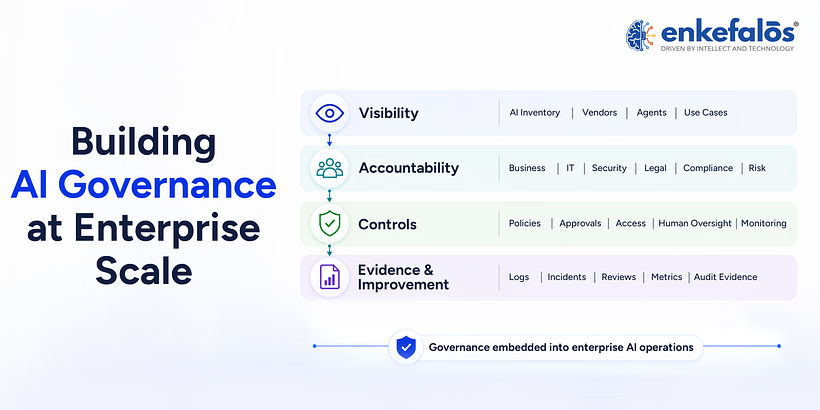
Scalable AI governance combines enterprise visibility, clear accountability, reusable controls, continuous monitoring, and evidence across the AI operating environment.
The Future of AI Governance for Enterprise AI Operations
Enterprise AI governance will become increasingly important as organizations move from individual AI tools toward AI agents, autonomous workflows, multimodal systems, and AI-driven decision support.
Future governance frameworks will likely focus more heavily on continuous control rather than periodic reviews. AI systems may need real-time monitoring, automated policy enforcement, dynamic permissions, agent activity tracking, and continuous risk assessment.
AI governance will also become more closely integrated with cybersecurity, data governance, identity management, software development, and enterprise risk management.
The organizations that benefit most from AI will not necessarily be those deploying the largest number of models. They will be those capable of deploying AI safely, consistently, transparently, and at scale.
Governed AI will therefore become an operational capability rather than simply a compliance requirement.
How Enkefalos Approaches Enterprise AI Governance
Enterprise AI governance cannot rely on policies that sit outside the systems they are meant to govern. As AI becomes embedded in business processes, governance must move closer to execution, with controls that operate alongside AI in real time.
Translate Policy into Action
Governance should convert organizational principles, risk requirements, and internal policies into controls that can guide how AI is used in practice.
Monitor AI Continuously
Continuous monitoring helps organizations identify unusual behavior, emerging risks, and policy breaches as AI systems operate.
Enforce Guardrails at Runtime
Controls should work during AI use, not only through retrospective reviews or periodic assessments.
Maintain Human Oversight
Clear escalation and approval paths keep people involved where judgment, accountability, or intervention is required.
Preserve Auditability
Governance should create a clear record of how AI systems were monitored, controlled, and reviewed.
This is where PreFrox fits into Enkefalos’s approach. It helps bring policy, oversight, runtime controls, human intervention, and auditability into the day-to-day operation of enterprise AI, so governance becomes part of how AI works rather than something applied after the fact.
Govern AI Before It Becomes Operational Risk
Bring visibility, accountability, policy enforcement, and continuous oversight into enterprise AI operations.
Conclusion
AI governance for enterprises provides the foundation needed to scale artificial intelligence responsibly. It brings together policies, risk management, data governance, security, human oversight, monitoring, auditing, and accountability.
Without governance, enterprise AI can create uncontrolled data exposure, inaccurate decisions, compliance problems, security vulnerabilities, and operational uncertainty. With effective governance, organizations can establish clear boundaries while still enabling employees and business teams to innovate.
The future of enterprise AI is not simply more AI. It is better-governed AI—systems that are secure, accountable, observable, compliant, and aligned with business objectives.
For enterprises seeking long-term value from AI, governance should not be treated as an obstacle to innovation. It should be treated as an operational infrastructure that makes scalable AI operations possible.
Frequently Asked Questions
What Is AI Governance in an Enterprise?
AI governance is the framework of policies, processes, controls, roles, and technologies an organization uses to manage AI systems responsibly throughout their lifecycle. It covers areas such as data protection, security, risk management, model oversight, compliance, monitoring, and accountability.
Why Is AI Governance Important for Enterprise AI Operations?
AI governance helps enterprises control the risks associated with AI while enabling scalable adoption. It provides consistent standards for data access, model deployment, security, human oversight, monitoring, and compliance.
What Are the Main Risks of Ungoverned AI?
Major risks include sensitive data exposure, inaccurate AI outputs, privacy violations, security vulnerabilities, biased decisions, unauthorized AI usage, regulatory issues, intellectual property concerns, and unclear accountability.
What Are the Key Components of an Enterprise AI Governance Framework?
Core components include AI policies, risk classification, data governance, model governance, security controls, access management, human oversight, documentation, monitoring, auditing, vendor management, and incident response.
How Does AI Governance Improve Data Security and Privacy?
AI governance establishes rules for what data AI systems can access, how information can be processed, who can access AI outputs, and how activity is monitored. These controls help prevent unauthorized access and inappropriate use of sensitive enterprise information.
How Does AI Governance Help Enterprises Meet Regulatory Requirements?
Governance creates documented processes for risk assessment, data handling, model oversight, monitoring, accountability, and auditing. These processes can help organizations demonstrate that AI systems are managed according to applicable legal and regulatory requirements.
What Role Does Human Oversight Play in AI Governance?
Human oversight provides an accountability layer for AI systems, particularly when AI influences high-impact decisions. Governance can define when human review is required, when AI recommendations can be accepted automatically, and when an issue must be escalated.
How Can Enterprises Monitor and Audit AI Systems?
Enterprises can use AI inventories, activity logs, access controls, model monitoring, performance metrics, security monitoring, audit trails, and periodic risk reviews. Continuous monitoring is especially important for systems that operate autonomously or interact with sensitive data.
What Is the Difference Between AI Governance and AI Management?
AI governance establishes the rules, accountability, controls, and risk boundaries for AI. AI management focuses more on operating AI systems, managing projects, allocating resources, maintaining models, and achieving business objectives. Governance determines how AI should be controlled; management focuses on how it is operated.
How Can Enterprises Build an Effective AI Governance Strategy?
Enterprises should begin by creating an AI inventory, classifying AI use cases by risk, assigning ownership, establishing policies, integrating governance into existing workflows, implementing technical controls, monitoring AI systems continuously, and regularly updating governance requirements as AI technologies and regulations evolve.