


Blog
Enterprise AI Search: How Private AI Turns Business Documents into Trusted Answers

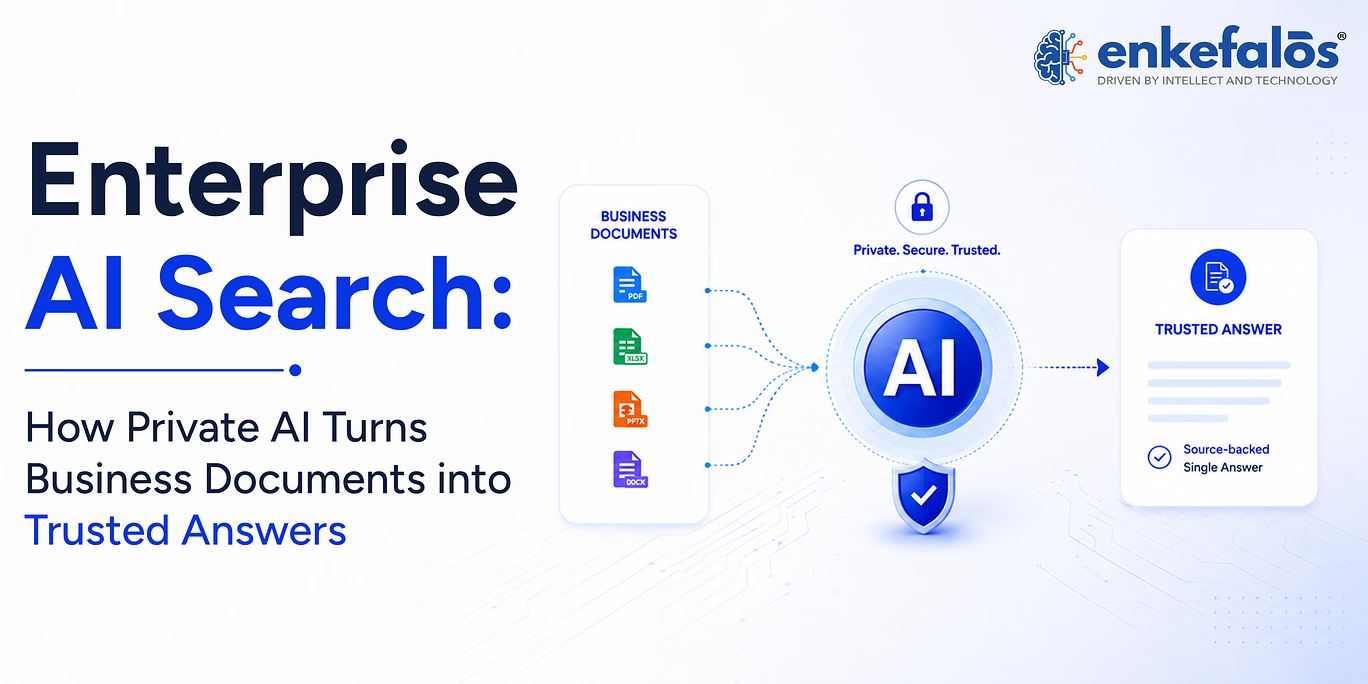
Businesses generate enormous amounts of information every day. Contracts, policies, financial reports, product documentation, employee handbooks, customer records, technical manuals, meeting notes, and internal knowledge bases all contain valuable information. Yet finding the right information quickly remains a major challenge.
The enterprise knowledge problem is no longer access to information. It is finding the right information, with the right context, at the moment a decision is being made.
Traditional enterprise search can locate documents containing specific keywords, but it often cannot understand context, interpret natural-language questions, or combine information from multiple sources. Employees may spend valuable time opening documents, searching through pages, and determining which information is actually relevant.
Enterprise AI search addresses this problem by combining enterprise data with artificial intelligence. Instead of simply returning a list of documents, it can understand a question, retrieve relevant information, and generate a concise answer based on authorized business content.
When this capability is built with private AI, organizations can gain the advantages of generative AI while maintaining stronger control over sensitive business information. The result is an enterprise search experience designed to turn scattered business documents into useful, contextual, and traceable answers.
What Is Enterprise AI Search?
Enterprise AI search is an intelligent search system designed to find, understand, and summarize information stored across an organization’s internal data sources.
Unlike conventional search engines that primarily match keywords, AI-powered enterprise search can interpret questions expressed in natural language.
For example, an employee might ask:
“What is our current policy for approving international travel expenses?”
Traditional search may return several policy documents. Enterprise AI search can identify the relevant policy, retrieve the applicable section, and provide a direct answer while linking the response to its source.
Enterprise AI search can connect information from document repositories, knowledge bases, intranets, collaboration platforms, databases, and other authorized systems.
Why Traditional Enterprise Search Falls Short
Traditional enterprise search remains useful, but it has several limitations when employees need answers rather than documents.
Keyword-based search depends heavily on how information is written. If an employee searches for a “customer refund deadline” while a policy uses the phrase “refund eligibility period,” the most relevant document may not appear prominently.
Another problem is information overload. A search can return hundreds of documents without explaining which one contains the answer.
Traditional search also struggles with complex questions requiring information from multiple documents. Employees may need to manually compare policies, reports, contracts, or procedures.
These limitations create what is sometimes called the knowledge discovery gap: the information exists, but employees cannot efficiently transform it into actionable knowledge.
How Private AI Transforms Business Document Search
Private AI introduces a more intelligent layer between employees and enterprise information.
Instead of simply matching keywords, an AI-powered system can interpret the intent behind a question, retrieve relevant content, and use a language model to formulate an answer.
The privacy component is equally important. Business documents may contain confidential financial information, intellectual property, customer data, legal agreements, employee information, or proprietary processes.
A private AI architecture is designed to keep enterprise information within controlled environments and enforce organizational access policies.
This allows businesses to explore AI-assisted search without treating sensitive internal information like publicly available content.
How Enterprise AI Search Works
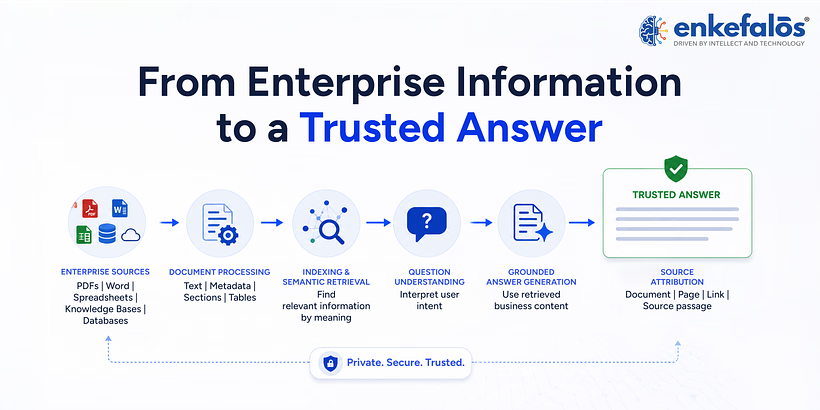
A typical enterprise AI search architecture includes several interconnected stages.
Data ingestion
The system connects to approved enterprise sources and collects relevant documents and information.
These sources may include PDFs, Word files, spreadsheets, presentations, intranet pages, knowledge bases, and databases.
Document processing
Documents are converted into machine-readable content. The system can identify text, metadata, sections, tables, and other useful information.
Large documents are generally divided into smaller sections so that relevant passages can be retrieved efficiently.
Indexing and retrieval
The content is indexed so that the system can quickly locate relevant information. Modern systems may combine traditional keyword search with semantic or vector-based retrieval.
Semantic search helps identify content based on meaning rather than exact wording.
Question understanding
When a user asks a question, AI interprets the intent and determines which information is most relevant.
Answer generation
Relevant passages are provided to the language model as context. The model generates an answer based on that retrieved information.
Source attribution
A well-designed system can provide citations, document names, page numbers, links, or source passages, so employees can verify the answer.
This retrieval-and-generation approach is commonly associated with retrieval-augmented generation (RAG).
What Is Private AI?
Private AI refers to AI systems designed to process organizational information within a controlled environment rather than relying on unrestricted public AI services.
Depending on the organization’s requirements, private AI can involve dedicated infrastructure, private cloud environments, controlled model deployments, enterprise access controls, encryption, and governance mechanisms.
The exact architecture varies by organization. The central idea is that the business maintains greater control over where information is processed, who can access it, and how it is used.
For enterprise search, this distinction matters because the quality of an answer is only useful if the organization can trust the way its underlying data is handled.
Why Privacy Matters for Enterprise AI Search
Enterprise information is rarely homogeneous. Some documents may be public internally, while others are restricted to executives, legal teams, finance departments, human resources, or specific project groups.
An AI search platform therefore needs to understand not only what information is relevant, but also whether the user is allowed to access it.
For example, an employee asking about a product launch should not automatically receive information from confidential acquisition documents simply because those documents contain relevant keywords.
Access controls, identity management, encryption, audit logging, data retention policies, and permission-aware retrieval are therefore critical components of private enterprise AI search.
Turning Business Documents into Trusted Answers
The goal of enterprise AI search is not simply to make AI generate convincing text. It is to ground responses in reliable organizational information.
Suppose an employee asks:
“What warranty coverage do we provide for Product X?”
The system can retrieve the relevant warranty policy, product documentation, and approved service information. The AI then synthesizes those sources into an understandable response.
The answer becomes more trustworthy when users can see where the information came from.
This is especially important for legal, financial, technical, compliance, and operational questions where employees need to verify information before acting on it.
Key Benefits of Private AI-Powered Enterprise Search
Faster access to knowledge
Employees can ask questions directly rather than navigating multiple folders and applications.
Better employee productivity
AI reduces the time spent searching, reading, comparing, and summarizing internal documents.
Improved knowledge discovery
Semantic retrieval can uncover relevant information even when the user’s terminology differs from the terminology used in the original document.
More consistent answers
Employees can access answers based on approved organizational sources rather than relying on informal interpretations.
Stronger data control
Private AI architectures can provide organizations with greater control over sensitive information, access permissions, and processing environments.
Better decision support
Managers and employees can quickly extract relevant information from large collections of reports, policies, contracts, and operational documents.
Turn Enterprise Knowledge into Trusted Answers
Help teams find relevant information across business documents without losing source traceability, access control, or enterprise governance
Enterprise Use Cases for AI Search
Enterprise AI search can support many business functions.
- Human resources: Employees can ask about benefits, leave policies, onboarding procedures, and workplace policies.
- Legal teams: Lawyers can search for contracts, clauses, regulatory documents, and previous agreements.
- Finance: Teams can find information across budgets, financial policies, reports, and accounting documentation.
- Customer support: Agents can retrieve product specifications, troubleshooting procedures, warranty information, and service documentation.
- Sales: Sales teams can quickly locate product information, pricing policies, proposals, and approved messaging.
- IT: Technical teams can search system documentation, troubleshooting guides, architecture records, and incident reports.
- Operations: Employees can find standard operating procedures, safety instructions, maintenance documents, and process guidelines.
Enterprise AI Search vs. Traditional Search
Traditional search primarily answers:
“Which documents contain information related to my query?”
Enterprise AI search aims to answer:
“What does our information say about my question?”
| Traditional Enterprise Search | Enterprise AI Search |
| Keyword-focused | Meaning and intent-focused |
| Returns documents | Generates answers |
| Requires manual reading | Summarizes relevant information |
| Limited contextual understanding | Understands natural-language questions |
| Often requires multiple searches | Can combine relevant sources |
| Usually less conversational | Conversational and interactive |
Traditional searches still have an important role. In many enterprise environments, the strongest solution combines conventional search with AI retrieval rather than replacing search completely.
Enterprise AI Search vs. Public AI Tools
Public AI tools are designed for broad use and can be excellent for drafting, brainstorming, summarizing, and general knowledge tasks.
However, they may not have direct access to an organization’s private documents, internal permissions, or proprietary knowledge.
Enterprise AI search is specifically designed around organizational information and governance.
The key difference is context and control. A public AI assistant may know general industry concepts, while a private enterprise AI system can answer questions using the organization’s own approved information.
Organizations should still evaluate the architecture, data handling practices, access controls, and security guarantees of any AI solution rather than assuming that a product labeled “private” is automatically secure.
Security and Governance in Private AI Search
Security must be integrated throughout the AI search architecture.
Important controls can include:
- Role-based access control
- Identity and authentication integration
- Encryption in transit and at rest
- Permission-aware document retrieval
- Audit logs
- Data retention controls
- Secure document ingestion
- Model and application monitoring
- Administrative controls
- Compliance and governance policies
Permission-aware retrieval is particularly important. AI should not become a mechanism for bypassing existing document permissions.
If a user cannot access a document through the organization’s normal systems, the AI search layer should not expose information from that document simply because it is relevant to a query.
Challenges of Implementing Enterprise AI Search
Enterprise AI search is powerful, but implementation is not automatic.
- The first challenge is data quality. Outdated, duplicate, contradictory, or poorly structured documents can reduce answer quality.
- The second challenge is access control. The system must correctly map existing permissions to AI for retrieval.
- The third is integration complexity. Organizations may have information distributed across many systems with different APIs, formats, and authentication mechanisms.
- Another challenge is AI hallucination. Even when supplied with relevant context, language models can sometimes generate unsupported information.
- Organizations must therefore use strong retrieval, grounding, evaluation, and citation mechanisms.
- Finally, adoption matters. Employees need to understand how to ask questions, verify sources, and use AI-generated answers responsibly.
How to Implement Private AI Search in an Enterprise
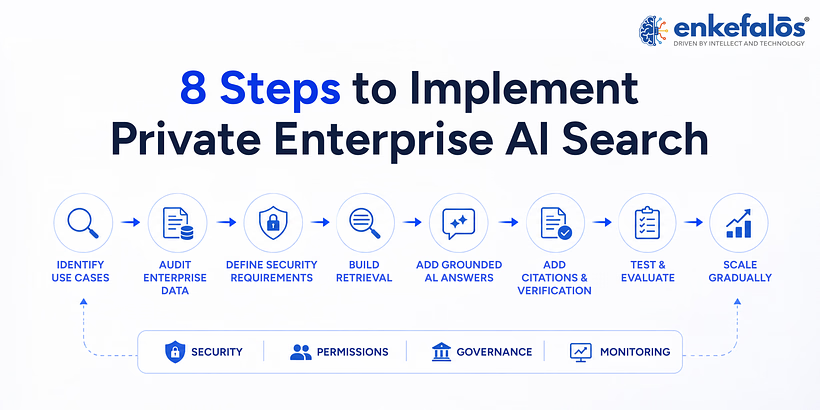
A practical implementation can follow several steps.
Step 1: Identify high-value use cases
Start with departments where employees regularly spend significant time searching for information.
Step 2: Audit enterprise data
Identify which repositories contain valuable information and assess their quality, structure, ownership, and access permissions.
Step 3: Establish security requirements
Define authentication, authorization, encryption, retention, auditing, and governance requirements before deploying the AI layer.
Step 4: Build the retrieval architecture
Connect to approved data sources and implement indexing, semantic retrieval, and permission-aware search.
Step 5: Add AI answer generation
Use a language model to generate responses from retrieved enterprise content rather than relying solely on the model’s general knowledge.
Step 6: Add citations and verification
Give users a clear way to inspect the source documents supporting an answer.
Step 7: Test and evaluate
Measure retrieval accuracy, answer quality, citation accuracy, latency, security, and user satisfaction.
Step 8: Expand gradually
After validating the initial use cases, add additional departments, repositories, and workflows.
The Future of Enterprise AI Search
Enterprise AI search is moving toward becoming a broader organizational knowledge interface.
Future systems are likely to move beyond answering questions and increasingly help employees analyze information, compare documents, summarize changes, identify knowledge gaps, and support business workflows.
AI search may also become more multimodal, allowing organizations to search not only text but also tables, images, diagrams, presentations, audio, and other enterprise content.
Another major development will be greater personalization. An employee could receive an answer based on their role, department, responsibilities, permissions, and current business context.
The most valuable systems, however, will not necessarily be those that generate the most sophisticated responses. They will be the systems that combine useful AI capabilities with strong security, reliable retrieval, transparent sources, and effective governance.
How Enkefalos Approaches Enterprise Knowledge Search
Enterprise knowledge search becomes more valuable when employees can find the right information without compromising security, context, or trust. Enkefalos approaches this by combining natural-language retrieval with source visibility, access controls, and human oversight.
Search Private Enterprise Data Naturally
Employees can ask questions in everyday language and retrieve relevant information from internal enterprise data, without depending on exact keywords or knowing where a document is stored.
Keep Answers Grounded in Sources
Search results should not feel like a black box. Enkefalos emphasizes source-backed answers with document and page-level traceability, giving users a clear path from the response back to the original material.
Respect Permissions at Every Step
Access remains governed by existing enterprise permissions, helping ensure users only see information they are authorized to access.
Support Verification and Governance
Human verification adds an important layer of confidence, while governance, auditability, and oversight help organizations manage AI-assisted search responsibly.
This approach comes together in Occiplex, Enkefalos’s enterprise knowledge platform for securely searching, understanding, and governing private organizational information through natural-language interaction.
Make Enterprise Knowledge Easier to Find and Verify
Use private AI to search business documents, retrieve relevant information, and provide source-backed answers while keeping enterprise data under organizational control.
Conclusion
Enterprise AI search changes how organizations interact with their internal knowledge. Instead of forcing employees to navigate disconnected repositories and keyword searches, it allows them to ask questions in natural language and receive answers grounded in business information.
Private AI adds an important layer of control by helping organizations protect sensitive information while applying AI to proprietary documents and knowledge.
The combination of AI retrieval, private data access, permission-aware search, grounded generation, and source citations can transform enterprise documents from passive files into an accessible knowledge resource.
For organizations evaluating AI adoption, the objective should not simply be to deploy a chatbot. The bigger opportunity is to build a trusted interface to organizational knowledge—one that helps employees find the right information faster while preserving security, privacy, and governance.
Frequently Asked Questions
What Is Enterprise AI Search?
Enterprise AI search is an AI-powered search solution that helps employees find and understand information stored across an organization’s internal systems. It can interpret natural-language questions, retrieve relevant business content, and generate contextual answers.
How Does Private AI Improve Enterprise Search?
Private AI can provide AI-powered search while keeping enterprise information within controlled environments. It can also integrate organizational access controls, security policies, and governance requirements.
How Does AI Turn Business Documents into Answers?
AI search retrieves relevant passages from business documents and supplies them as context to a language model. The model uses that context to generate a natural-language answer, often with citations or links to the original sources.
Why Is Private AI Important for Business Documents?
Business documents can contain confidential financial information, intellectual property, customer information, contracts, employee data, and proprietary processes. Private AI can provide greater control over how this information is accessed and processed.
How Does Enterprise AI Search Reduce AI Hallucinations?
Enterprise AI search can reduce hallucinations by grounding responses in retrieved business documents instead of relying solely on a language model’s general knowledge. Source citations, retrieval quality, answer validation, and carefully designed prompts can provide additional safeguards.
Can Enterprise AI Search Provide Sources for Its Answers?
Yes. Enterprise AI search can be designed to provide document citations, links, page references, or relevant source passages. Source attribution allows users to verify important information before relying on an answer.
What Types of Business Documents Can Enterprise AI Search Process?
Depending on the platform, enterprise AI search can process PDFs, Word documents, spreadsheets, presentations, policies, contracts, technical manuals, reports, knowledge-base articles, intranet content, and other structured or unstructured business information.
Is Private AI More Secure Than Public AI for Enterprise Data?
Private AI can provide stronger control over enterprise data, but security depends on the actual architecture, configuration, provider, access controls, and governance practices. Organizations should evaluate these factors rather than assume that every private AI solution provides the same level of protection.
How Does Enterprise AI Search Protect Sensitive Business Information?
It can use authentication, authorization, encryption, permission-aware retrieval, audit logging, data governance, and controlled processing environments. A well-designed system should ensure that users only receive information they are authorized to access.
What Are the Benefits of Private AI-Powered Enterprise Search?
Key benefits include faster information retrieval, improved employee productivity, better knowledge discovery, contextual answers, stronger data control, source-based responses, and improved access to organizational knowledge.