


Blog
Why the Future of Enterprise AI Will Be Built on Private AI Control Platforms

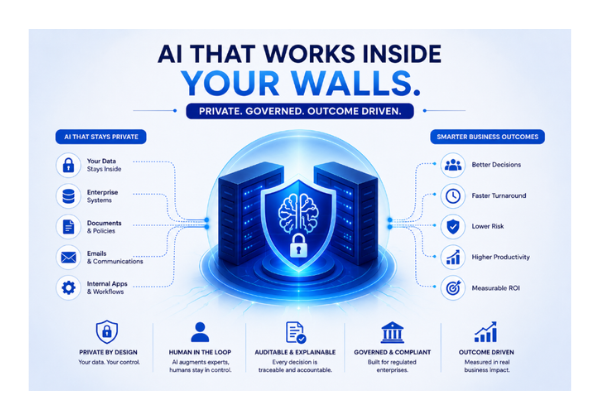

Over the last few quarters, one thing has become increasingly clear to me: AI is not slowing because of technology limitations. The models are improving rapidly. Capabilities continue to expand. Innovation is moving at an extraordinary speed.
Yet despite all the excitement, enterprise-wide AI adoption is still progressing slower than many expected.
Why?
Because enterprises are no longer asking: “Can AI work?”
They are asking far more important questions:
- Can we trust it?
- Can we explain its decisions?
- Can we govern it?
- Can we audit it?
- Can we use it safely inside core business operations?
These questions become even more critical in regulated industries like insurance, healthcare, financial services, and large enterprises where decisions carry operational, legal, and financial consequences.
AI experiments are everywhere. Pilots are abundant. Proof-of-concepts continue to grow.
But production-scale AI remains relatively rare.
The gap between experimentation and operational deployment continues to widen because organizations are discovering that deploying AI is not simply about adding a model or deploying another chatbot.
The challenge is operationalizing intelligence responsibly.
At Enkefalos, we believe this requires a fundamentally different approach: a Private AI Control Platform.
Private AI is not simply about keeping data behind a firewall.
It means enterprise intelligence remains within organizational boundaries while preserving governance, security, accountability, and human oversight.
It means AI does not operate independently.
It operates within the rules, policies, workflows, and business controls of the enterprise.
In our view, AI systems for regulated environments must be:
Private by design
Intelligence stays inside the enterprise.
Governed by default
Every decision must be traceable and auditable.
Human-controlled
AI augments expertise—it does not replace accountability.
Outcome-driven
Success should be measured by measurable business impact.
This shift changes the role AI plays in organizations.
The future is not AI replacing underwriters, claims professionals, analysts, or operational teams.
The future is AI becoming an invisible intelligence layer inside workflows—enhancing expertise, accelerating decisions, reducing repetitive work, and helping teams focus on higher-value outcomes.
Organizations that win will not necessarily be those using the most AI.
They will be the organizations that embed AI responsibly into the operational fabric of the enterprise.
The next generation of AI leaders will not be defined by experimentation.
They will be defined by trust.
Private Intelligence. Real Business Outcomes.