


Blog
Insurance AI in 2027: What US Carriers Need to Operationalize Before Scaling AI

Artificial intelligence (AI) is moving into underwriting, claims management, policy servicing, and other core insurance operations. Yet the transition from successful pilots to reliable enterprise deployment remains challenging. Fragmented data, legacy systems, inconsistent governance, and unclear operational ownership can limit how effectively insurers expand AI beyond individual use cases.
The gap between adoption and readiness is becoming more visible. KPMG’s September 2026 global insurance research found that only 11% of surveyed insurers reported having strong data foundations and governance to scale AI beyond pilots. The findings highlight an important distinction: deploying AI applications does not automatically mean an organization is prepared to operate them across critical business workflows.
As carriers plan for 2027, the priority is shifting toward production readiness. Scaling insurance AI requires governed data access, reliable architecture, continuous monitoring, accountable decision-making, and measurable business outcomes. These capabilities must become part of everyday operations rather than remain isolated within technology projects.
Why Is 2027 an Important Planning Year for Insurance AI?
Insurance AI adoption is progressing, but maturity varies across organizations, business functions, and technologies.
The 2026 Innovation Report from the International Insurance Society found that 87% of surveyed insurance organizations were pursuing generative AI initiatives, while only 25% had reached production-level deployment. This illustrates the difference between exploring AI and integrating it into sustained operations.
Agentic AI is also attracting attention because it can coordinate tasks across connected systems. However, insurers must account for the additional risks associated with tool access, workflow execution, and automated actions.
For 2027 planning, three priorities stand out:
- Production reliability: AI applications need consistent performance under real operating conditions.
- Governance maturity: Policies must translate into enforceable controls, approval procedures, and oversight.
- Operational accountability: Business and technology teams need clear responsibility for AI outcomes, incidents, and continuous improvement.
The objective is not to deploy more AI applications independently, but to establish capabilities that support responsible expansion across the insurance enterprise.
What Must Insurance Carriers Operationalize Before Scaling AI?
Enterprise AI requires coordinated capabilities across technology, information management, governance, and business operations.
The following table summarizes the main requirements insurers should address before expanding AI into production workflows.
|
Operational requirement |
What insurers need |
|
Data readiness |
Reliable, accessible, and governed enterprise information |
| System integration |
Controlled connections to legacy and modern applications |
|
AI governance |
Defined policies, accountability, and risk controls |
| Human oversight |
Approval boundaries and exception-handling procedures |
|
Production monitoring |
Continuous evaluation of performance, risks, and reliability |
| Vendor management |
Visibility into third-party models, data use, and dependencies |
|
Business measurement |
Metrics connecting AI performance to operational outcomes |
These requirements are interconnected. Reliable monitoring, for example, depends on clearly defined performance expectations, appropriate logging, and access to trustworthy operational data.
1. Establish Reliable and Governed Data Foundations
AI applications depend on information from policy administration systems, claims databases, underwriting documents, and customer interactions.
When information is incomplete, inconsistent, or distributed across disconnected platforms, AI-generated outputs may lack essential context.
Insurers should establish data ownership, consistent definitions, quality controls, and access policies before expanding deployment.
For generative AI applications using retrieval-augmented generation (RAG), additional considerations include document permissions, source attribution, retrieval quality, and information updates.
A governed data foundation should also preserve the distinction between authoritative system records and AI-generated interpretations.
2. Prepare Enterprise Architecture for AI Integration
Scaling AI requires more than connecting individual models to existing applications.
Insurance environments often combine legacy core platforms, modern cloud services, document repositories, and specialized business systems. AI applications need reliable communication across these components.
Application programming interfaces (APIs), middleware, and integration services can provide controlled access to approved enterprise functions.
Insurers should also establish standardized authentication, authorization, error handling, and transaction management.
An integration architecture should support gradual modernization without assuming that every existing platform must be replaced.
3. Translate AI Governance Into Operational Controls
An AI governance policy provides direction, but production deployment requires enforceable procedures.
Governance should establish who approves AI use cases, evaluates model performance, manages risks, and authorizes changes.
Operational controls may include:
- Risk-based approval procedures for new AI applications.
- Model evaluation and documentation requirements.
- Access restrictions and data handling policies.
- Approval checkpoints for consequential actions.
- Change management and incident response procedures.
- Periodic reviews of AI performance and business impact.
These controls should reflect the potential consequences of each use case rather than applying identical requirements to every AI application.
How Should Insurers Operationalize AI Governance and Regulatory Readiness?
Regulatory oversight is particularly relevant when AI supports underwriting, pricing, claims, or other activities affecting policyholders.
In the United States, insurance regulation is primarily state based. The National Association of Insurance Commissioners (NAIC) adopted its Model Bulletin on the Use of Artificial Intelligence Systems by Insurers in December 2023.
The bulletin outlines supervisory expectations for AI governance, risk management, and documentation. It is not itself a federal law or nationwide binding regulation. Insurers should evaluate applicable requirements in the jurisdictions where they operate.
The NAIC’s Big Data and Artificial Intelligence Working Group released version 6.0 of its AI Risk Evaluation Supplement for public comment in October 2026, with further discussions scheduled for November. Its pilot and development activities in 2026 should not be interpreted as creating an automatic 2027 compliance deadline.
Apply the NIST AI Risk Management Framework
The National Institute of Standards and Technology (NIST) AI Risk Management Framework provides voluntary guidance for managing AI risks.
Its four functions can help insurers organize governance activities.
The following table shows how the NIST framework relates to operational AI management in insurance.
|
NIST function |
Insurance AI application |
|
Govern |
Define accountability, policies, and oversight responsibilities |
| Map |
Identify AI use cases, affected systems, and potential risks |
|
Measure |
Evaluate accuracy, reliability, security, and business impacts |
| Manage |
Apply risk controls, monitor outcomes, and address identified issues |
NIST’s Generative AI Profile provides additional guidance for risks associated with generative AI applications.
The framework is not a legal compliance certification. Insurers must assess their obligations under applicable insurance and other relevant laws.
An effective AI governance framework helps insurers establish accountability, manage operational risks, and maintain oversight throughout the AI lifecycle.
Maintain Auditability and Decision Traceability
Production AI systems should generate records appropriate to their risks and intended uses.
For example, an AI-assisted underwriting workflow may need to retain the data sources used, model or rule versions, generated recommendations, and relevant human approvals.
Traceability helps organizations investigate errors, review decisions, and provide evidence during internal assessments or regulatory examinations.
However, logging alone does not establish that an AI-generated recommendation is correct or explainable.
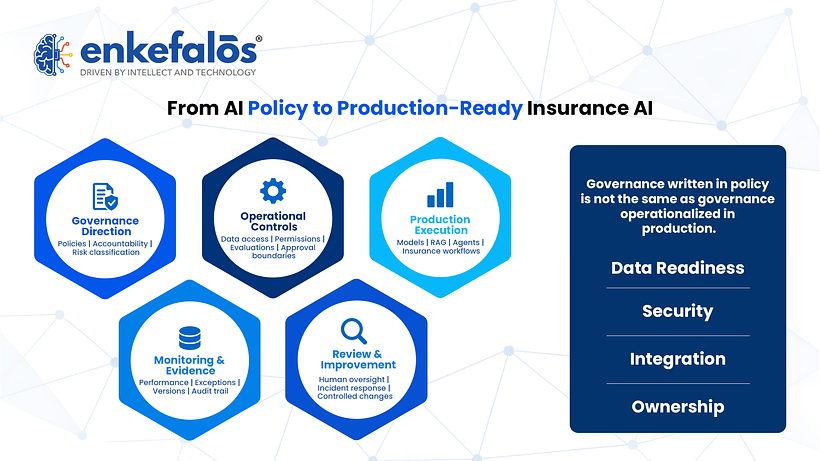
Scaling insurance AI requires governance policies to translate into enforceable production controls across data access, evaluation, permissions, human approval, monitoring, traceability, and controlled change.
What Changes When Insurers Introduce Agentic AI?
Generative AI can summarize documents and support information retrieval. Agentic AI extends these capabilities by coordinating tasks, invoking authorized tools, and managing defined workflows.
This creates additional operational considerations because AI-generated actions may interact with enterprise systems.
The growing adoption of agentic AI in insurance is helping carriers coordinate complex workflows across underwriting, claims, and policy servicing with appropriate human oversight.
Define Agent Permissions and Execution Boundaries
An insurance AI agent should operate within explicit permissions.
For example, an underwriting support agent may retrieve submission records, check required information, and prepare a review task. It should not independently authorize coverage or modify binding terms unless the action is explicitly authorized by the insurer, permitted under applicable requirements, and subject to appropriate controls and oversight.
Agent permissions should be enforced through trusted application controls rather than relying solely on model instructions.
Establish Human Approval and Exception Handling
Agentic workflows need clear rules for when tasks can proceed automatically and when human intervention is required.
Approval checkpoints may be necessary for claims payments, coverage changes, sensitive customer communications, and other consequential activities.
Exception handling should address missing information, conflicting system responses, repeated transactions, and failed integrations.
Human oversight must be supported by sufficient information for reviewers to understand and assess the proposed action.
Monitor Agent Behavior in Production
Traditional model evaluation is not sufficient for understanding complete agentic workflows.
Insurers should examine tool execution, task completion, authorization failures, repeated actions, and system interactions.
Monitoring should also identify unexpected behavior and support timely intervention.
These capabilities are essential when agentic systems move from supervised testing into recurring operational workflows.
How Can Insurers Maintain Reliable AI Performance in Production?
AI systems may perform well during testing but encounter different conditions after deployment.
Changes in documents, business processes, data distributions, and system dependencies can affect results. Language model applications may also produce inconsistent responses to similar requests.
Production monitoring should therefore address model behavior and the surrounding workflow.
Key performance indicators include:
- Output quality: Accuracy, completeness, and relevance of generated information.
- Workflow reliability: Successful task completion and exception frequency.
- System performance: Latency, availability, and integration failures.
- Human intervention: Frequency and reasons for corrections or approvals.
- Security events: Unauthorized access attempts and policy violations.
- Operational costs: Model usage, infrastructure expenses, and support requirements.
Insurers should establish acceptable thresholds for each application and define what happens when performance falls outside those boundaries.
Version control, regression testing, rollback procedures, and controlled deployment changes can help manage production risk.
Is Your Insurance AI Ready to Move Beyond Pilots?
Assess whether your data, integration, governance, monitoring and human-oversight foundations are ready to support AI at production scale.
How Should Insurers Manage Third-Party AI Dependencies?
Many insurance AI initiatives depend on external models, cloud infrastructure, data providers, or technology vendors.
These dependencies introduce questions about data handling, service availability, model updates, contractual obligations, and operational continuity.
Before production deployment, insurers should assess:
- How vendors process, retain, and access insurance information.
- Whether model or service changes can affect application behavior.
- What evaluation and audit information vendors provide.
- How service disruptions and incidents are handled.
- Whether alternative providers or deployment options are practical.
Third-party oversight is also an active area of insurance regulatory discussion.
The NAIC’s Third-Party Data and Models Working Group is developing a regulatory oversight framework, with its current proposal focusing on third-party data and models used in property and casualty insurance pricing and underwriting. The framework remains under development and does not establish universal requirements for all third-party AI vendors.
Insurers should monitor such developments without treating proposals or ongoing work as finalized regulatory requirements.
How Can InsurancGPT Support Production AI in Insurance?
As insurers expand AI across underwriting, claims, documents, and analytics, separate applications can create inconsistent governance and fragmented operational oversight. Insurance-focused platforms may help organizations coordinate these capabilities within a common operating environment.
Enkefalos positions InsurancGPT as a private, agentic AI platform designed for insurance operations. Its published product information describes modular capabilities for underwriting support, claims intelligence, document processing, conversational analytics, and compliance-related workflows. The platform also describes human-governed decision support, enterprise integration, traceability, and production monitoring. These capabilities align with the operational priorities of insurers preparing to scale AI. Actual performance, integration compatibility, and deployment requirements should be validated against each insurer’s systems and use cases.
Operationalize AI Across Insurance Workflows
Bring AI into underwriting, claims, document intelligence and other insurance operations with governed integration, human oversight and production controls.
How Should Insurance Carriers Measure AI Business Value?
AI adoption metrics alone do not demonstrate business value.
Tracking the number of deployed models or employee interactions may indicate usage, but these measures do not establish whether AI improves operational outcomes.
Insurers should connect AI performance with relevant business indicators.
For underwriting, useful measures may include submission preparation time, review effort, exception rates, and information accuracy.
For claims, carriers may evaluate document processing time, administrative workload, routing accuracy, and human correction rates.
Implementing AI claims processing can help insurers reduce manual document handling, improve workflow efficiency, and track claims-related operational outcomes.
Customer service applications may be measured through response preparation time, resolution outcomes, escalation frequency, and quality reviews.
Cost evaluations should also include integration, infrastructure, security, monitoring, and ongoing operational expenses.
A meaningful assessment compares these outcomes with an appropriate baseline and considers differences in workload complexity.
What Should Insurers Include in Their 2027 AI Roadmap?
A practical 2027 AI roadmap should prioritize operational readiness over the number of new AI applications introduced.
A staged approach can help insurers establish consistent standards before expanding deployment.
Phase 1: Assess Existing AI Initiatives
Create an inventory of models, applications, third-party dependencies, business owners, and affected workflows.
Identify which systems are experimental, which operate in production, and where governance or integration gaps exist.
Phase 2: Standardize Production Controls
Develop common requirements for data access, model evaluation, monitoring, human approval, security, and change management.
Apply these requirements according to use-case risk and business impact.
Phase 3: Expand Validated Insurance Workflows
Prioritize applications that demonstrate reliable performance and measurable value.
Extend successful capabilities through reusable integration services while maintaining oversight and operational ownership.
Phase 4: Review and Improve Continuously
Monitor business outcomes, model performance, regulatory developments, and system dependencies.
Use the findings to refine controls, update deployment decisions, and determine where additional automation is appropriate.
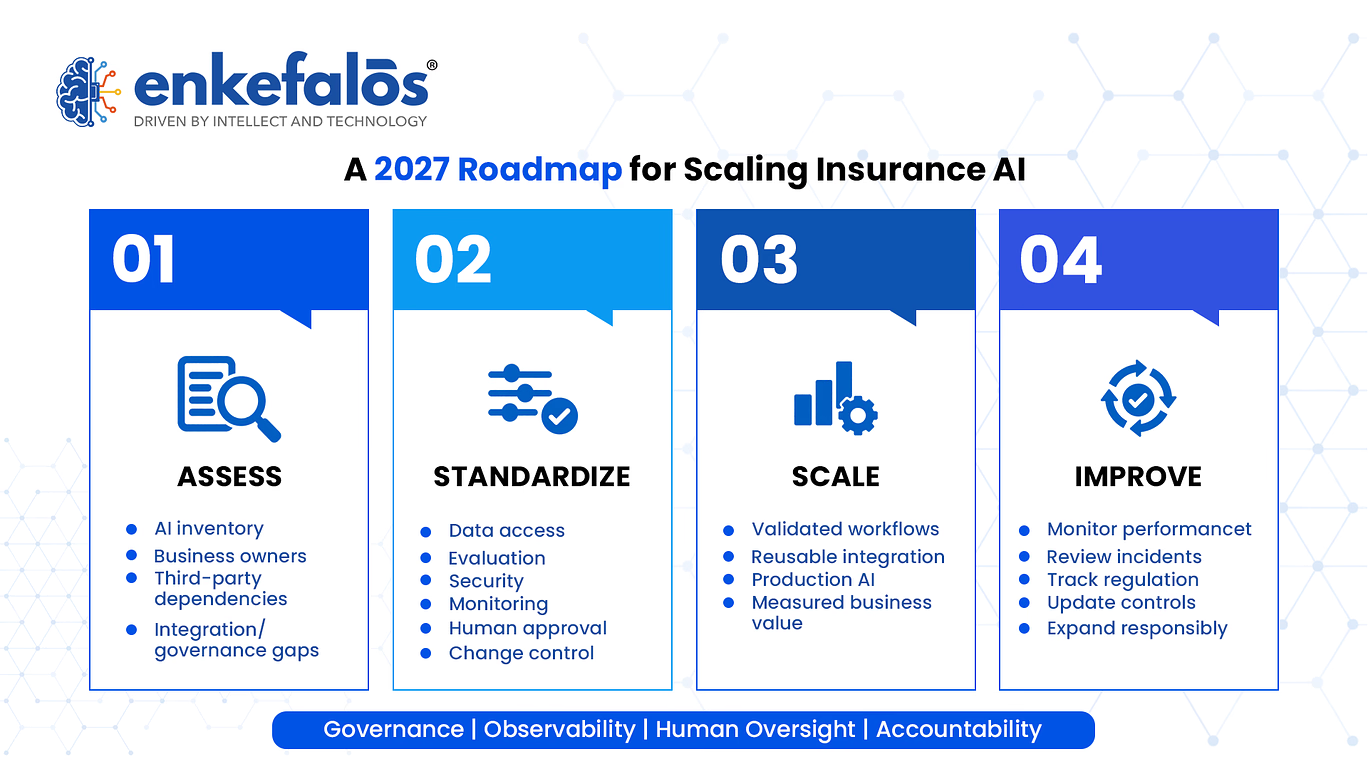
A practical 2027 AI roadmap should move from inventory and readiness assessment to standardized production controls, validated workflow expansion, and continuous measurement and improvement.
Conclusion
Insurance AI in 2027 will require greater attention to the operational foundations supporting enterprise deployment. Reliable data, controlled integration, effective governance, production monitoring, and clear accountability are essential for moving beyond isolated applications.
Insurers should approach scaling as a business and technology transformation rather than a model deployment exercise. By establishing reusable controls, validating operational outcomes, and preserving professional oversight, carriers can expand AI across insurance workflows while managing the risks associated with increasingly connected systems.
Frequently Asked Questions
What insurance companies should prioritize for AI in 2027?
Insurance companies should prioritize data readiness, system integration, AI governance, production monitoring, human oversight, and measurable business outcomes. These capabilities support reliable deployment across operational workflows.
Why is AI governance important for insurance carriers?
AI governance defines accountability, approval requirements, risk controls, and oversight procedures. It helps insurers manage AI applications that process sensitive information or support consequential business decisions.
How is agentic AI different from generative AI in insurance?
Generative AI produces and interprets content, while agentic AI combines models with tools and workflow orchestration to coordinate tasks. Agentic systems require additional controls over permissions, execution, and authorized actions.
Can insurers scale AI without replacing legacy systems?
Insurers can connect AI applications to existing platforms using APIs, middleware, and controlled integration services. Some systems may still require modernization to support reliable production workflows.
What are the main risks of scaling insurance AI?
Major risks include inaccurate outputs, fragmented data, unauthorized actions, information exposure, integration failures, weak governance, and inadequate monitoring.
How can insurers monitor AI in production?
Insurers can track output quality, workflow completion, system reliability, exception rates, human interventions, security events, and operating costs. Monitoring should continue throughout the application lifecycle.
What role does human oversight play in insurance AI?
Human oversight allows authorized professionals to review AI-generated information, handle exceptions, and approve consequential actions. The level of intervention should reflect the workflow’s risks and applicable requirements.
How can insurers measure the return on AI investment?
Insurers can compare improvements in processing time, accuracy, workload, and service outcomes against implementation and ongoing operating costs. Evaluations should use suitable baselines and representative business cases.