


Blog
Protecting Confidential Insurance Data in the Age of AI: Security, Governance and Private AI

Insurance companies manage sensitive information across underwriting, claims processing, policy administration, and customer service. These records may contain personal identifiers, financial details, medical information, and confidential business documents. As insurers introduce generative and agentic artificial intelligence (AI) into these workflows, protecting this information becomes more complex.
AI applications may retrieve documents, process customer records, connect with external services, and generate responses using enterprise data. Without appropriate controls, these interactions can expose confidential information to unauthorized users, applications, or service providers. Traditional security measures remain necessary, but AI introduces additional risks involving model inputs, generated outputs, retrieval systems, and automated actions.
Protecting confidential insurance data requires an approach combining data security, AI governance, and controlled deployment. Private AI can support this strategy by giving insurers greater control over AI infrastructure and data processing. However, effective protection depends on how access permissions, information handling, monitoring, and human oversight are implemented throughout the AI lifecycle.
Why Does AI Introduce New Risks to Confidential Insurance Data?
Insurance organizations already use established security controls to protect enterprise systems. AI changes how information is accessed, interpreted, and shared across those systems.
A conventional application may retrieve predefined database fields. A generative AI assistant, however, may process entire policy documents, claims correspondence, or underwriting reports to answer a question.
Agentic AI introduces another consideration because authorized agents may interact with several applications while completing a workflow. With agentic AI in insurance, organisations must establish clear permissions and monitoring mechanisms for every automated workflow.
These capabilities can expand the ways confidential information moves through an organization.
Common risks include:
- Sensitive information disclosure: AI applications may reveal personal, financial, or proprietary information in generated responses.
- Excessive data access: Models or agents may receive broader information access than their tasks require.
- Prompt injection: Malicious instructions embedded in documents or retrieved content may influence AI behavior.
- Third-party exposure: External AI services may introduce additional data processing, retention, or contractual risks.
- Insufficient traceability: Organizations may struggle to determine which information was accessed or used in a particular workflow.
The OWASP GenAI LLM Top 10 2026 identifies risks including sensitive information disclosure, prompt injection, and excessive agency.
Addressing these risks requires controls at both the AI application and enterprise infrastructure levels.
What Types of Insurance Data Need Protection in AI Workflows?
Insurance companies process information with different confidentiality requirements. Understanding these categories helps determine which AI applications can access specific records.
The following table identifies common confidential insurance data types and their associated protection considerations.
|
Insurance data category |
Examples |
Protection considerations |
|
Personal information |
Names, addresses, identification details | Access restrictions and appropriate data handling |
| Financial information | Payment details, income records, claim amounts |
Confidentiality and transaction integrity |
|
Medical information |
Health records, physician statements | Restricted access and applicable privacy requirements |
| Policyholder records | Coverage details, claims histories |
Authorized use and source traceability |
|
Business information |
Underwriting guidelines, pricing methodologies | Protection of proprietary information |
| Third-party information | Broker submissions, external reports |
Contractual permissions and data sharing controls |
Not every record requires identical security measures. Controls should reflect information sensitivity, applicable obligations, business purpose, and the potential consequences of disclosure.
Data Classification and Minimization
Before connecting AI applications to enterprise repositories, insurers should classify information according to sensitivity and permitted use.
Data minimization limits the information supplied to an AI application to what is necessary for its approved task.
For example, a claims document summarization application may need incident descriptions and relevant policy provisions without requiring unrelated financial or medical records.
Reducing unnecessary data exposure can limit the impact of errors or unauthorized access.
What Is Private AI, and How Can It Protect Insurance Data?
Private AI generally refers to AI systems deployed or operated within infrastructure and access boundaries controlled by an organization or its authorized providers.
Depending on implementation, Private AI may use on-premises infrastructure, dedicated private cloud environments, or other controlled enterprise deployments.
Its main advantage is greater organizational control over where information is processed, how systems connect, and which services can access confidential data.
However, Private AI is not a standalone security control or compliance certification.
Private AI vs. Public AI Services
Public AI services and Private AI environments can both support enterprise workloads. Their data handling characteristics depend on architecture, contractual terms, and configured security controls.
The following table compares considerations insurers should evaluate when selecting an AI deployment model.
|
Consideration |
Public AI service |
Private AI deployment |
|
Infrastructure |
Provider-managed service environment | Organization-controlled or dedicated environment |
| Data processing | Governed by service architecture and agreements |
Configured within selected enterprise boundaries |
|
Model management |
Depends on provider capabilities | May support greater configuration control |
| Integration | Uses supported service interfaces |
Can be designed around internal enterprise systems |
|
Security responsibility |
Shared according to service model | Requires substantial organizational oversight |
| Compliance | Must be assessed for each use case |
Must also be assessed for each use case |
Public AI services may offer enterprise privacy and security configurations. Likewise, private infrastructure can remain vulnerable to weak permissions, insecure integrations, or operational failures.
The appropriate deployment choice depends on data sensitivity, technical requirements, risk tolerance, and vendor commitments.
How Can Insurers Secure Data Throughout the AI Lifecycle?
Insurance data protection should begin before information enters an AI model and continues after the application produces its output.
A secure architecture needs controls across data ingestion, retrieval, model execution, and downstream actions.
Protect Data During Ingestion and Processing
AI applications may ingest scanned documents, databases, emails, and third-party information.
Before processing, insurers should verify that data sources are authorized and apply appropriate classification, validation, and access restrictions.
Sensitive information may also be masked or redacted when the application does not require the original values.
Encryption should be considered for information in transit and at rest, alongside secure key management.
Enforce Identity and Access Controls
AI services should authenticate users and connected applications before granting access to enterprise data.
Role-based or attribute-based access controls can restrict information according to business responsibilities and other relevant conditions.
For agentic AI, permissions should also limit which tools an agent can invoke and what operations those tools can perform.
An agent authorized to retrieve policy information should not automatically receive permission to modify policy records.
Secure Retrieval-Augmented Generation
Retrieval-augmented generation (RAG) allows AI models to use information retrieved from enterprise knowledge sources.
In insurance, RAG may support policy research, claims summaries, and underwriting assistance.
However, retrieval introduces security considerations involving document permissions, vector databases, embeddings, and source integrity.
Insurers should enforce access controls during retrieval, validate indexed content, and prevent users from obtaining documents outside their authorization scope.
Generated answers should not expose confidential passages simply because those passages were available in a shared knowledge repository.
Validate AI Outputs and Actions
AI-generated content may contain confidential information, inaccurate interpretations, or instructions unsuitable for downstream execution.
Applications should validate outputs before inserting information into business systems or communicating consequential results.
Agentic workflows also need explicit authorization for sensitive actions.
Trusted application controls, rather than model-generated instructions alone, should determine whether an operation can proceed.
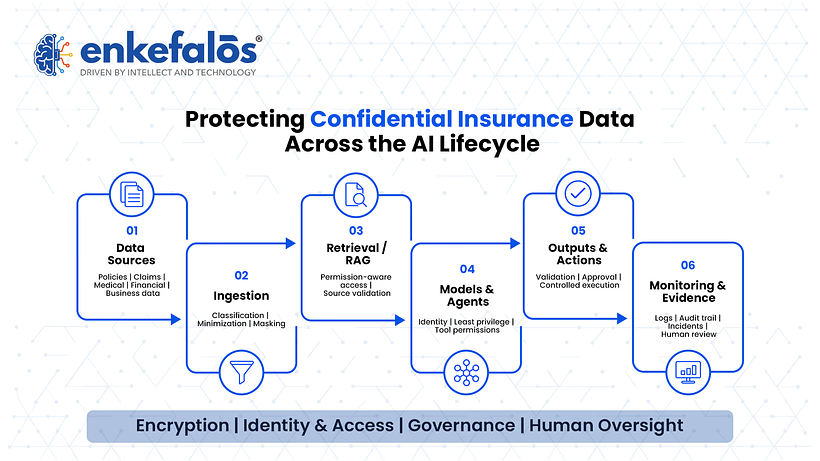
Protecting confidential insurance data requires controls across the complete AI lifecycle, from data ingestion and retrieval through model access, agent actions, output validation, monitoring, and human oversight.
How Can Insurers Establish AI Data Governance?
Data security determines how information is protected. AI governance establishes who is accountable for how that information is used, evaluated, and managed.
An effective governance program should connect AI development and deployment with existing enterprise risk management practices.
Assign Clear Accountability
Insurers should define responsibilities across business leadership, information security, compliance, data management, and AI development teams.
These responsibilities may include approving AI use cases, classifying data, evaluating third-party providers, reviewing incidents, and monitoring model performance.
Clear accountability becomes especially important when AI applications operate across multiple business functions.
Define AI Data Usage Policies
Governance policies should specify which information can be used for model inputs, retrieval, evaluation, and any approved model improvement activities.
Policies should also address retention periods, deletion procedures, employee access, and third-party processing arrangements.
Insurers should distinguish routine AI inference from model training or fine-tuning because these activities may involve different data handling requirements.
Maintain Auditability and Human Oversight
AI workflows should produce records appropriate to their operational risks.
Relevant evidence may include data sources, access events, model versions, tool interactions, policy decisions, and human approvals.
For consequential insurance processes, authorized professionals should review AI-generated recommendations before relevant business decisions are finalized.
Audit records support accountability and investigation but do not independently establish that a system is accurate or compliant.
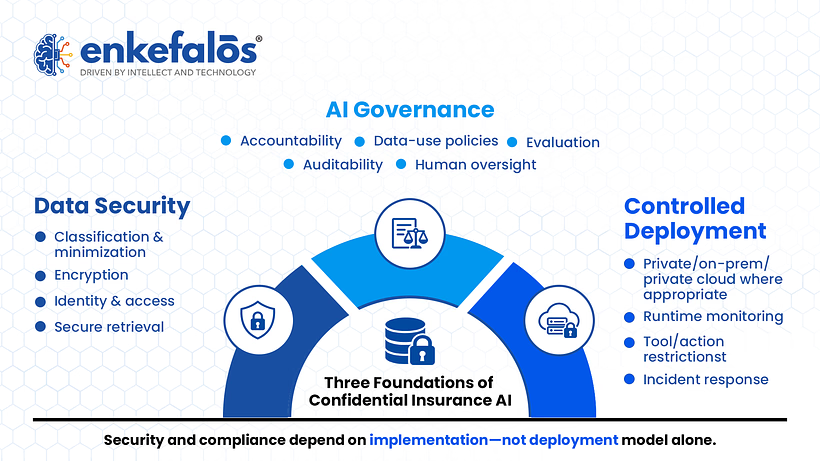
Protecting confidential insurance data requires a combination of technical security, AI governance, and controlled deployment, supported by accountability, monitoring, and human oversight.
Can You Trace How Confidential Data Moves Through Your AI Systems?
Assess whether your AI environment has the access controls, governance, monitoring, and evidence needed to protect sensitive insurance information.
What Regulatory Requirements Affect Insurance AI Data Security?
Insurance AI deployments must account for applicable information security, privacy, and insurance regulations.
In the United States, insurance oversight is primarily state-based, although federal and other laws may also apply depending on the information and activities involved.
Two National Association of Insurance Commissioners (NAIC) initiatives provide relevant regulatory context.
NAIC Insurance Data Security Model Law
The NAIC Insurance Data Security Model Law (#668) establishes a model framework covering information security programs, cybersecurity event investigation, and notification requirements.
Its requirements apply through adoption and implementation by individual states, subject to jurisdiction-specific provisions.
The model emphasizes risk assessment, information security controls, third-party service provider oversight, and organizational accountability.
Insurers should determine which enacted requirements apply to their operations rather than treating the model law itself as universally binding.
NAIC AI Model Bulletin
The NAIC adopted its Model Bulletin on the Use of Artificial Intelligence Systems by Insurers in December 2023.
The bulletin describes supervisory expectations for AI governance, risk management, and documentation, including considerations involving third-party systems.
It is not a federal law or nationwide binding regulation. Its application depends on state regulatory action and existing legal obligations.
Insurers should also consider relevant privacy requirements, including laws governing certain consumer financial and health information.
Applying the NIST AI Risk Management Framework
The National Institute of Standards and Technology (NIST) AI Risk Management Framework provides voluntary guidance for managing AI risks.
Its four functions, Govern, Map, Measure, and Manage, can help structure oversight across the AI lifecycle.
NIST’s Generative AI Profile provides further guidance for risks associated with generative AI, including information integrity, privacy, and security.
These frameworks support risk management but do not replace legal compliance assessments.
How Can Insurers Evaluate Third-Party AI Security?
Insurance AI environments may depend on external models, cloud providers, software vendors, or data services.
Each dependency introduces questions about information processing, security responsibilities, and operational resilience.
Third-party assessments should examine:
- Data usage: Whether customer information is used for inference, model improvement, or other purposes.
- Retention: How long does the provider store submitted data and generated outputs
- Access: Which personnel, systems, or sub-processors can access confidential information
- Security: Available technical controls, testing evidence, and incident procedures.
- Contractual protections: Confidentiality commitments, permitted uses, and reporting obligations.
- Operational continuity: Service availability, incident recovery, and migration options.
Insurers should obtain evidence supporting vendor claims and assess whether contractual commitments align with internal data governance requirements.
How Can PreFrox Support Governed AI Security?
As insurers introduce AI across multiple workflows, applying security and governance policies consistently can become difficult. Individual applications may use different models, data sources, access permissions, and monitoring procedures, creating gaps in enterprise oversight.
Enkefalos positions PreFrox as an enterprise AI governance platform designed to oversee AI agents, large language models, predictive models, and automated workflows. Its published capabilities include centralized policy management, runtime monitoring, policy enforcement, human escalation, and audit evidence collection. These functions are relevant to insurers seeking consistent governance across AI applications that process confidential information. Actual security effectiveness, integration compatibility, and regulatory suitability must be validated for each deployment.
Govern AI Where Sensitive Insurance Data Is Used
Apply policy controls, runtime monitoring, human oversight, and auditability across AI models, agents, and workflows handling enterprise information.
What Should Insurers Prioritize Before Scaling Private AI?
Private AI deployment should form part of a broader security and governance strategy rather than operate as an isolated technology project.
Insurers can prioritize three areas.
Consistent Enterprise Controls
Apply common identity, access, encryption, and monitoring requirements across AI applications.
Shared controls can reduce inconsistencies as additional models and workflows are introduced.
Security Testing and Monitoring
Evaluate AI applications for unauthorized information disclosure, prompt injection, inappropriate tool use, and retrieval permission failures.
Testing should include realistic business scenarios and attempts to access information outside authorized boundaries.
Incident Response and Operational Ownership
Establish procedures for detecting AI-related security events, restricting affected services, investigating exposure, and restoring operations.
Assign responsibility for model changes, access reviews, vendor incidents, and continuing security assessments.
These capabilities support ongoing protection as AI becomes more closely integrated with core insurance operations.
Conclusion
Protecting confidential insurance data in the age of AI requires more than selecting a secure deployment environment. Insurers must manage how information enters AI applications, which users and services can access, how outputs are validated, and how actions are monitored.
Private AI can provide greater control over infrastructure and data processing, while governance frameworks establish accountability and operational safeguards. By combining appropriate security architecture, regulatory awareness, and continuous oversight, insurers can expand AI adoption while managing risks to sensitive information.
Frequently Asked Questions
What is confidential insurance data?
Confidential insurance data includes personal identifiers, financial information, medical records, policyholder details, claims documents, and proprietary business information that requires protection against unauthorized access or disclosure.
How can AI expose confidential insurance information?
AI applications may expose information through excessive access permissions, insecure integrations, generated responses, compromised retrieval systems, or inappropriate third-party data handling. Security controls should address each stage of processing.
What is Private AI in insurance?
Private AI refers to AI systems operated within organization-controlled or dedicated environments. It can provide greater control over infrastructure, information access, and processing arrangements, depending on implementation.
Is Private AI more secure than public AI?
Not automatically. Private AI may offer greater deployment and data control, but security depends on configuration, access restrictions, monitoring, and operational practices. Public AI services can also provide enterprise security controls.
How can insurers secure RAG applications?
Insurers can secure RAG applications through permission-aware retrieval, controlled document ingestion, source validation, vector database security, encrypted connections, and monitoring unauthorized information access.
What is the role of AI governance in insurance data security?
AI governance defines policies, accountability, approval procedures, and oversight requirements for AI systems. It helps insurers manage how confidential information is accessed, processed, retained, and shared.
Does the NAIC require all insurers to use Private AI?
The NAIC does not establish a universal requirement for insurers to deploy Private AI. Applicable insurance regulations and supervisory expectations focus on appropriate governance, risk management, and information protection.
How can insurers evaluate AI data security controls?
Insurers can assess access violations, information disclosure incidents, retrieval permission failures, security testing results, audit completeness, and third-party risk assessments. Evaluations should continue throughout the AI lifecycle.