


Blog
Insurance Fraud Detection: How AI Identifies Suspicious Claims

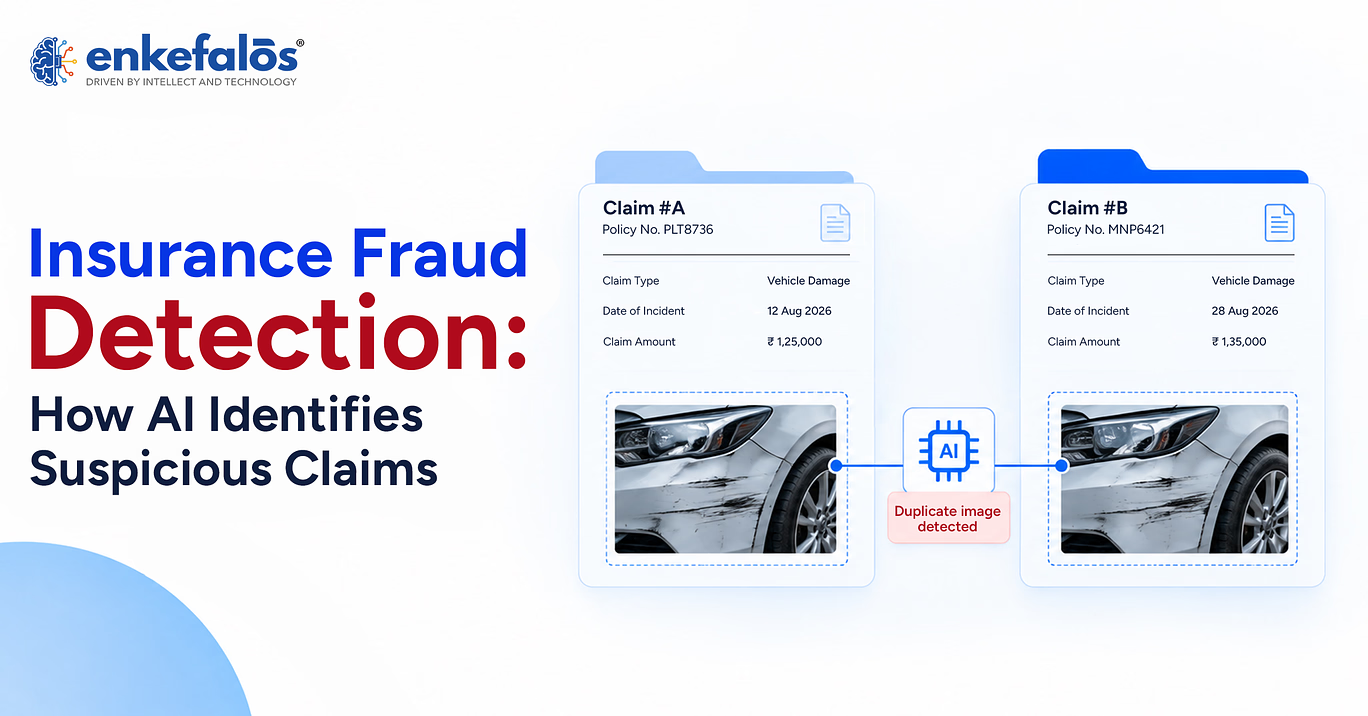
Insurance fraud detection has traditionally relied on claim-handler experience, predefined rules, manual document review, and referrals to investigation teams. Those methods remain important, but insurers now process large volumes of structured data, documents, images, and digital interactions that can be difficult to review consistently by hand.
Artificial intelligence (AI) can help by analyzing claims for unusual patterns, inconsistencies, relationships, and other fraud-risk indicators. The goal is not to automatically label a claimant as fraudulent. AI can help insurers identify claims that warrant closer review, organize supporting evidence, and give investigators more information for making decisions. The National Association of Insurance Commissioners (NAIC) identifies fraud detection as one of the areas where insurers use AI and machine learning.
What Is Insurance Fraud Detection?
Insurance fraud detection is the process of identifying claims, behaviors, documents, or relationships that may indicate misrepresentation, manipulation, or another form of suspicious activity.
Fraud detection can involve:
- Reviewing unusual claim patterns
- Comparing claims with historical data
- Checking inconsistencies across documents
- Identifying duplicate or related claims
- Analyzing relationships between people, providers, vehicles, or addresses
- Reviewing unusual timing or transaction patterns
- Evaluating images and supporting evidence
- Referring higher-risk claims for investigation
AI expands this process by analyzing more variables and relationships simultaneously than a simple rules-based workflow can typically handle.
Why Traditional Fraud Detection Struggles with Modern Claims
Traditional rules remain useful because they provide clear, understandable triggers. A rule may flag a claim when a particular amount, event, or combination of conditions is present.
The challenge is that suspicious behavior does not always follow one predefined pattern. Claims may also contain large amounts of unstructured information spread across forms, adjuster notes, invoices, photographs, reports, emails, and policy documents.
Traditional approaches can struggle with:
- Rigid thresholds that miss less obvious patterns
- Large volumes of unstructured documents
- Isolated data across different systems
- High numbers of false-positive referrals
- Complex relationships between multiple claims or parties
- New fraud patterns not represented in existing rules
The NAIC notes that text analytics can identify potential red-flag trends across adjuster reports, while the National Insurance Crime Bureau (NICB) has developed tools including an early detection model and a questionable-claims network model to identify suspicious patterns and relationships.
How AI Detects Suspicious Insurance Claims
AI fraud detection typically combines several analytical methods rather than depending on one model.
- Pattern recognition: Machine learning can compare a new claim with historical claims and identify combinations of characteristics associated with previous referrals or confirmed outcomes.
- Anomaly detection: Models can identify behavior that differs significantly from expected patterns, even when no specific rule has been written for it.
- Network analysis: AI can examine relationships between claimants, providers, vehicles, addresses, accounts, repair facilities, or other entities. This can help with surface connections that may not be visible when individual claims are reviewed separately.
- Natural language processing: AI can analyze adjuster notes, incident descriptions, medical records, invoices, and other text for relevant entities, events, inconsistencies, or unusual patterns.
- Computer vision: Image models can analyze photographs submitted with auto or property claims, helping claims professionals organize visible damage and compare visual evidence with other claim information.
- Risk scoring: Multiple signals can be combined into a fraud-risk score or referral recommendation. The score should guide investigation rather than act as proof that fraud occurred.
NICB’s recent work reflects this multi-method approach, including network models, machine learning, and large language models designed to support investigative workflows.
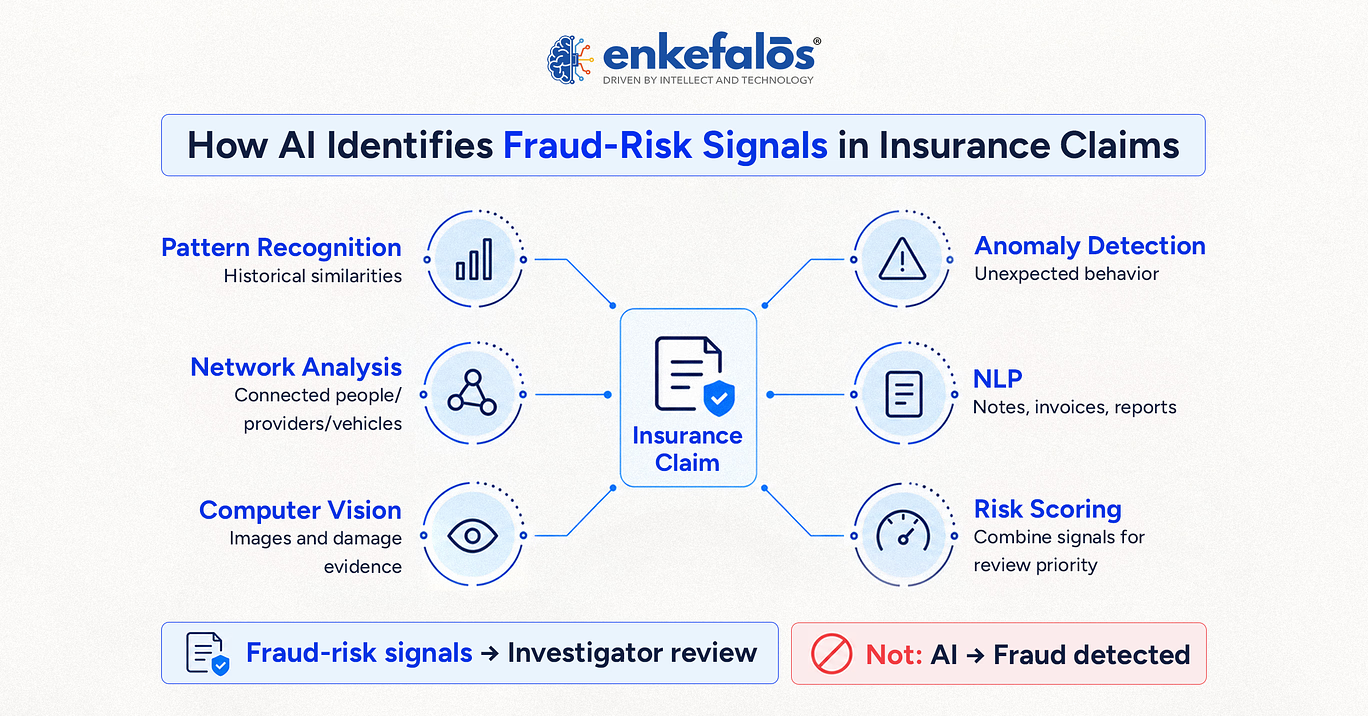
AI can combine pattern recognition, anomaly detection, network analysis, language analysis, computer vision, and risk scoring to surface fraud-risk signals for further investigation.
How AI Analyzes Insurance Documents for Fraud Signals
A large part of claims investigation involves documents. Claims files may contain First Notice of Loss forms, repair estimates, invoices, receipts, policies, medical documents, loss reports, photographs, and correspondence.
AI document intelligence can help structure this information before investigators review it.
The workflow may include:
- Document classification: Identify whether a file is an invoice, claim form, policy, report, estimate, or another document type.
- Field extraction: Capture names, dates, policy numbers, amounts, locations, providers, and other relevant information.
- Cross-document comparison: Compare extracted information between files to identify missing or conflicting details.
- Entity matching: Connect recurring people, businesses, addresses, vehicles, or other entities across claims.
- Content analysis: Surface unusual language, events, amounts, or patterns that may warrant further review.
- Source verification: Keep the original document available so claims professionals can verify AI-generated findings.
Enkefalos’ DocuSure, for example, is designed to classify insurance documents, extract structured information, summarize files, and retain source references for professional review.
AI Fraud Detection vs Traditional Rules-Based Systems
AI and rules-based fraud detection can complement each other rather than operate as competing approaches.
| Factor | Rules-Based Detection |
AI-Based Detection |
|
Logic |
Predefined conditions |
Learned patterns and analytical models |
|
Best For |
Known, clearly defined scenarios |
Complex or less obvious patterns |
|
Data Types |
Mainly structured fields |
Structured and unstructured data |
|
Relationships |
Limited predefined links |
Can analyze broader networks and interactions |
|
Adaptability |
Requires rules to be updated |
Models can be retrained or updated |
|
Explainability |
Usually straightforward |
Depends on model and implementation |
|
Human Review |
Required for investigation |
Still required for investigation |
A practical insurance fraud system may combine business rules with machine learning, document intelligence, network analysis, and investigator review.
How AI Helps Investigators Prioritize Suspicious Claims
AI becomes especially useful when insurers have more claims requiring review than investigation teams can examine immediately.
Instead of treating every claim equally, AI can help create a prioritized review queue based on available risk signals.
Investigators may receive:
- A fraud-risk score
- The factors contributing to the referral
- Relevant documents
- Detected inconsistencies
- Related claims or entities
- Network connections
- Supporting images
- Recommended next steps
This can reduce the time investigators spend gathering basic information and allow them to focus on claims requiring professional judgment.
Enkefalos’ ClaimsFlow follows this type of workflow. It structures claim information, validates data, evaluates fraud-risk signals, and presents supporting evidence and recommendations for claims-professional review rather than automatically making a fraud determination.
Turn Claims Data into Investigation-Ready Intelligence
Structure claim information, surface fraud-risk indicators, and bring supporting documents and evidence together for professional review.
Can AI Detect Insurance Fraud Without Replacing Human Investigators?
Yes. AI can support fraud detection without replacing the role of investigators.
Fraud investigations often require context that cannot be reduced to a risk score. Investigators may need to assess evidence, speak with claimants or providers, understand policy terms, coordinate with legal or compliance teams, and determine whether additional investigation is justified.
A human-in-the-loop model allows AI to:
- Screen claims
- Surface suspicious patterns
- Gather related information
- Summarize evidence
- Recommend prioritization
- Support investigation
- The investigator can then interpret those findings and decide what action is appropriate.
This distinction is particularly important because an anomaly does not necessarily indicate fraud. Unusual claims may have legitimate explanations.
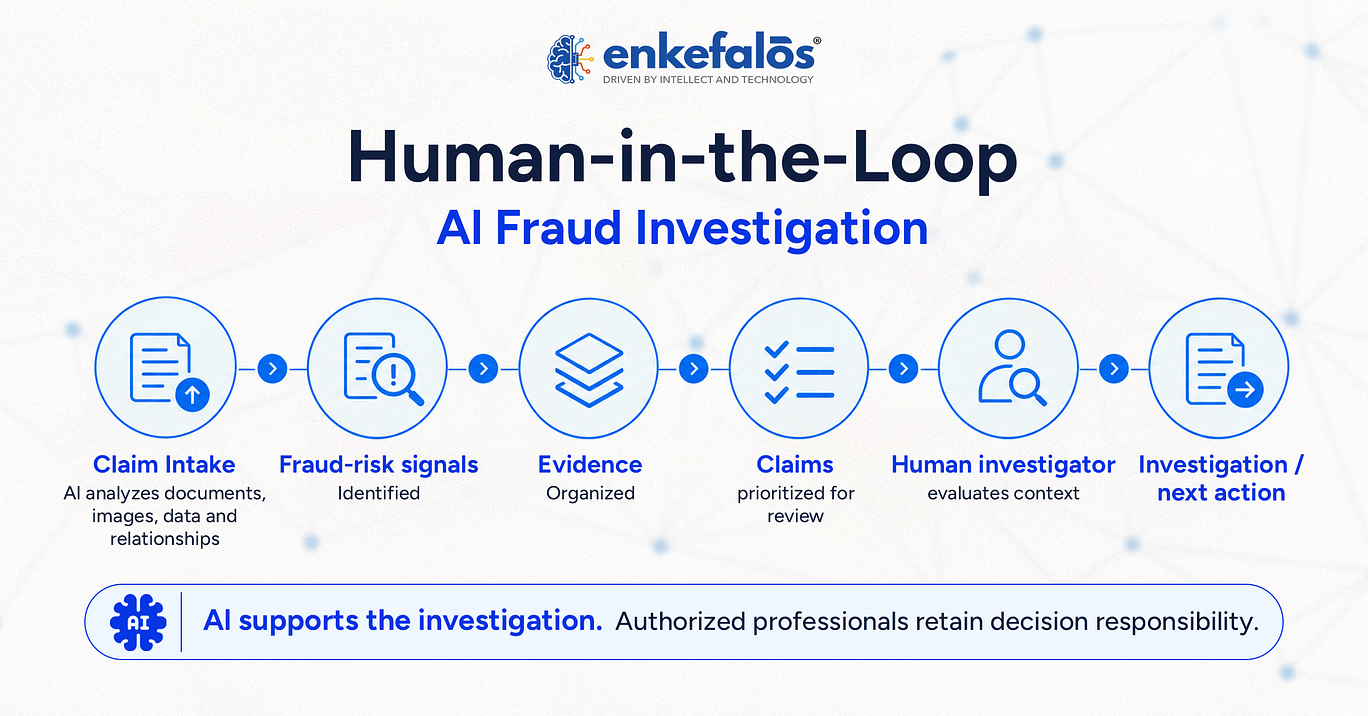
AI can help screen claims, organize evidence, identify fraud-risk signals, and prioritize referrals while authorized investigators retain responsibility for interpreting findings and determining the appropriate next action.
Challenges of Using AI for Insurance Fraud Detection
AI can improve fraud-risk analysis, but it also introduces technical and governance challenges.
- Data quality: Incomplete, inconsistent, or inaccurate claims data can reduce model reliability.
- False positives: A model may flag legitimate claims, create unnecessary investigation work, or affect customers if controls are weak.
- False negatives: Fraud patterns that differ from training data may remain undetected.
- Bias: Historical data may contain patterns that create unfair or inappropriate outcomes if models are not tested and governed carefully.
- Explainability: Investigation teams need to understand why a claim was referred, particularly when AI influences decisions affecting consumers.
- Model drift: Fraud patterns, customer behavior, and business processes change over time, requiring ongoing monitoring and evaluation.
- Integration: AI must often connect with claims platforms, document repositories, policy systems, data warehouses, and investigation workflows.
Regulators are also paying close attention to governance, data quality, transparency, fairness, cybersecurity, and accountability in insurers’ use of AI. The NAIC Model Bulletin emphasizes risk management, testing, documentation, and governance for AI systems that support decisions affecting consumers.
Why Private AI Matters for Insurance Fraud Detection
Fraud detection may require access to sensitive claims information, including personally identifiable information, policy details, financial records, medical information, photographs, and investigation notes.
Private AI provides an architecture in which models, data, retrieval systems, and workflows can operate within controlled enterprise environments such as on-premises infrastructure, private cloud, or approved hybrid deployments.
For fraud detection, this can help insurers maintain greater control over:
- Where claims data is processed
- Which users and systems can access information
- Which models can use sensitive data
- How model activity is logged
- How outputs are reviewed
- How data connects to internal claims systems
- How model versions and policies are governed
Private deployment alone does not guarantee secure, compliant, or unbiased AI. Insurers still need access controls, model evaluation, monitoring, auditability, data governance, and human review.
How Enkefalos Supports AI-Powered Insurance Workflows
Enkefalos approaches insurance fraud detection as part of a broader governed claims workflow rather than an isolated fraud-scoring model.
Its InsurancGPT platform is designed for insurance workflows and runs on the GenAI Foundry private AI control plane. The platform includes modules for claims, document intelligence, image analysis, analytics, underwriting, and compliance.
For fraud-related claims workflows:
ClaimsFlow structures claim information, validates configured business rules, evaluates fraud-risk indicators, and presents evidence and recommendations for review by claims professionals rather than automatically making a fraud determination. Approved outputs can then be written back to connected core systems.
DocuSure processes claim files and supporting documents by classifying files, extracting metadata and relevant fields, generating summaries, and keeping source documents available for verification.
AutoLens analyzes vehicle accident photographs and creates structured findings about visible damage that claims professionals can review alongside the broader claim file. It is designed to support, rather than replace, adjusters or physical inspections when those are required.
At the platform level, GenAI Foundry provides capabilities for model evaluation, deployment control, guardrails, retrieval-augmented generation, human feedback, versioning, and auditability across on-premises, private-cloud, and hybrid-ready environments.
Together, these capabilities can support a workflow in which AI organizes evidence and identifies fraud-risk signals while authorized insurance professionals retain responsibility for investigation and decisions.
Bring Governed AI into Claims Investigation
See how InsurancGPT connects claims intelligence, document processing, visual evidence, and human review within controlled insurance workflows.
Conclusion
AI is changing insurance fraud detection from a primarily rules-driven process into a broader form of risk intelligence. Machine learning, network analysis, document intelligence, natural language processing, and computer vision can help insurers identify suspicious patterns across claims, documents, images, and connected entities.
The value comes from helping investigators focus their attention, not from automatically declaring that a claim is fraudulent. Effective implementation requires high-quality data, explainable signals, continuous model evaluation, privacy controls, auditability, and human review. For insurers working with sensitive claims information, private AI can add another layer of control by keeping models, data, and workflows within governed enterprise environments.
Frequently Asked Questions
1.How does AI detect insurance fraud?
AI analyzes claims for patterns, anomalies, inconsistencies, relationships, and other risk indicators. Machine learning, text analytics, network analysis, and computer vision can be combined to identify claims that may require additional investigation.
2. What types of insurance fraud can AI identify?
AI can help identify risk signals associated with duplicate or related claims, unusual provider or claimant networks, inconsistent documents, suspicious transaction patterns, inflated or unusual claim characteristics, and other anomalies. A flagged pattern should be investigated before any fraud conclusion is made.
3. Can AI analyze insurance documents?
Yes. AI can classify documents, extract fields, summarize information, compare details across files, identify relevant entities, and surface inconsistencies. Source documents should remain available for human verification.
4. How accurate is AI fraud detection?
There is no universal accuracy rate for insurance fraud detection. Performance depends on the data, insurance line, fraud patterns, model design, thresholds, and evaluation method. Insurers should measure false positives, false negatives, precision, recall, and operational outcomes for their specific use case.
5. Can AI replace insurance fraud investigators?
AI can support investigators but should not be treated as a replacement for professional investigation. Human investigators provide context, evaluate evidence, handle exceptions, and make decisions that cannot be based on a model score alone.
6. How does private AI protect insurance data?
Private AI can keep models, data, and workflows within an insurer’s controlled infrastructure and apply enterprise access, monitoring, and governance policies. It does not automatically guarantee privacy or compliance, so organizations still need technical, operational, and regulatory controls.
7. What is the role of AI in claims investigation?
AI can help structure claims, analyze documents, detect risk indicators, connect related entities, prioritize referrals, summarize evidence, and recommend the next steps. Investigators can then use that information to decide whether further review or action is required.
8. Can AI automatically determine if an insurance claim is fraudulent?
AI can identify fraud-risk signals and help prioritize claims for investigation, but a risk score or anomaly should not be treated as proof of fraud. Appropriate human review, evidence assessment, insurer procedures, and applicable legal or regulatory requirements should guide higher-impact decisions.