


Blog
What Is an AI Control Plane? A Guide for Enterprise AI Teams

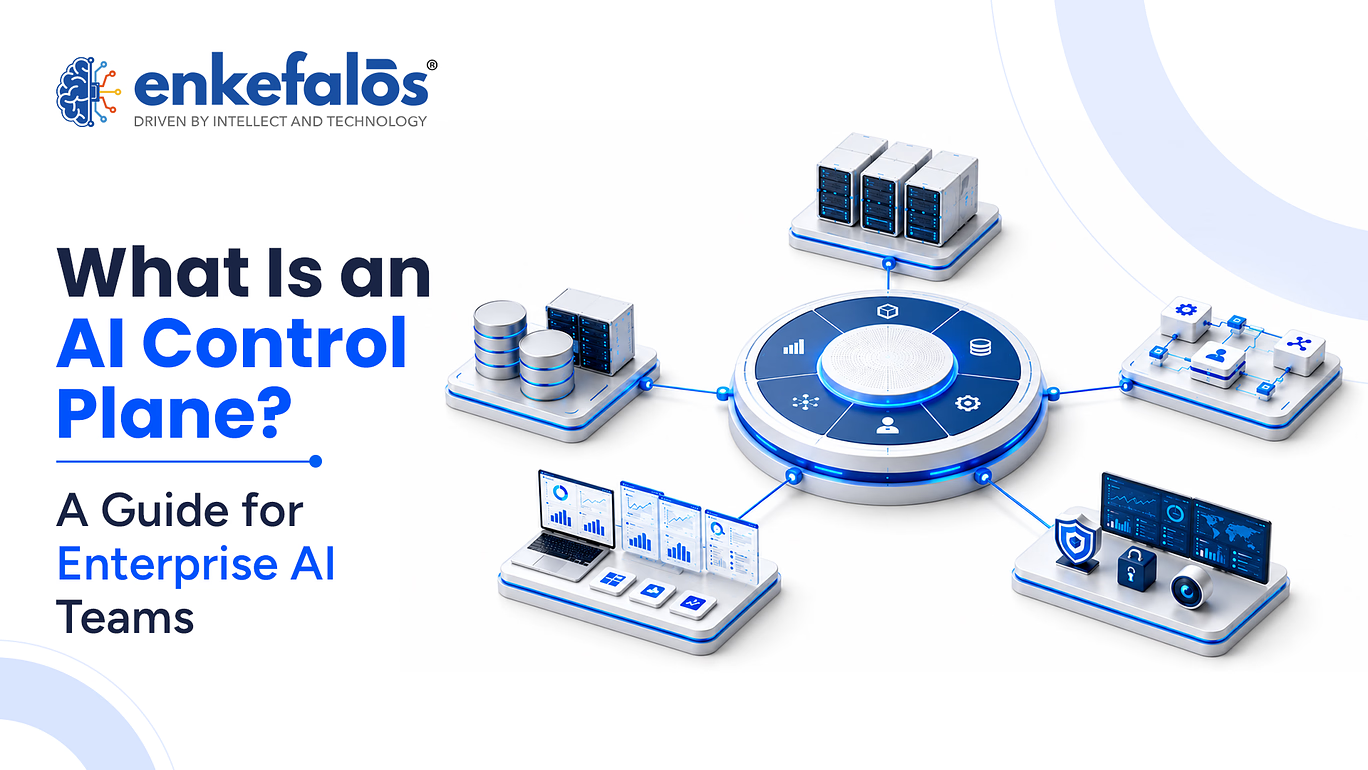
Enterprise AI is expanding beyond isolated chatbots and model experiments. Organizations are now using large language models (LLMs), retrieval-augmented generation (RAG), private AI systems, and AI agents across teams and workflows. Gartner predicts that 40% of enterprise applications will include task-specific AI agents by the end of 2026, up from less than 5% in 2025. As adoption grows, so do the control questions: which models can be used, what data can they access, what tools can agents call, and how can teams monitor and govern AI consistently?
This is where an AI control plane can help. It provides a centralized layer for managing policies, access, monitoring, evaluation, and governance across enterprise AI systems. In this guide, we will explore what an AI control plane is, how it works, its key capabilities, how it differs from AI gateways and AI platforms, and when enterprises may need one.
What Is an AI Control Plane?
An AI control plane is a centralized layer used to govern, secure, observe, and manage AI models, applications, agents, data access, tools, policies, and deployments across an enterprise. It controls the conditions under which AI operates rather than performing every AI task itself. In simple terms, the execution layer does the AI work, while the control plane decides how that work can happen.
Control Plane and Execution Plane
A useful way to understand architecture is to separate control from execution.
The execution layer handles activities such as:
- Sending prompts to models
- Generating model responses
- Retrieving documents for RAG
- Calling APIs and external tools
- Running agent workflows
The control plane determines whether and how those activities can occur. It may verify identities, apply policies, restrict data access, approve model versions, monitor agent actions, enforce guardrails, and record audit information.
There is no single standardized architecture for an AI control plane, and its capabilities can vary by platform and enterprise requirements. Broadly, it serves as an architectural layer for turning enterprise AI policies into consistent technical controls.
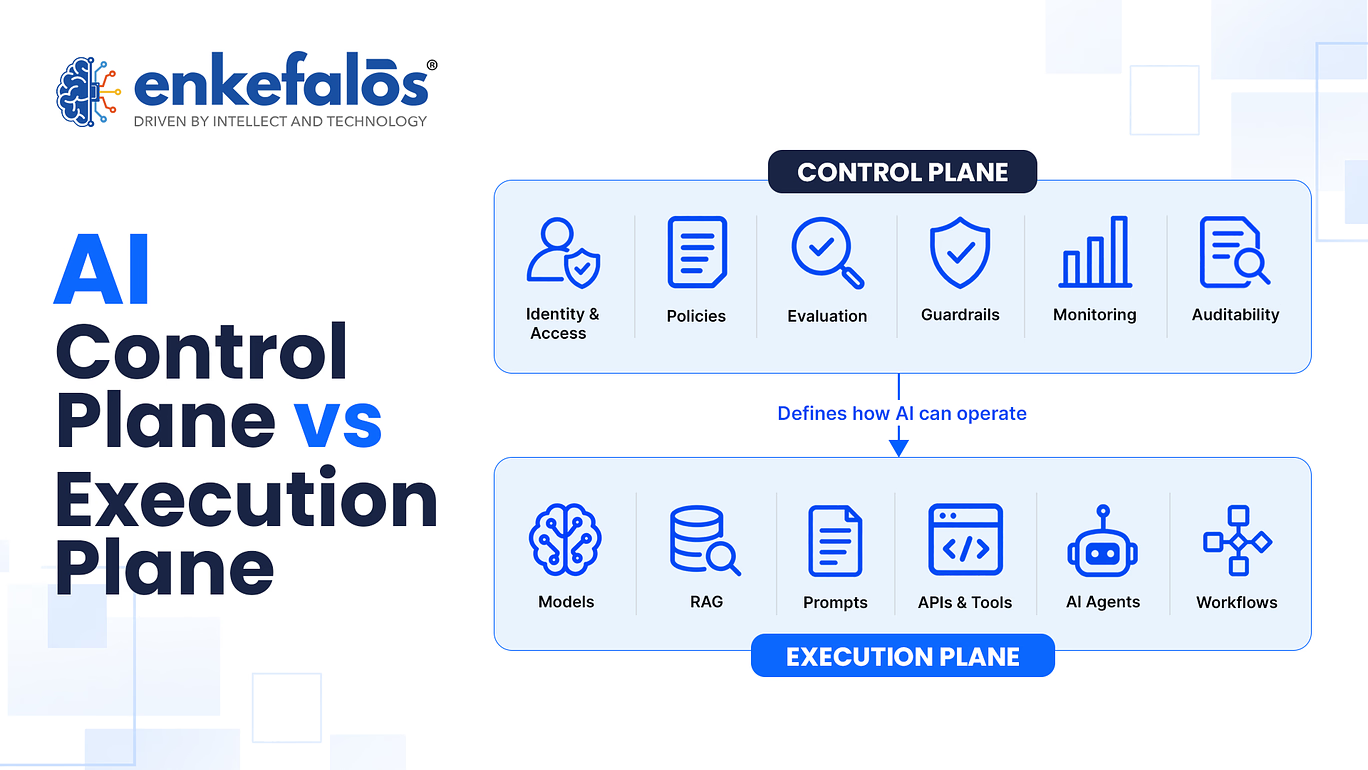
The execution plane performs AI tasks, while the control plane applies the policies, permissions, evaluations, monitoring, and governance that determine how those tasks can operate.
Why Enterprise AI Needs a Control Plane
Enterprises may need an AI control plane when governance becomes fragmented across teams using different models, applications, data sources, tools, and deployment processes. One team may use its own access controls and logging, while another follows different evaluation, monitoring, and approval processes. This can create gaps in governance and duplicate work across the organization.
A shared AI control plane gives enterprises a more consistent way to apply access rules, policies, monitoring, evaluation, and governance across AI systems. This reflects established AI risk-management approaches such as the NIST AI Risk Management Framework and ISO/IEC 42001, which treat AI governance and risk management as ongoing activities across the AI lifecycle rather than one-time approval exercises.
Why AI Agents Increase the Need for Control
AI agents increase the need for these controls because they can do more than generate responses. Depending on their permissions, agents may retrieve business data, call tools, connect with other systems, or perform actions.
This introduces additional questions around identity, access, permissions, and monitoring. OWASP’s security guidance for agentic AI highlights risks such as tool misuse, excessive privileges, and manipulated agent goals. An AI control plane can help enterprises define what an agent is allowed to access, which actions it can perform, and how those activities are monitored.
How an AI Control Plane Works
An AI control plane can apply controls throughout the lifecycle of an AI request or agent action. Consider an internal AI assistant asked to analyze confidential financial documents.
A Typical Control Flow
- Identifythe requester
The system establishes whether the request comes from an authorized employee, application, service, or AI agent.
- Determinepermissions
It checks which models, knowledge sources, tools, or actions that identity can access.
- Apply policies
Enterprise policies can determine whether particular information can be processed, which model can receive it, and whether additional controls are required.
- Execute and monitor
The approved AI workload runs while relevant requests, responses, tool calls, errors, and policy events can be monitored.
- Evaluate andAudit
The organization can evaluate AI behavior and retain records of the model version, configuration, data sources, policies applied, agent actions, and relevant results.
The exact implementation differs. Some enforcement may happen through an AI gateway, while other controls operate through model registries, deployment pipelines, evaluation systems, RAG infrastructure, policy engines, or agent runtimes.
The goal is not necessarily one technical component. It is one coherent control model across the AI environment.
Key Capabilities of an Enterprise AI Control Plane
The required capabilities depend on the organization’s AI architecture, but an enterprise control plane commonly needs to address the following areas.
| Capability | What It Helps Enterprise Teams Manage |
| AI inventory | Models, applications, agents, endpoints, tools, and knowledge sources |
| Identity and access | Which users, services, and agents can access AI resources |
| Policy enforcement | Rules for models, data, prompts, outputs, tools, and actions |
| Runtime guardrails | Sensitive data, restricted content, and policy violations |
| Evaluation | Model and agent quality, safety, consistency, and regressions |
| Lifecycle management | Versions, approvals, releases, configurations, and rollback |
| Observability | Requests, outputs, latency, errors, tool calls, and agent behavior |
| Auditability | Records linking AI activity to users or agents, models, data sources, and policies |
| RAG governance | Which enterprise knowledge sources RAG applications can access and retrieve from |
| Human oversight | Review or approval points for defined AI decisions and actions |
A mature control plane does not simply tell teams what AI exists. It helps them apply and verify controls while those AI systems are operating.
AI Control Plane vs. Traditional AI Governance
AI governance defines an organization’s policies, responsibilities, and risk-management requirements, while an AI control plane helps translate those requirements into technical controls.
For example, governance may establish a policy stating that confidential customer information cannot be processed by an unapproved external model.
The control plane can help operationalize that policy by restricting model access, inspecting requests, controlling routing, and recording policy events.
AI Control Plane vs. AI Gateway vs. AI Platform
These terms increasingly overlap, but they have different starting points.
| AI Control Plane | AI Gateway | AI Platform | |
| Primary purpose | Enterprise AI control and governance | Manage AI request traffic | Build and operate AI |
| Typical scope | Models, agents, data, tools, policies, lifecycle | Models and API requests | Models, agents, development and deployment |
| Routing | May support it | Common capability | Often supported |
| Lifecycle governance | Broad | Usually narrower | Often extensive |
| Agent governance | Increasingly important | Product-dependent | Product-dependent |
| Best suited for | Cross-enterprise AI governance and control | Managing model and API traffic | Building, deploying, and operating AI systems |
An AI gateway typically sits between an application and AI models. Cloudflare’s current AI Gateway, for example, includes analytics, logging, caching, rate limiting, retries, and model fallback.
An AI platform provides a broader environment for building and running AI. Microsoft Foundry currently brings agents, models, and tools into a common management environment with tracing, monitoring, evaluations, role-based access control, networking, and policy capabilities.
An AI control plane is distinguished primarily by its goal: establishing consistent control across the enterprise AI environment.
Because product boundaries are converging, buyers should examine what a system actually governs rather than relying only on labels such as gateway, platform, or control plane.
When Does an Enterprise Need an AI Control Plane?
A contained proof of concept using one model may not require dedicated control-plane infrastructure.
The need becomes stronger when AI starts functioning as shared enterprise infrastructure.
Common indicators include:
- Multiple AI models or providers are in production.
- Several departments are developing AI independently.
- RAG applications access internal business information.
- Private and hosted AI environments operate together.
- Agents can use enterprise systems or tools.
- Teams maintain different security and evaluation controls.
- AI activity is difficult to reconstruct after an incident.
- Every new AI project rebuilds similar governance functions.
Repeatedly rebuilding the same controls is another strong signal. When authentication, guardrails, evaluation, logging, approvals, and monitoring are recreated for every project, the enterprise may already be building parts of a control plane in a fragmented way.
Benefits of an AI Control Plane for Enterprise AI Teams
The value of an AI control plane comes from creating consistency without requiring every AI application to be identical.
For AI Engineering Teams
Reusable evaluation, observability, deployment, and policy mechanisms can reduce the need to rebuild governance for every AI workload.
For Security and Governance Teams
Central visibility makes it easier to understand which identities are using which models, what data agents can access, and which tools or actions are permitted.
Audit records can also provide stronger evidence of how policies were applied.
For Enterprise Leaders
A common control layer can provide a clearer picture of AI adoption, model usage, operational risks, and resource consumption across business functions.
For Teams Scaling AI
Shared controls can allow new AI projects to reuse established policies, guardrails, evaluation processes, and monitoring rather than creating them from scratch.
How to Choose an AI Control Plane
Do not begin with the vendor feature list. Begin with the control problem your enterprise needs to solve.
Ask seven questions:
1.What can the system discover?
Look for visibility across models, applications, agents, tools, endpoints, and knowledge sources.
2. Where can policies be enforced?
Determine whether controls apply only to model requests or also to evaluation, deployment, RAG, and agent execution.
3. Can it govern agents?
Examine agent identity, permissions, tool access, action history, and human approval capabilities.
4. How traceable is AI activity?
Teams should be able to connect activity with relevant users, models, versions, policies, and data sources.
5. Does it support the complete lifecycle?
Evaluation gates, version management, controlled releases, monitoring, and rollback become increasingly important in production.
6.Does it fit the existing architecture?
The control plane should reduce fragmentation rather than becoming another isolated system.
7. Can it work across multiple models and providers?
Check whether the control layer can apply consistent policies across the mix of private, hosted, and third-party models your organization uses or plans to use.
If the primary need is model API routing and traffic management, an AI gateway may be sufficient. If governance needs to extend across models, agents, knowledge, evaluation, deployment, and private infrastructure, a broader control plane becomes more relevant.
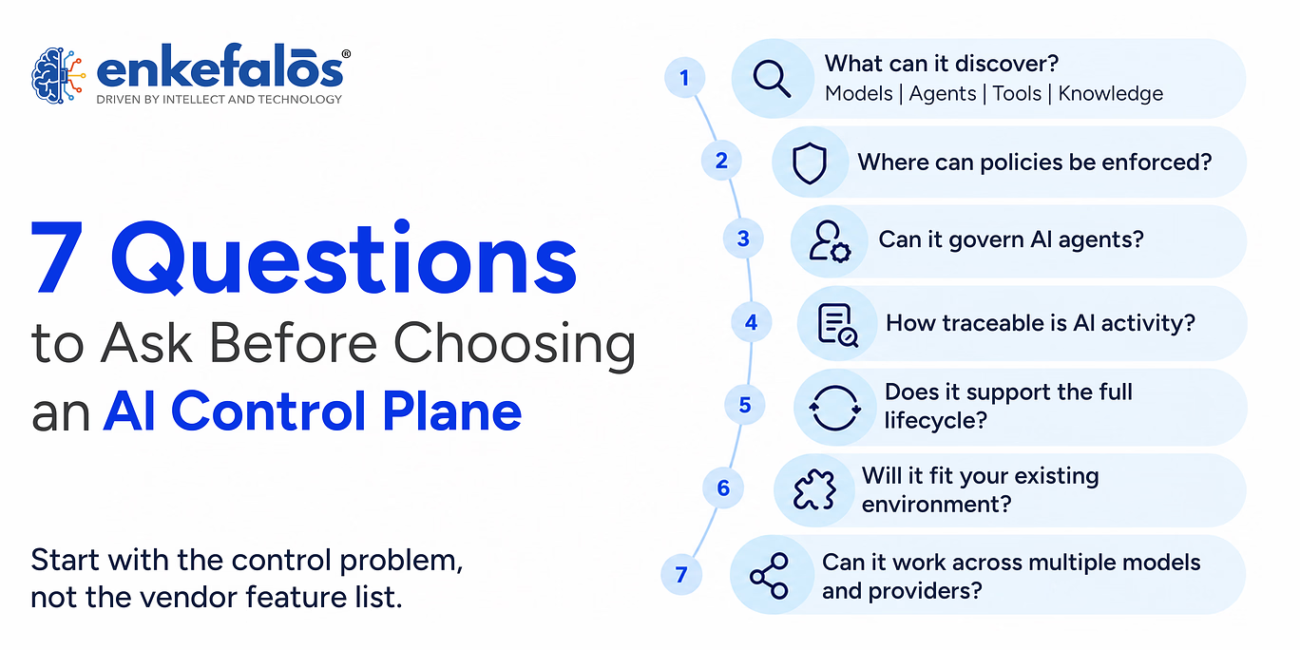
Enterprises should evaluate an AI control plane based on the scope of control it provides across models, agents, data, lifecycle, policies, traceability, and existing AI environments.
Are Your AI Controls Scaling with Your AI Adoption?
As models, agents, data sources and AI applications multiply, fragmented controls can become operational risk. Assess whether your enterprise needs a more consistent AI control layer.
How Enkefalos Approaches the AI Control Plane
Enkefalos addresses this enterprise control problem through GenAI Foundry, its private AI control plane for building and operating production AI.
Full-Lifecycle AI Control
Rather than concentrating only on inference traffic, GenAI Foundry connects multiple stages of the AI lifecycle.
Its current capabilities include:
- AI Data Studio for preparing datasets
- Training and Reinforcement Learning from Human Feedback (RLHF)
- Model evaluation
- Version-controlled deployment and rollback
- Runtime guardrails
- RAG and knowledge management
- Model testing
- Reusable prompt management
Enkefalos also positions human oversight and auditability as part of this operating model. Its evaluation tooling is designed to compare model versions before production, while deployment controls support version management and rollback.
Supporting Private AI Environments
Enkefalos states that GenAI Foundry supports on-premises, private-cloud, and hybrid environments. This can be relevant to enterprises seeking greater control over models, proprietary data, deployment infrastructure, and intellectual property.
This illustrates one way the AI control-plane concept can extend beyond governance at the API boundary and into the complete AI lifecycle.
Bring Consistent Control to Enterprise AI
Govern models, agents, enterprise knowledge and production AI operations through a common control layer designed for private, governed AI.
The Future of Enterprise AI Governance
As enterprise AI moves into production, governance is increasingly extending into runtime monitoring and control.
The shift toward autonomous agents is likely to accelerate this change. As enterprises deploy more autonomous agents, they may need to govern a growing number of machine identities and automated actions across business systems.
That requires governance to answer increasingly operational questions:
- Which agent is acting?
- Which permissions does it have?
- Which tools can it call?
- What context influenced its decision?
- When is human approval required?
- Can its actions be traced or reversed?
OWASP’s agentic AI security guidance highlight’s identity, privileges, tool use, runtime containment, and monitoring as important areas of agent security.
For that reason, AI control planes are likely to place greater emphasis on agent identity, policy-as-code, continuous evaluation, tool authorization, automated evidence collection, and runtime intervention.
Conclusion
Enterprise AI creates a control problem as much as a model problem.
As models, agents, RAG systems, business data, and AI tools spread across the organization, relying on separate controls for every application becomes difficult to sustain. An AI control plane provides an architectural approach for creating consistent visibility, governance, security, evaluation, lifecycle management, and auditability across that environment.
The question for enterprise AI teams is therefore shifting from “How do we deploy AI?” to “How do we remain in control of AI after we deploy it?”
That is where the AI control plane becomes increasingly relevant.
Frequently Asked Questions
1. What is an AI control plane?
An AI control plane is a centralized layer for governing, securing, monitoring, and managing enterprise AI models, applications, agents, data access, tools, and policies.
2. Why do enterprises need an AI control plane?
It helps enterprises apply consistent controls as AI expands across multiple models, teams, data sources, applications, and agents.
3. How does an AI control plane work?
It coordinates identity, permissions, policies, monitoring, evaluation, and auditing around AI workloads before, during, and after execution.
4. What is the difference between an AI control plane and an AI gateway?
An AI gateway primarily manages traffic between applications and models, while an AI control plane can govern the broader AI lifecycle, including agents, data, tools, and deployments.
5. What capabilities should an enterprise AI control plane have?
Core capabilities include AI inventory, access control, policy enforcement, guardrails, evaluation, observability, lifecycle management, and auditability.
6. Can an AI control plane manage AI agents?
Yes. It can help control agent identities, permissions, data access, tool usage, actions, monitoring, and approval requirements.
7. How does an AI control plane improve AI security?
It provides centralized visibility and controls for model access, sensitive data, agent permissions, runtime behavior, and tool usage.
8. How does an AI control plane support AI governance?
It helps translate enterprise AI policies into operational controls for access, evaluation, deployment, monitoring, and auditing.
9. Is an AI control plane necessary for private AI?
Not always, but it can provide common governance and lifecycle controls across private models, enterprise data, RAG systems, and deployments.
10. How can enterprises implement an AI control plane?
Start by mapping existing AI assets and governance requirements, then centralize the controls that are currently fragmented across identity, evaluation, deployment, security, and monitoring.