


Blog
Why Governed AI Training is Essential for Production-Ready Generative AI

Generative AI has quickly moved from experimental use cases to real-world enterprise applications. Businesses now use large language models (LLMs) for customer support, content generation, document analysis, coding assistance, knowledge retrieval, and operational automation. However, strong model capabilities alone do not guarantee reliable performance in production environments.
The gap between a successful AI experiment and a production AI system is not simply model performance. It is operational control. Enterprises need to know what data shaped the system, how its behavior was evaluated, who approved it, what happens when performance changes, and who remains accountable once the system enters a live business workflow.
Production-ready Generative AI requires security, accountability, transparency, consistency, and regulatory control. Governed AI training brings these requirements into the model development lifecycle. It helps organizations control data, evaluate model behavior, document decisions, manage risks, and continuously monitor AI systems so they can scale Generative AI responsibly across business-critical applications.
What is Governed AI Training?
Governed AI training is a structured approach to developing, fine-tuning, evaluating, and deploying AI models under defined policies and controls.
It goes beyond improving model performance. The process also addresses how training data is collected, who can access it, how models are tested, what risks must be evaluated, and who is responsible for approving deployment.
Governed AI training should not be understood as governance of model training alone. It extends governance across the development lifecycle, from data preparation and model evaluation through deployment, monitoring, change management, and retirement.
Data Governance
Data governance ensures that training, fine-tuning, and retrieval datasets are accurate, relevant, secure, and authorized for use. It may include data classification, privacy controls, access restrictions, retention policies, and source documentation.
Model Governance
Model governance focuses on the AI model itself. It covers model selection, versioning, evaluation, approvals, updates, monitoring, and retirement.
Human and Organizational Oversight
Governed AI training also establishes clear ownership. Technical, legal, compliance, security, and business teams should understand their responsibilities throughout the AI lifecycle.
Together, these controls make AI systems easier to manage, audit, and improve.
Why Production AI Needs More Than Powerful Models
A Generative AI model can perform impressively during a demonstration and still fail when exposed to real users, real data, and unpredictable business scenarios.
Production environments introduce challenges such as sensitive information, unusual prompts, changing datasets, security threats, latency requirements, and regulatory obligations.
A production-ready AI system therefore needs:
- Consistent performance across different user scenarios
- Strong security and access controls
- Reliable and measurable outputs
- Clear model and data lineage
- Defined approval processes
- Human oversight for high-risk decisions
- Continuous performance monitoring
- Procedures for handling AI incidents
Governed AI training creates the operational framework required to manage these factors consistently.
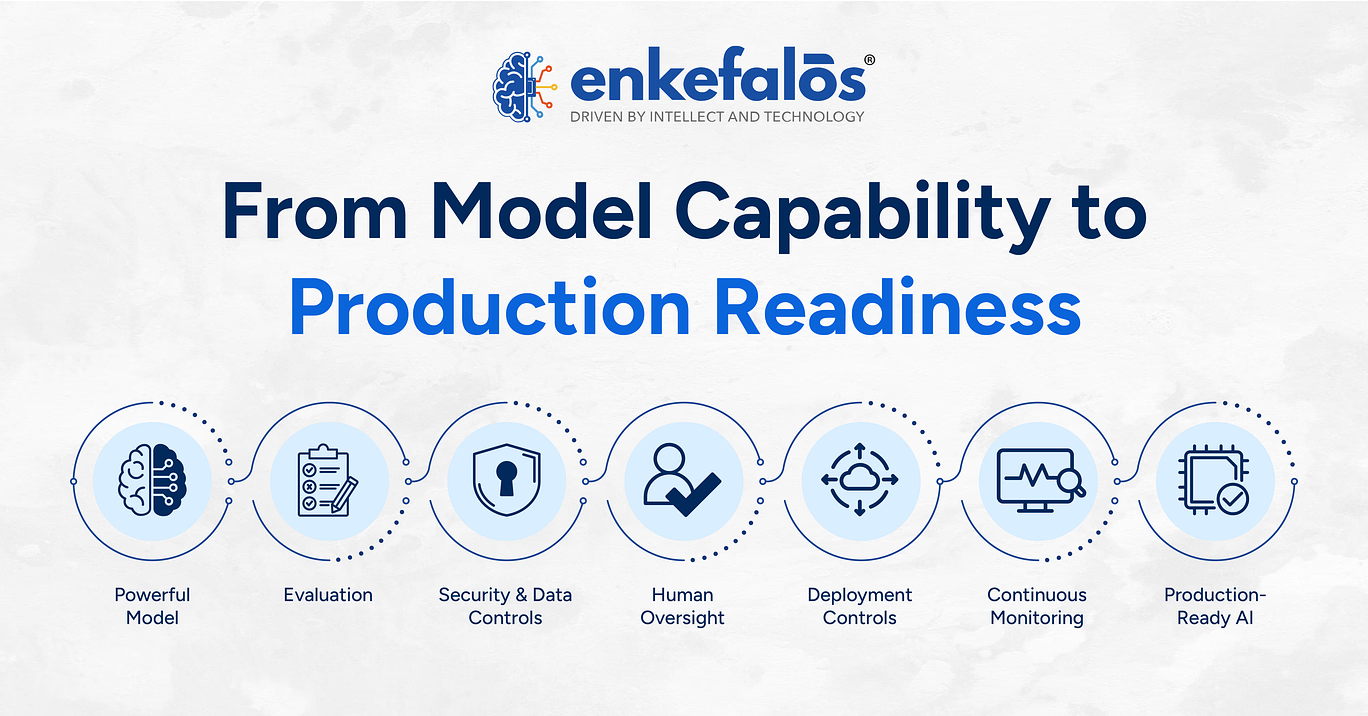
The path from model capability to production-ready AI requires systematic evaluation, security and data controls, human oversight, deployment controls, and continuous monitoring.
Key Risks of Ungoverned Generative AI
Organizations that deploy Generative AI without strong governance may face technical, legal, security, and reputational risks.
| AI Risk | What Can Happen | Governance Control |
| Hallucinations | AI generates incorrect or fabricated information | Accuracy testing and output validation |
| Data leakage | Sensitive or confidential information is exposed | Data governance and access controls |
| Bias | Models produce unfair or discriminatory outputs | Bias testing and dataset review |
| Security vulnerabilities | Attackers manipulate prompts or model behavior | Security testing and monitoring |
| Compliance failures | AI usage violates policies or regulations | Documentation and compliance reviews |
| Model drift | Performance declines as data or conditions change | Continuous production monitoring |
| Poor accountability | Teams cannot determine who owns an AI decision | Defined roles and approval workflows |
These risks become especially important when Generative AI is used in customer-facing applications or high-impact business processes.
Core Components of Governed AI Training
Effective AI governance combines technical controls with organizational processes throughout the entire model lifecycle.
Training Data Controls
Organizations should understand where training and fine-tuning data comes from, whether it is permitted for use, and whether it contains sensitive information.
Data should also be reviewed for quality, duplication, bias, and relevance.
Model Evaluation and Testing
Models should be tested against clearly defined performance standards before deployment.
Evaluation may include:
- Factual accuracy
- Hallucination rates
- Relevance
- Consistency
- Bias and fairness
- Safety
- Robustness
- Latency
- Task completion rates
Versioning and Traceability
Every major model, dataset, prompt, and configuration change should be documented. Traceability helps teams investigate performance problems and reproduce previous versions when necessary.
Continuous Monitoring
Governance does not end when a model enters production. Organizations should monitor model behavior, usage patterns, failures, security incidents, and performance changes over time.
Human Oversight and Accountability
Organizations should define when AI can act autonomously, when human review is required, who can override an AI recommendation, and who remains accountable for business outcomes. Oversight requirements should reflect the risk and impact of the AI use case.
How Governed AI Training Supports Enterprise Compliance
Governed AI training helps enterprises connect how AI systems are developed and used with the controls expected in today’s regulatory and risk-management environment. This includes documenting decisions, assigning accountability, evaluating risk, maintaining human oversight, and keeping evidence that supports internal or external review.
These practices also align with established AI governance frameworks and standards:
- EU AI Act: Introduces risk-based obligations for AI, including requirements around risk management, transparency, human oversight, documentation, and governance for applicable systems.
- NIST AI RMF: Organizes AI risk management around the functions Govern, Map, Measure, and Manage, helping organizations integrate risk considerations throughout the AI lifecycle.
- ISO/IEC 42001: Provides an AI management system framework for establishing structured policies, responsibilities, processes, and continual governance of AI within an organization.
Governed training does not by itself guarantee compliance. It gives enterprises a more structured way to demonstrate how AI risks, responsibilities, and controls are being managed as regulatory expectations evolve.
Business Benefits of Governed AI Training
Governed AI training is not only about reducing risk. It can also improve the speed and quality of enterprise AI adoption.
Faster Production Deployment
When governance processes are standardized, teams do not need to create new approval and testing procedures for every AI project.
Reusable evaluation frameworks, risk classifications, and deployment controls can accelerate production readiness.
Better AI Reliability
Standardized testing and monitoring help organizations identify weak model behavior earlier.
Problems involving hallucinations, inaccurate answers, unsafe responses, or poor data quality can be detected before they affect large numbers of users.
Stronger Enterprise Trust
Customers, employees, executives, and business partners are more likely to trust AI systems when organizations can explain how they are tested, monitored, and controlled.
Easier AI Scaling
Governance creates repeatable processes. Instead of managing every AI project independently, enterprises can establish common standards across multiple models, teams, and business units.
Is Your AI Ready for Production?
Evaluate whether your AI systems have the governance, validation, monitoring, accountability, and operational controls required for enterprise deployment.
Best Practices for Building Production-Ready Generative AI
Organizations building production Generative AI should combine technical engineering practices with governance controls.
Production-ready Generative AI requires governance controls across data, evaluation, access, testing, monitoring, documentation, and human oversight.
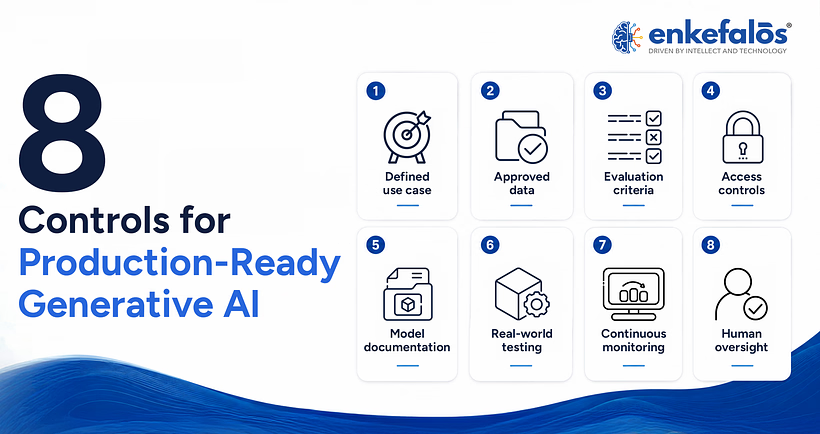
Key best practices include:
- Define a specific AI use case: Identify what the system should do, who will use it, and which outcomes are unacceptable.
- Use approved, high-quality data: Review training, fine-tuning, and retrieval data for accuracy, relevance, privacy, and authorization.
- Establish measurable evaluation criteria: Define acceptable thresholds for accuracy, hallucination, safety, latency, consistency, and business performance.
- Apply role-based access controls: Limit who can change prompts, datasets, model configurations, and production systems.
- Maintain model documentation: Track model versions, evaluation results, known limitations, data sources, and deployment decisions.
- Test real-world scenarios: Evaluate edge cases, adversarial prompts, unexpected user behavior, and business-specific tasks.
- Monitor models continuously: Detect performance degradation, abnormal outputs, security events, and changing data patterns.
- Keep humans involved where necessary: High-impact decisions should include appropriate review, escalation, or approval mechanisms.
Common Mistakes Organizations Make
Several mistakes can weaken AI governance even when formal policies exist.
Treating Governance as a Final Checklist
Governance should begin during AI design and development, not immediately before launching. Adding controls at the end of the project often creates delays and leaves important risks undiscovered.
Focusing Only on the Foundation Model
Production AI systems usually include much more than an LLM. Prompts, retrieval pipelines, vector databases, APIs, business applications, external tools, and user permissions can all introduce risk.
Relying Only on Public Benchmarks
A model may score highly on general benchmarks but still perform poorly on organization-specific tasks. Enterprise evaluations should reflect actual user scenarios and business requirements.
Ignoring Post-Deployment Monitoring
Testing a model once is insufficient. Data changes, model updates, user behavior, and business requirements can alter performance over time.
Failing to Assign Clear Ownership
Organizations sometimes create governance policies without identifying who is accountable for each AI system.
Every production deployment should have clearly defined technical, business, security, and risk owners.
Why AI Governance is Becoming a Competitive Advantage
AI governance is increasingly becoming an enabler of faster and more sustainable AI adoption.
Companies with established governance frameworks can evaluate new models more efficiently because they already have testing standards, approval processes, data controls, and monitoring systems in place.
This can shorten the path from AI experimentation to production.
Governance can also strengthen relationships with enterprise customers and partners. Businesses increasingly want to understand how AI vendors and service providers handle sensitive data, manage AI risks, evaluate model quality, and respond to failures.
Organizations that can provide clear answers may gain an advantage over competitors that cannot demonstrate comparable controls.
Most importantly, governance creates consistency. It allows enterprises to expand AI adoption without relying on different risk-management approaches for every project.
How Enkefalos Approaches Governed Production AI
Enkefalos approaches governed production AI by building governance into how AI systems are designed, evaluated, deployed, and operated. Rather than treating governance as documentation added after deployment, the focus is on maintaining control and accountability throughout the AI lifecycle.
In practice, this means keeping the following controls connected to production AI:
- Defined accountability: Clear roles and decision ownership establish who is responsible for AI use and risk.
- Pre-deployment evaluation: Systems are assessed before production to identify performance, safety, and governance gaps.
- Human oversight: Appropriate approvals and human-in-the-loop controls remain part of AI decisions and learning.
- Continuous evaluation: Performance, drift, bias, and risk signals are monitored as systems operate.
- Traceability and auditability: AI activity and governance evidence remain observable and available for review.
PreFrox, Enkefalos’ Responsible AI Governance Platform, supports this governance layer by helping enterprises maintain policy-driven oversight, accountability, risk management, and ongoing governance as AI moves into production.
Conclusion
Production-ready Generative AI requires more than selecting a powerful LLM. Enterprises need AI systems that are accurate, secure, transparent, traceable, monitored, and aligned with business and compliance requirements.
Governed AI training provides the framework for achieving those goals. By controlling data, testing models systematically, assigning clear ownership, documenting decisions, and monitoring production performance, organizations can reduce AI risk while increasing confidence in deployment.
As Generative AI becomes embedded in critical workflows, strong governance will increasingly separate organizations that simply experiment with AI from those capable of operating it reliably at enterprise scale.
FAQs
- What is governed AI training?
Governed AI training is the process of developing, fine-tuning, testing, and deploying AI models under defined controls for data quality, privacy, security, compliance, risk management, transparency, and accountability.
- Why is AI governance important for Generative AI?
AI governance is important because Generative AI can produce inaccurate, biased, unsafe, or sensitive outputs. Governance creates policies and controls that improve reliability, security, oversight, and accountability.
- How does governed AI training reduce AI risks?
It reduces AI risks through controlled datasets, model evaluations, security testing, access restrictions, human oversight, audit trails, documented approvals, and continuous production monitoring.
- What makes an AI model production ready?
A production-ready AI model is reliable, secure, scalable, monitored, documented, measurable, and capable of meeting defined business requirements under real-world operating conditions.
- What industries benefit most from governed AI training?
Governed AI training is particularly valuable in financial services, healthcare, insurance, government, legal services, telecommunications, manufacturing, and other industries that manage sensitive data or high-impact decisions.
- How does governed AI training support regulatory compliance?
Governed AI training supports compliance through documented data controls, model lineage, risk assessments, access policies, evaluation records, approval workflows, audit trails, and ongoing monitoring.
- What is the difference between AI governance and AI model management?
AI model management primarily covers the technical lifecycle of a model, including development, versioning, deployment, monitoring, and retirement. AI governance is broader and includes organizational policies, accountability, compliance, security, data governance, risk management, and oversight.
- Can governed AI training improve AI accuracy and reliability?
Yes. Strong governance can improve AI accuracy and reliability by enforcing better data-quality standards, structured evaluations, controlled model updates, production monitoring, and corrective processes when performance falls below defined thresholds.
- What is the difference between AI governance and governed AI training?
AI governance is the broader organizational system of policies, roles, controls and accountability governing AI.
Governed AI training applies those governance requirements directly to how models are developed, fine-tuned, evaluated, approved, deployed, and monitored.