


Blog
FAISS: A Guide to Efficient Similarity Search and Applications

Introduction to FAISS
FAISS, or Facebook AI Similarity Search, is an open-source library developed by Meta for efficient similarity search and clustering of dense vectors. It is designed to help applications quickly find similar items within large, high-dimensional datasets, making it useful for vector search, recommendation systems, image search, natural language processing, and other AI applications.
In this article, we explore what FAISS is, how FAISS similarity search works, its key indexing techniques, and its applications across e-commerce, search, recommendation systems, NLP, and computer vision.
How Does FAISS Work?
FAISS, which stands for Facebook AI Similarity Search, is designed to efficiently search and compare high-dimensional vectors. It uses indexes and similarity metrics to identify vectors that are closest to a query vector. Depending on the index type and configuration, FAISS can perform exact or approximate nearest neighbor search while balancing search speed, memory usage, and accuracy. It helps computers quickly find similar things and group them together. This is super handy for tasks where you want to find the most similar items or put similar things in the same group, especially when working with a lot of data in machine learning.
FAISS is designed to work with large datasets and high-dimensional vectors, which are common in fields like computer vision, natural language processing, and recommendation systems. It employs various techniques to accelerate similarity search and make it computationally efficient. Here’s an overview of how FAISS works:
Indexing in FAISS
At the core of FAISS is the concept of indexing. An index is a data structure that helps organize and represent the vectors in a way that facilitates efficient similarity search. FAISS provides different types of indexes, such as the flat index, IVF (Inverted File) index, PQ (Product Quantization) index, and more. Each index type has its strengths and is suitable for different use cases.
Vector Quantization
One of the key techniques used in FAISS is vector quantization, which involves partitioning the vector space into smaller regions and assigning each vector to one of these regions. This allows FAISS to reduce the search space and focus on a smaller subset of vectors that are likely to be similar to the query vector.
Product Quantization
This technique involves splitting the vector into subvectors and quantizing each subvector separately. This can significantly reduce memory usage and improve search efficiency.
Inverted File Index
In the IVF index, vectors are grouped into clusters, and an inverted file structure is used to store information about which vectors belong to each cluster. This helps in quickly narrowing down the search to a specific cluster, reducing the number of vectors that need to be compared for similarity.
Distance Metrics in FAISS
FAISS supports various distance metrics, such as L2 distance (Euclidean distance) and inner product (dot product). These metrics determine the similarity between vectors and are crucial for ranking search results.
FAISS Search Algorithms
FAISS implements different search algorithms optimized for speed and accuracy, such as exact search, approximate search, and hybrid search. These algorithms make use of the indexing techniques to efficiently retrieve the most similar vectors to a query.
GPU Acceleration
FAISS supports GPU acceleration, allowing you to leverage the power of modern GPUs to perform similarity search and clustering even faster.
FAISS and Vector Search
FAISS is commonly used for vector search, where data such as products, images, documents, or text is represented as numerical vectors called embeddings. A query is also converted into a vector, and FAISS searches the index to identify the most similar vectors.
This makes FAISS useful for applications such as semantic search, product recommendations, image similarity search, document retrieval, and other AI-powered search systems. FAISS supports different indexing approaches that allow developers to balance search speed, memory usage, and result accuracy.
FAISS Applications and Use Cases
1. Nearest Neighbor Search
Suppose you have a large dataset of image embeddings, where each image is represented as a high-dimensional vector. You want to find the most similar images to a given query image.
Data Preparation: First, you would create an index using FAISS. You choose an appropriate index type (e.g., IVF or PQ) based on your data and memory constraints. You then add your image embeddings to the index.
Query: When you want to find the nearest neighbors of a query image, you convert the query image into an embedding vector. You then use the FAISS index to perform a similarity search.
Similarity Search: FAISS performs an efficient search using the index. It narrows down the search space by quickly identifying clusters of similar vectors that are likely to contain the nearest neighbors. It then computes the similarity scores between the query vector and the vectors within these clusters.
Results: FAISS returns a list of the nearest neighbor vectors along with their similarity scores. These vectors are the most similar images to the query image based on the chosen distance metric (e.g., L2 distance).
2. Clustering:
Imagine you have a large collection of text documents, each represented as a high-dimensional vector (e.g., TF-IDF or word embeddings). You want to group similar documents into clusters.
Data Preparation: Similar to the previous example, you create an index using FAISS and add the document embeddings to the index.
Clustering: FAISS also provides clustering functionality for grouping vectors based on their similarity. This can be useful for organizing large collections of embeddings, documents, images, or other high-dimensional data.
Query Clusters: Once the clustering is done, you can query the index to retrieve the documents belonging to a specific cluster. This can help you analyze and understand the content of each cluster.
3. FAISS for E-commerce Recommendation Systems:
FAISS can be used in e-commerce recommendation systems to find products that are similar to items a customer has viewed, searched for, or purchased. Product information can be converted into embeddings and stored in a FAISS index, allowing the system to quickly retrieve similar products.
For example, an e-commerce platform can use FAISS to power “Similar Products,” “You May Also Like,” and related product recommendations. When a customer interacts with a product, its embedding can be used as a query to retrieve similar products from the FAISS index.
This approach can help e-commerce platforms build scalable product similarity and recommendation features using vector search.
Data Preparation: You create an index using FAISS and add the item embeddings (e.g., item features or embeddings learned from neural networks) to the index.
Query for Similar Items: When a user interacts with a specific item, you can use FAISS to find the most similar items to that item. This can be useful for suggesting related items to the user.
These examples demonstrate how FAISS can efficiently handle high-dimensional data and perform tasks like nearest neighbor search, clustering, and similarity-based recommendations. It employs indexing, quantization, and efficient search algorithms to make these operations feasible even in large-scale datasets.
4. Content-Based Search:
FAISS is useful for content-based search in various domains, such as searching for similar images, text documents, videos, or audio clips based on their content features.
5. Image Search Engines:
In image search engines, FAISS can accelerate the process of finding visually similar images. This is valuable in reverse image search, where users upload an image to find similar images on the web.
6. Text Similarity and Search:
FAISS can be used to find similar documents or text passages, enabling applications like plagiarism detection, duplicate content identification, and information retrieval.
7. Anomaly Detection:
FAISS can help in identifying anomalies or outliers in high-dimensional data by comparing data points to their nearest neighbors. This is valuable in fraud detection, quality control, and anomaly monitoring.
8. Natural Language Processing (NLP):
In NLP tasks, FAISS can assist in identifying similar sentences or phrases, finding paraphrases, and clustering similar text documents.
9. Genomic Data Analysis:
FAISS has been used in bioinformatics to accelerate the search for similar genetic sequences and DNA fragments, aiding in gene discovery and analysis.
10. Image and Video Compression:
FAISS can be utilized in image and video compression algorithms to group similar data for more efficient storage and retrieval.
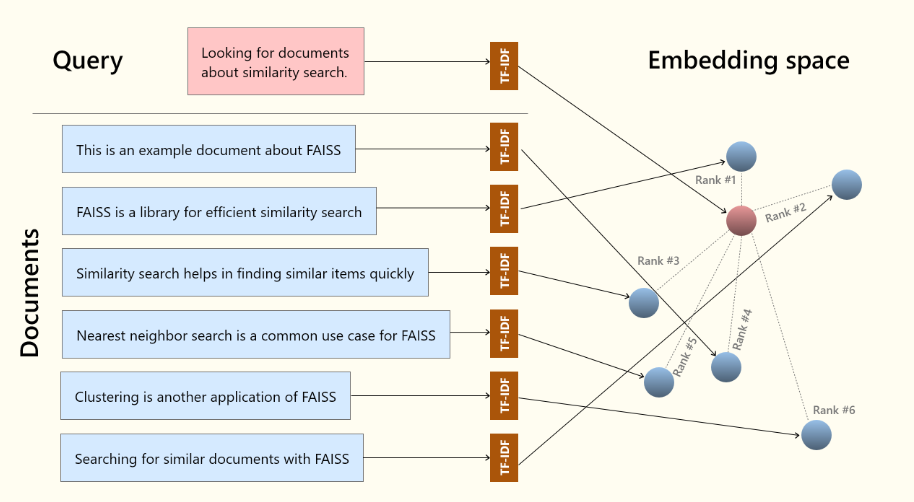
- Practical Implementation (Text Similarity and Search)
- Import required libraries
- Create sample text documents
- Create TF-IDF vectors for the documents (you can use any vectorization method here)
- Create a flat index using Euclidean distance for the TF-IDF vectors
- Perform a query for similar documents
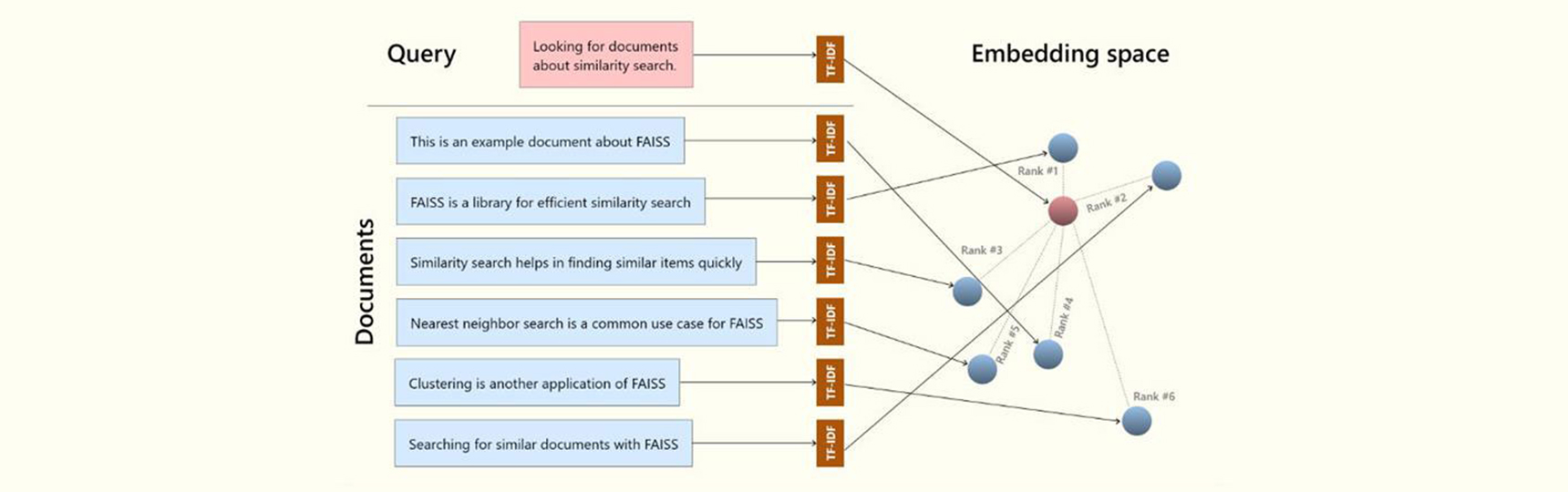
- Workflow Diagram
- Facebook AI Similarity Search workflow diagram Conclusion
In a world inundated with data, the ability to swiftly unearth similarity and patterns is a transformative capability. FAISS, with its cutting-edge algorithms and index structures, paves the way for enhanced user experiences, improved decision-making, and groundbreaking innovations. From recommendation systems to NLP applications and beyond, FAISS empowers us to navigate the complex realm of high-dimensional data, opening doors to uncharted possibilities. As we continue our journey into the future of AI, FAISS stands as a testament to the remarkable strides we’ve taken in the pursuit of efficient similarity search.
Conclusion
FAISS has become an important tool for efficient similarity search and clustering of high-dimensional vectors. By using indexing, quantization, and optimized search techniques, FAISS enables applications to quickly identify similar data across large datasets.
From e-commerce product recommendations and content-based search to image retrieval, NLP, and anomaly detection, FAISS supports a wide range of AI and machine learning applications. Its ability to handle large-scale vector data efficiently makes it particularly useful for businesses building AI-powered search and recommendation systems.
As vector search continues to become an important part of modern AI applications, FAISS provides a flexible foundation for building fast and scalable similarity search solutions. Whether used for product recommendations, semantic search, or other AI-driven applications, FAISS can help businesses turn high-dimensional data into more relevant and efficient search experiences.
FAQs
What is FAISS?
FAISS, or Facebook AI Similarity Search, is an open-source library for efficient similarity search and clustering of dense vectors. It is developed primarily by Meta’s Fundamental AI Research group.
What is FAISS used for?
FAISS is used for nearest neighbor search, vector search, clustering, recommendation systems, image similarity search, text retrieval, NLP applications, and other applications involving high-dimensional vectors.
Can FAISS be used for e-commerce?
Yes. FAISS can be used to identify similar products and support product recommendation systems by searching product embeddings for similar vectors.
Is FAISS a vector database?
FAISS is primarily a similarity search and clustering library rather than a full-featured vector database. It provides indexing and search functionality for vector data, while vector databases generally provide additional capabilities such as persistence, metadata filtering, distributed operation, and database management features.
Does FAISS support Python?
Yes. FAISS provides Python wrappers, allowing developers to build and search FAISS indexes using Python.
Does FAISS support GPU acceleration?
Yes. FAISS provides GPU implementations for several algorithms, allowing similarity search and clustering workloads to use GPU acceleration.