


Blog
How US Insurance Companies Can Use AI to Analyze Unstructured Data

Insurance companies process large volumes of information every day, from underwriting submissions and claims reports to customer emails, photographs, and medical records. Much of this information exists in unstructured formats that traditional data systems cannot readily interpret. As a result, valuable details can remain scattered across documents and disconnected applications, requiring employees to spend time reviewing, extracting, and reconciling information manually.
Artificial intelligence (AI) offers a way to address this challenge. AI for insurance companies can help automate document analysis and improve access to information across business workflows. Natural language processing, document intelligence, and multimodal AI can help insurers interpret different content types, extract relevant information, and connect findings with established business workflows. However, processing sensitive insurance data also requires reliable validation, access controls, and regulatory oversight.
For insurance carriers, the opportunity is not simply to process more documents. It is to turn fragmented information into usable intelligence that supports underwriting, claims management, and operational decisions without compromising data governance or human accountability.
What Is Unstructured Data in Insurance?
Unstructured data refers to information that does not follow a predefined tabular structure suitable for direct processing by conventional databases.
Insurance companies encounter unstructured information across policy administration, underwriting, claims management, and customer servicing. Common examples include:
- Underwriting documents: Broker emails, inspection reports, risk descriptions, and supporting applications.
- Claims records: Adjuster notes, incident descriptions, photographs, and correspondence.
- Policy documents: Contracts, endorsements, exclusions, and coverage descriptions.
- Medical information: Physician notes, attending physician statements, and other authorized health records.
- Customer interactions: Emails, call transcripts, complaints, and service requests.
Some insurance documents also contain semi-structured data, such as tables, standardized forms, or fields embedded within PDFs.
The challenge is that important information may be distributed across different formats. A claims record, for example, may include structured policy information alongside photographs, handwritten notes, and narrative descriptions.
Why Is Unstructured Insurance Data Difficult to Analyze?
Traditional insurance applications are generally designed to process structured fields, predefined transactions, and standardized records. Unstructured information requires additional interpretation before it can support these systems.
Three challenges frequently affect insurance data analysis.
Inconsistent Document Formats
Insurance documents vary by provider, business line, and submission channel. The same information may appear in different locations, formats, or terminology.
Fixed extraction rules may struggle when document layouts change, or required information appears within narrative text.
Fragmented Enterprise Information
Information relevant to one insurance case may exist across document repositories, claims platforms, email systems, and policy administration applications.
Without consistent identifiers and controlled data access, employees may need to reconcile information manually.
Data Quality and Context
Extracting a figure or sentence does not necessarily establish its business meaning.
For example, a policy document may contain several coverage limits, exceptions, and effective dates. An AI system must associate extracted values with the correct provisions rather than treating them interchangeably.
These challenges explain why insurance document analysis requires contextual interpretation alongside data extraction.
How Does AI Analyze Unstructured Insurance Data?
AI analyzes unstructured insurance data through a combination of content recognition, language interpretation, information extraction, and contextual analysis.
Different techniques address different data types and business requirements.
The following table explains the main AI technologies used to analyze unstructured insurance information and their practical applications.
|
AI technology |
Primary function |
Insurance application |
|
Optical character recognition (OCR) |
Converts text in scanned images into machine-readable text |
Digitizing scanned forms and correspondence |
|
Natural language processing (NLP) |
Analyzes and classifies written language |
Interpreting claim notes and customer emails |
|
Intelligent document processing (IDP) |
Combines extraction, classification, and validation |
Processing underwriting submissions |
|
Multimodal AI |
Processes combinations of text, images, and other supported modalities |
Reviewing documents containing photographs and text |
|
Generative AI |
Summarizes and interprets content |
Preparing policy summaries and document responses |
These technologies can work together within a document processing pipeline.
Document Classification and Information Extraction
AI can identify document types and extract configured fields, such as policy numbers, dates, insured names, coverage limits, and claim references.
Effective insurance document processing helps organize extracted information for further validation and workflow use.
Extracted information can then be validated against predefined rules or authoritative business records.
Contextual Interpretation and Summarization
Language models can identify relevant clauses, summarize lengthy reports, and answer questions using supplied documents.
Retrieval-augmented generation (RAG) can provide additional context from authorized enterprise sources.
However, generated summaries and extracted findings require validation, particularly when documents contain conflicting or incomplete information.
Connecting Information Across Documents
AI-supported search and relationship mapping can help users identify connections between related records.
For example, an analyst may need to review a policy, its endorsements, and associated claims correspondence to understand the context of a coverage question.
The underlying documents should remain accessible so employees can verify the information supporting an AI-generated response.
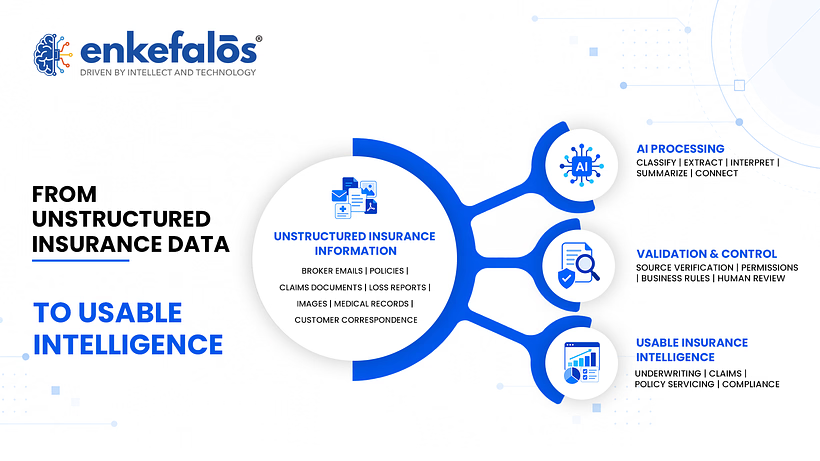
AI can transform fragmented insurance documents and other unstructured information into usable business intelligence through classification, extraction, contextual interpretation, validation, and controlled workflow integration.
Where Can Insurers Apply AI to Unstructured Data?
Unstructured data analysis can support several insurance functions. The value depends on the information available, the complexity of the workflow, and the level of accuracy required.
Underwriting and Risk Assessment
Underwriters regularly review applications, inspection reports, loss histories, and broker correspondence.
AI can extract relevant attributes, identify missing documents, summarize risk information, and organize submission packages.
For commercial insurance, this may involve identifying insured locations, reported exposures, historical losses, and other relevant details across multiple attachments.
These capabilities support underwriting preparation, while risk assessment and acceptance remain subject to established underwriting authority. AI underwriting tools can further support the review and organization of complex insurance submissions.
Claims Intake and Investigation
Claims files combine incident descriptions, photographs, adjuster notes, invoices, and policy information.
AI can classify incoming materials, extract relevant details, and prepare summaries for claims professionals.
For example, an AI application might identify the reported incident date, involved parties, and supporting documents.
The system should distinguish extracted facts from interpretations or unresolved discrepancies. Adjusters remain responsible for evaluating information and making authorized claims decisions.
Customer Service and Policy Administration
Service representatives often need to review policy documents, correspondence, and historical requests before responding to customers.
AI-assisted knowledge retrieval can help locate relevant provisions and prepare draft responses.
Document classification can also support routing requests to appropriate service teams.
Responses involving coverage interpretations or consequential policy changes require additional validation.
Compliance and Document Review
Insurance compliance teams review internal policies, regulatory materials, contracts, and operational records.
AI can assist by locating relevant passages, comparing document versions, and identifying information requiring further examination.
These applications can support review activities but do not independently establish regulatory compliance.
How Can Insurance Companies Implement AI-Based Unstructured Data Analysis?
Successful implementation requires a defined business use case, reliable information processing, and integration with existing insurance systems.
A phased approach allows insurers to evaluate accuracy and operational value before expanding deployment.
Step 1: Identify the Documents and Business Problem
Start with a specific workflow, such as extracting information from underwriting submissions or organizing claims correspondence.
Identify which documents the workflow uses, what information employees need, and how the findings support downstream activities.
Step 2: Assess Data Quality and Accessibility
Review document formats, completeness, duplication, access restrictions, and available metadata.
Determine whether scanned materials require OCR, and whether different repositories use consistent identifiers.
Poor-quality source documents can affect extraction accuracy regardless of the AI model selected.
Step 3: Select Appropriate AI Techniques
Choose technologies according to document characteristics and analytical requirements.
OCR may be sufficient for recognizing scanned text, while NLP and document intelligence can support classification and extraction.
AI document processing can combine these techniques to extract and organize information from different document formats.
Multimodal models may be useful when tasks require interpreting both images and accompanying text.
Model selection should consider accuracy, privacy requirements, processing costs, and deployment constraints.
Step 4: Validate Extracted Information
Establish checks for important fields, ambiguous content, and missing information.
Validation may combine business rules, comparisons with authoritative records, confidence indicators, and human review.
A system should flag uncertain results rather than silently inserting unsupported information into insurance records.
Step 5: Integrate Findings with Existing Workflows
Connect validated information to approved applications through application programming interfaces (APIs), middleware, or controlled data services.
Maintain separation between extracting information and authorizing consequential business actions.
Integration should also preserve source references, access permissions, and relevant audit records.
Step 6: Pilot and Monitor Performance
Test the solution using representative documents, including complex layouts, low-quality scans, and unusual cases.
Measure extraction quality, review effort, exception rates, and processing time.
After deployment, monitor performance as document formats, business requirements, and data sources change.
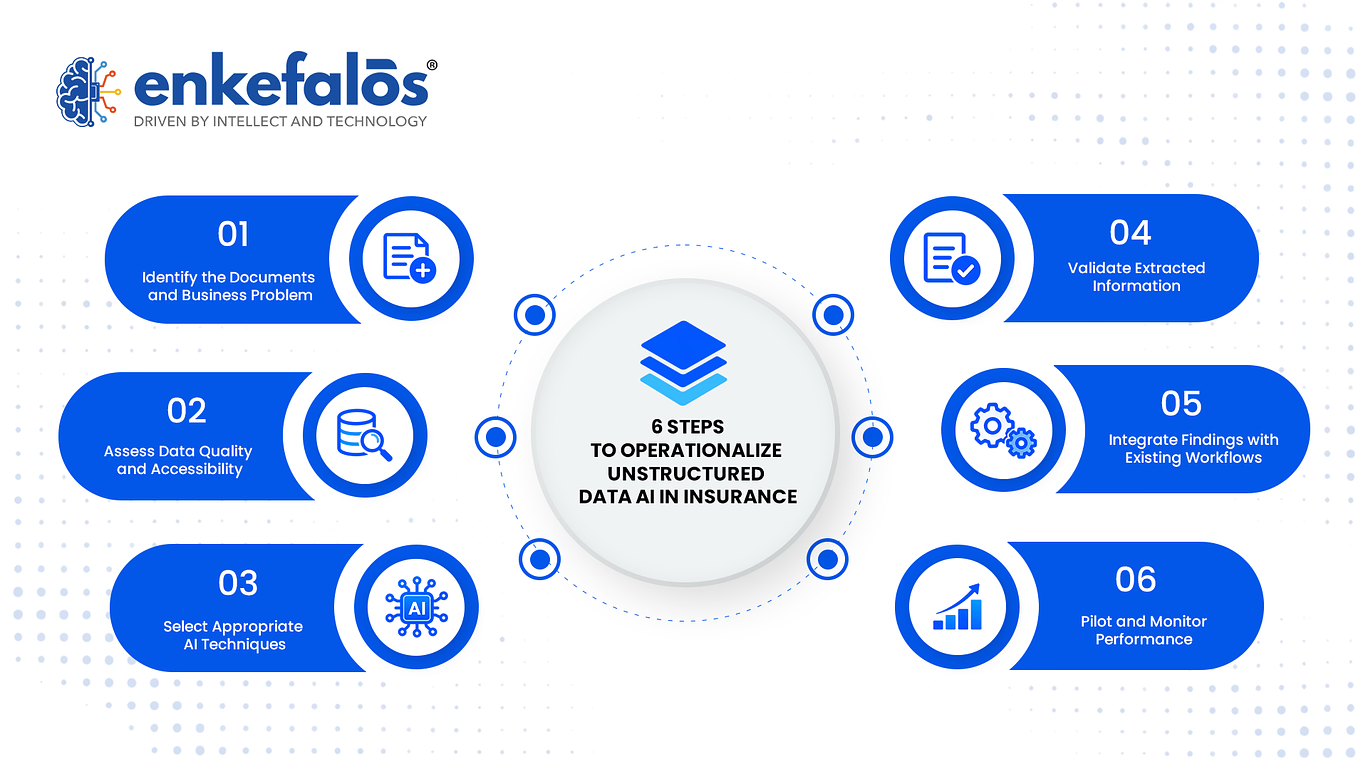
Insurers can introduce AI for unstructured data progressively, starting with a defined business problem and moving through data assessment, technology selection, validation, workflow integration, and controlled production monitoring
Turn Unstructured Insurance Data Into Usable Intelligence
Evaluate where AI can reduce manual document review, improve information access, and support existing insurance workflows while maintaining validation and human oversight.
How Can Insurers Maintain Data Security and Regulatory Oversight?
Unstructured insurance information can contain personal, financial, medical, and commercially sensitive data. AI processing therefore requires appropriate controls across ingestion, storage, model interactions, and downstream workflows.
In the United States, insurance regulation is primarily state based. The National Association of Insurance Commissioners (NAIC) adopted its Model Bulletin on the Use of Artificial Intelligence Systems by Insurers in December 2023.
The bulletin describes supervisory expectations for AI governance, risk management, and documentation. It is not itself a nationwide binding regulation, and insurers must evaluate requirements applicable to their jurisdictions.
The National Institute of Standards and Technology (NIST) AI Risk Management Framework also provides voluntary guidance for identifying, measuring, and managing AI risks.
Key Controls for Insurance Document AI
A governed implementation should address:
- Data access: Restrict access to documents and extracted information to authorized users and services.
- Sensitive information: Apply appropriate encryption, retention, and data handling controls.
- Source traceability: Retain links between extracted findings and supporting documents.
- Human oversight: Require review when results are uncertain or could affect consequential decisions.
- Model evaluation: Test performance across representative document types and business scenarios.
- Operational monitoring: Track errors, exceptions, unauthorized access attempts, and changing model performance.
Private or enterprise-controlled AI deployments can provide additional control over processing environments, but deployment location alone does not establish security or regulatory compliance.
How Can Occiplex Support Enterprise Document Intelligence?
As insurers expand unstructured data analysis, extracting individual fields may no longer be sufficient. Teams also need to locate related documents, understand relationships across records, and connect information with authorized business workflows.
Enkefalos positions Occiplex as an Intelligent Document Processing platform designed to help enterprises understand, process, and work with information across documents and other unstructured content. According to its published product information, Occiplex supports interpretation of documents including PDFs, forms, tables, and images, alongside natural-language search, knowledge relationships, and workflow capabilities. These functions are relevant to insurers seeking to make fragmented enterprise information more accessible while maintaining controlled data environments. Specific integration, accuracy, and deployment requirements should be validated against the insurer’s documents and operational needs.
Make Enterprise Documents Easier to Understand and Use
Bring document understanding, contextual discovery, source visibility, and controlled enterprise knowledge access into document-heavy workflows.
How Should Insurers Measure Unstructured Data AI Performance?
Document processing speed alone does not demonstrate whether an AI implementation is effective.
Insurers should evaluate how reliably the technology extracts information and supports business workflows.
Useful performance indicators include:
- Field extraction accuracy: Correctness of extracted values against verified reference documents.
- Document classification accuracy: Ability to assign records to the correct categories.
- Human correction rate: Frequency of manual changes to AI-generated results.
- Exception rate: Documents requiring additional investigation or processing.
- Processing time: Time required to prepare information for business use.
- Source traceability: Availability of evidence supporting extracted or summarized information.
- Operational impact: Changes in manual effort, rework, and workflow completion time.
Evaluation should include representative documents rather than relying only on clean, standardized examples.
Insurers should also monitor performance separately for high-impact fields and document categories. An acceptable average extraction score can conceal errors involving important coverage details or financial values.
What Should Insurers Consider Before Scaling Document AI?
Scaling unstructured data analysis requires consistent information management and clear operational accountability.
Three considerations are particularly important.
- Data standardization: Common document categories, field definitions, and identifiers help connect extracted information across enterprise applications.
- Reusable controls: Shared validation rules, access policies, and monitoring procedures can reduce inconsistencies between AI projects.
- Operational ownership: Teams need clear responsibility for document quality, model changes, exception handling, and incident response.
These foundations support a transition from isolated extraction tools toward governed enterprise document intelligence.
Conclusion
AI can help insurance companies turn unstructured documents, images, and communications into information that supports underwriting, claims management, and policy servicing. The greatest value comes from combining accurate extraction, contextual interpretation, and reliable connections to existing business systems.
A phased approach allows insurers to evaluate document quality, establish governance controls, and measure operational improvements before expanding deployment. Human review, source traceability, and ongoing monitoring remain essential as AI becomes part of everyday insurance workflows.
Frequently Asked Questions
What is unstructured data in insurance?
Unstructured data includes insurance information that does not follow a predefined tabular format, such as emails, claims notes, photographs, policy documents, and medical reports. It often requires additional processing before conventional systems can analyze it.
How can AI analyze unstructured insurance documents?
AI can use OCR, NLP, intelligent document processing, and multimodal models to recognize content, classify documents, extract relevant information, and generate summaries. Results should be validated against source records.
What is the difference between OCR and intelligent document processing?
OCR converts text in images into machine-readable characters. Intelligent document processing combines recognition with techniques such as document classification, information extraction, and validation to produce usable data.
Can generative AI extract information from insurance policies?
Generative AI can identify and summarize policy information, including provisions, exclusions, and coverage details. Accuracy depends on document quality, task design, and validation against the original policy.
How can AI help insurance underwriters analyze unstructured data?
AI can organize submission documents, extract relevant attributes, identify missing information, and summarize supporting records. Underwriters can use these findings while retaining responsibility for authorized risk decisions.
Can AI analyze photographs and handwritten insurance documents?
Suitable multimodal models and document recognition technologies can process photographs and handwritten content. Performance varies with image quality, handwriting, document format, and model capabilities.
What are the risks of using AI for insurance document analysis?
Risks include incorrect extraction, missing context, sensitive information exposure, inconsistent results, and inadequate traceability. Insurers should implement validation, access controls, monitoring, and appropriate human oversight.
How can insurers measure the accuracy of AI document processing?
Insurers can compare extracted values and document classifications with verified reference records. Useful metrics include precision, recall, field-level accuracy, exception rates, and human correction frequency.