


Blog
Private AI for Financial Services: Security, Governance and Data Control

For financial institutions, the question is not only whether AI can use sensitive data. It is who controls that data, the model, and the decisions AI influences.
Private AI gives financial institutions greater control over how AI models, data, infrastructure, and workflows are deployed and managed. Instead of relying entirely on externally hosted AI environments, banks, insurers, investment firms, and other financial organizations can use private AI within controlled on-premises, private-cloud, or hybrid environments, depending on their architecture and business requirements.
For financial services, this approach can support AI use cases such as fraud analysis, document processing, internal knowledge retrieval, risk and compliance workflows, and customer-service assistance while maintaining greater control over sensitive data, model access, governance, and auditability. This guide explores how private AI works in financial services, its role in security and data governance, common deployment models and control considerations, and the factors financial institutions should evaluate before adopting it.
Why Financial Services Need a Different Approach to AI
Financial institutions work with information that can include personally identifiable information, account records, transactions, credit information, claims data, and proprietary financial models. Using this information with AI creates a different risk profile from using AI for general-purpose content generation.
The Financial Stability Institute noted in March 2026 that data privacy, quality and security remain important barriers to wider AI adoption in financial services, with risks further complicated by reliance on third-party providers.
Financial organizations therefore need to consider questions such as:
- Where does sensitive data go when an AI model processes it?
- Who can access prompts, outputs, and model logs?
- Can business data be used to train or improve another provider’s model?
- Which employees or AI agents can retrieve particular records?
- Can the institution trace how an AI-assisted outcome was produced?
- How are models evaluated before and after deployment?
- Private AI gives financial institutions an architectural option for addressing these questions while keeping greater control over the AI environment.
What Is Private AI?
Private AI is an approach to deploying and operating AI in which an organization maintains defined control over its data, models, infrastructure, access, AI workflows, and intellectual property.
Depending on the architecture, private AI may run on premises, within a private cloud or in a controlled hybrid environment.
Private AI does not mean that every model must be developed from scratch. Financial institutions can use suitable foundation models, fine-tuned models or retrieval-augmented generation (RAG) while controlling where those models run and what enterprise information they can access.
It is also important to distinguish privacy by architecture from guaranteed security. Running AI privately does not automatically make an AI system secure, accurate, compliant, or unbiased. Access controls, evaluation, monitoring, data governance, and human oversight are still required.
The Three Pillars of Private AI in Financial Services
For financial institutions, the value of private AI can be understood through three connected pillars.
-
Security
Private architectures can limit exposure by keeping models, sensitive datasets and AI workloads within defined organizational boundaries.
Security controls may include encryption, identity and access management, network isolation, least-privilege access and restrictions on which knowledge sources models or agents can retrieve.
This is particularly relevant because OWASP identifies sensitive-information disclosure as a major risk for LLM applications and advises organizations to control access to sensitive data and external data sources.
-
Governance
Financial institutions need to understand which AI systems are operating, who owns them, how they were evaluated and what happens when models or policies change.
Private AI can make it easier to connect AI deployment with internal approval processes, model evaluation, version control, monitoring, and human review.
-
Data Control
Data control determines where information resides, who can use it and for what purpose.
A private AI environment can help institutions establish rules for training data, RAG knowledge sources, prompts, outputs, logs, model feedback and retention rather than sending these assets through uncontrolled AI services.
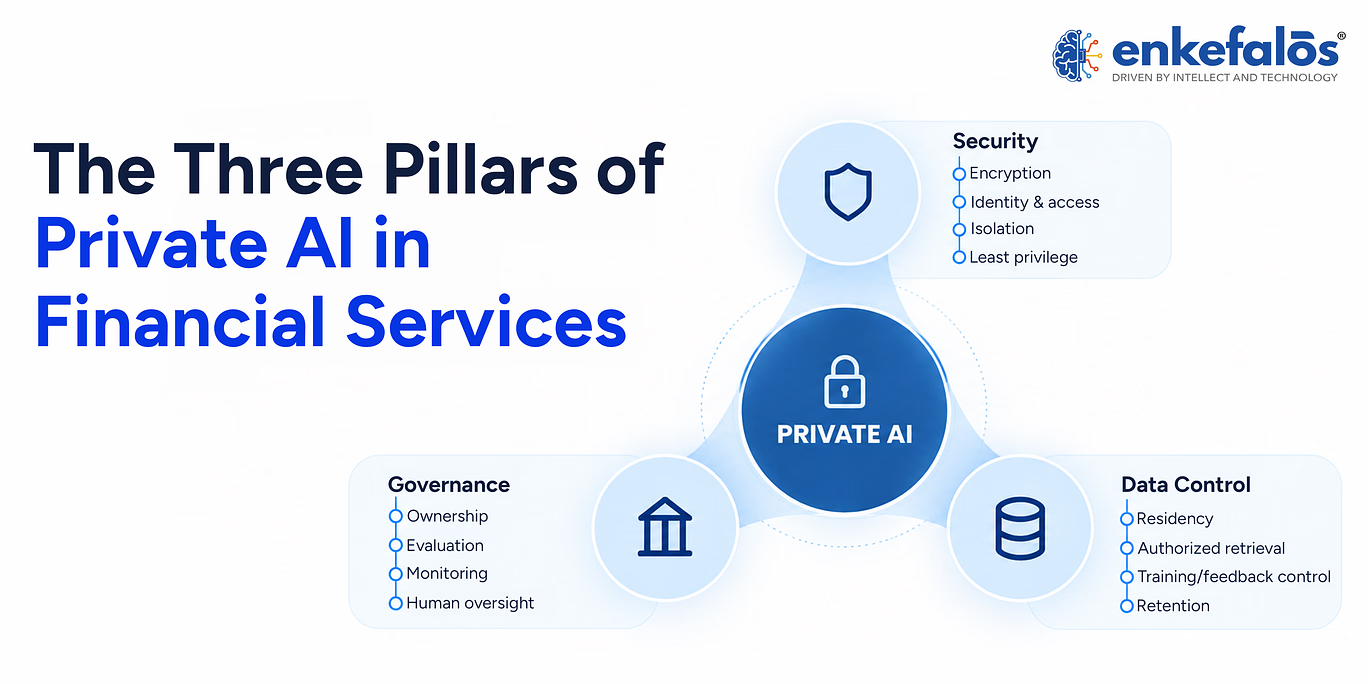
Private AI in financial services depends on three connected foundations: security, governance, and control over how sensitive enterprise data is accessed and used.
Where Private AI Can Be Used in Financial Services
Private AI can support both employee-facing and operational financial workflows.
|
Use Case |
How Private AI Can Support It |
| Internal knowledge retrieval | Allow employees to search policies, procedures, research and approved internal documents using RAG |
| Fraud and financial-crime support | Analyze patterns, alerts and case information within controlled data environments |
| Document processing | Extract and classify information from financial statements, forms, contracts and other documents |
| Risk and compliance analysis | Help teams review policies, reports, transactions or regulatory information |
| Customer-service assistance | Help authorized staff retrieve approved information for customer inquiries |
| Credit or underwriting support | Assist analysts with information retrieval and assessment while maintaining appropriate human and regulatory controls |
| Operational automation | Support repetitive workflows involving internal data and business systems |
The appropriate level of automation depends on the use case and applicable regulations. Private deployment by itself does not remove requirements relating to fairness, explainability, accountability, or human oversight.
Is Your Financial AI Environment Ready for Private AI?
Assess where greater data control, governance, private deployment, and human oversight could reduce risk as AI moves into financial workflows.
How Private AI Improves Data Governance
Private AI can give financial institutions more choices about how enterprise data interacts with AI.
Control Data Access
Access can be tied to user roles, applications, or AI agents so that a model retrieves only information authorized for a particular task.
Separate Enterprise Knowledge
RAG systems can use controlled knowledge repositories rather than placing large amounts of enterprise information directly into model training.
Maintain Data and Model Lineage
Organizations can track which datasets, knowledge sources, model versions, and policies contribute to an AI workflow or output.
Control Training and Feedback
Human feedback and operational data can be reviewed before being incorporated into future model improvements instead of automatically becoming training material.
These controls matter because financial supervisors increasingly view AI data management as part of wider privacy, security, and operational-resilience concerns.
Governance Challenges Financial Institutions Must Solve
Private infrastructure solves only part of the problem. Financial institutions still need a governance framework around the AI running inside it.
Model and Output Risk
Teams need methods for testing accuracy, consistency, inappropriate outputs, and performance changes before and after deployment.
Explainability and Auditability
For higher-impact financial decisions, institutions may need evidence showing what model was used, which data informed the output and where human review occurred.
Bias and Fairness
Keeping a model private does not remove bias from training data or AI decisions. Organizations still need appropriate testing and review.
Regulatory Classification
Rules vary by jurisdiction and use case. Under the EU AI Act, for example, certain systems used to evaluate the creditworthiness of natural persons or establish credit scores are classified as high-risk, subject to specific conditions and exceptions.
Private AI should therefore be considered part of an AI governance strategy, not a replacement for one.
Building a Private AI Strategy for Financial Services
A private AI strategy should begin with business and risk requirements rather than infrastructure.
-
Prioritize AI Use Cases
Identify where AI can solve a meaningful business problem and determine the consequences if the system produces an incorrect or inappropriate result.
-
Classify the Data
Map the customer, transactional, proprietary and regulatory information each AI workload needs.
-
Define the Trust Boundary
Decide where models, data, vector databases, logs and applications can run, and which external services, if any, can interact with them.
-
Establish Governance
Assign ownership and define approval, access, evaluation, monitoring, human-review and escalation requirements.
-
Evaluate Before Production
Test models against relevant business tasks, safety requirements, and known failure scenarios before deployment.
-
Monitor After Deployment
Continue evaluating outputs, policy violations, model changes and data usage once the system enters production.
This lifecycle approach is consistent with the NIST AI Risk Management Framework, which encourages organizations to manage AI risks across design, development, deployment, use and evaluation rather than treating risk review as a one-time exercise.
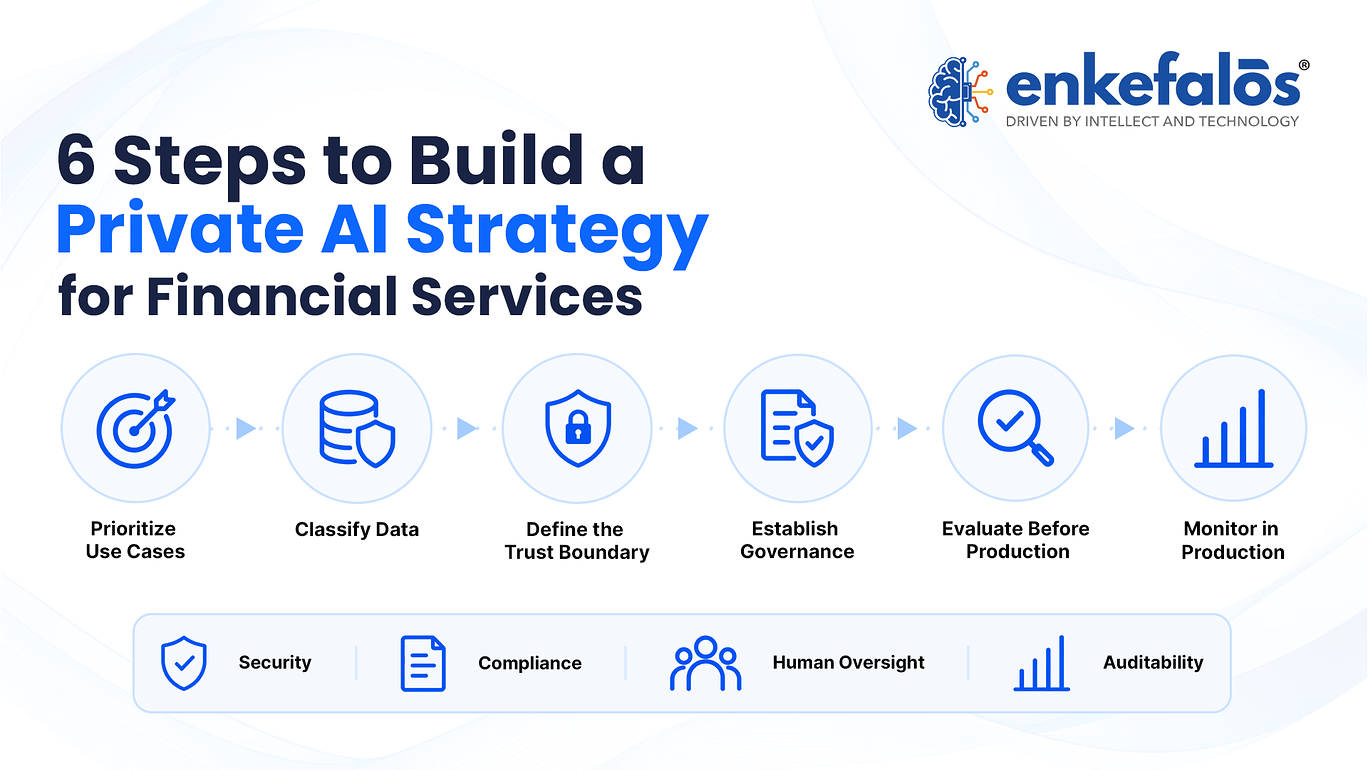
A financial-services Private AI strategy should progress from use-case and data classification through trust boundaries, governance, pre-production evaluation, and continuous production monitoring.
Conceptual Layers of Private AI Environment
A private AI environment for financial services can be understood through several conceptual layers.
|
Layer |
Purpose |
| Enterprise data layer | Customer records, transactions, documents, policies and approved knowledge |
| AI/model layer | Foundation models, domain models, embeddings and model endpoints |
| RAG and knowledge layer | Controlled retrieval of enterprise information |
| Governance and control layer | Identity, policies, guardrails, evaluation, versioning, audit and monitoring |
| Application layer | Employee assistants, risk tools, document workflows and AI agents |
| Infrastructure layer | On-premises, private-cloud or hybrid compute and storage |
The architecture should keep clear boundaries between who is requesting information, what data they can access, which model can process it, and what the AI is permitted to do.
Private AI vs. Externally Hosted Enterprise AI
Private AI is not a completely different type of artificial intelligence. The difference primarily concerns deployment, ownership, and control.
|
Area |
Private AI |
Externally Hosted Enterprise AI |
| Infrastructure | On-premises, private cloud or controlled hybrid environment | Primarily provider-managed infrastructure |
| Data boundary | Defined by the enterprise architecture | Data may cross into provider infrastructure |
| Model control | Greater enterprise control over models and configurations | Depends heavily on provider offering |
| Training and feedback | Can remain under enterprise-controlled processes | Depends on contractual and service settings |
| Customization | Can support domain-specific tuning and private RAG | Usually depends on platform capabilities |
| Governance | Can be embedded across the private AI lifecycle | Often shared between enterprise and provider |
| Operational responsibility | Greater responsibility remains with the enterprise | More infrastructure responsibility may sit with the provider |
Neither model is automatically right for every workload. The choice should depend on data sensitivity, regulatory requirements, technical capability, cost, use case, and the level of control the institution requires.
What Financial Leaders Should Evaluate Before Adopting Private AI
Adopting private AI requires more than choosing where a model will run. Financial leaders need to assess how the proposed environment handles sensitive data, governance, infrastructure, existing systems, and ongoing AI operations.
Data Residency and Control
Start with where customer data, transaction records, prompts, outputs, logs, and model data will be stored and processed. The architecture should clearly define which information remains within the organization’s controlled environment and whether any data is shared with external services.
Governance and Auditability
Private AI should support clear ownership, access controls, model evaluation, version tracking, monitoring, and audit records. Financial institutions should be able to trace which models and data sources were involved in important AI workflows and identify when changes were made.
Deployment and Infrastructure Requirements
The deployment model should match the institution’s technology environment. This may include on-premises infrastructure, private cloud, or a hybrid approach. Compute requirements, scalability, model updates, and operational support should also be considered.
Integration with Existing Financial Systems
Private AI needs to work with existing identity systems, data platforms, business applications, and approved knowledge sources. Poor integration can create additional silos rather than improving control.
Ongoing Operational Responsibility
Private deployment gives an organization greater control, but it also creates greater responsibility for model monitoring, security controls, updates, evaluation, and governance. Financial leaders should understand which responsibilities remain with internal teams, and which are handled by technology providers.
A suitable private AI approach should therefore be evaluated not only by how securely it hosts a model, but by how well it supports data control, governance, integration, and ongoing AI management across the financial organization.
How Enkefalos Helps Financial Enterprises Adopt Private AI
For financial institutions, adopting private AI is not only about keeping models inside a private environment. It also requires control over how sensitive data is used, how models are evaluated, how knowledge is retrieved, and how AI systems are governed after deployment.
Enkefalos addresses these requirements through GenAI Foundry, its private AI control plane. The platform is designed to support AI development and production within on-premises, private-cloud, and hybrid environments, allowing financial enterprises to keep greater control over their models, proprietary data, and AI workflows.
For financial use cases, GenAI Foundry can support several parts of the AI lifecycle in one governed environment:
- Controlled enterprise data use: Financial data can be prepared and used within defined private environments rather than being distributed across disconnected AI services.
- Governed knowledge retrieval: RAG and knowledge-management capabilities can help AI applications access approved internal policies, documents, and business information.
- Model evaluation before deployment: Teams can compare and evaluate model versions before deploying them into production of financial workflows.
- Runtime controls: Guardrails and monitoring can help organizations apply policies while AI applications are operating.
- Version and deployment management: Controlled releases and rollback capabilities provide greater oversight when models or configurations change.
- Human-supervised improvement: Reinforcement Learning from Human Feedback (RLHF) can support controlled model improvement where human review remains part of the process.
This approach allows financial enterprises to treat private AI as a governed operating environment, rather than simply a privately hosted model. It connects data control, model management, evaluation, deployment, and oversight within the same governed AI operating environment.
Build Private AI Without Losing Operational Control
Bring data governance, model evaluation, controlled deployment, monitoring, and human oversight into a private AI environment designed for enterprise production.
Conclusion
Financial institutions have strong reasons to use AI, but they also operate under requirements that make uncontrolled AI adoption difficult.
Private AI offers an approach for keeping greater control over data, models, infrastructure, access and AI workflows while still enabling financial institutions to use technologies such as generative AI, RAG, and AI agents.
The important distinction is that private AI is not simply about keeping a model behind a firewall. A workable private AI strategy also requires governance, evaluation, auditability, access control, and human oversight throughout the AI lifecycle.
FAQs: Private AI for Financial Services
1. What is Private AI for financial services?
Private AI allows financial institutions to operate AI within controlled infrastructure while maintaining defined control over their data, models, access, workflows, and governance.
2. Why is Private AI important for banks and financial institutions?
It can help institutions use AI while maintaining greater control over sensitive financial data, model access, governance, auditability, and deployment.
3. How does Private AI protect sensitive financial data?
Private AI can keep data within defined enterprise environments and apply controls such as restricted access, private retrieval, network isolation, and governed data use.
4. What is the difference between Private AI and Public AI?
Private AI emphasizes enterprise-controlled deployment, data boundaries, and governance, while public or externally hosted AI services typically operate on provider-managed infrastructure. The actual level of data control and security depends on the provider, configuration, and contractual terms
5. Does Private AI prevent customer data from being used to train AI models?
It can be designed to prevent customer data from entering training workflows, but this depends on the architecture, configuration, and governance policies the institution implements.
6. Does Private AI guarantee regulatory compliance?
No. Private AI can provide greater control over data, infrastructure, access, and model operations, but compliance still depends on the use case, applicable regulations, governance controls, testing, documentation, and human oversight.
7. What financial services use cases are suitable for Private AI?
Private AI can support use cases such as internal knowledge search, document processing, fraud and financial-crime analysis, risk and compliance workflows, customer-service assistance, credit or underwriting support, and other workflows involving sensitive financial information.