


Blog
AI Document Processing in Insurance: Automating Claims and Underwriting with AI

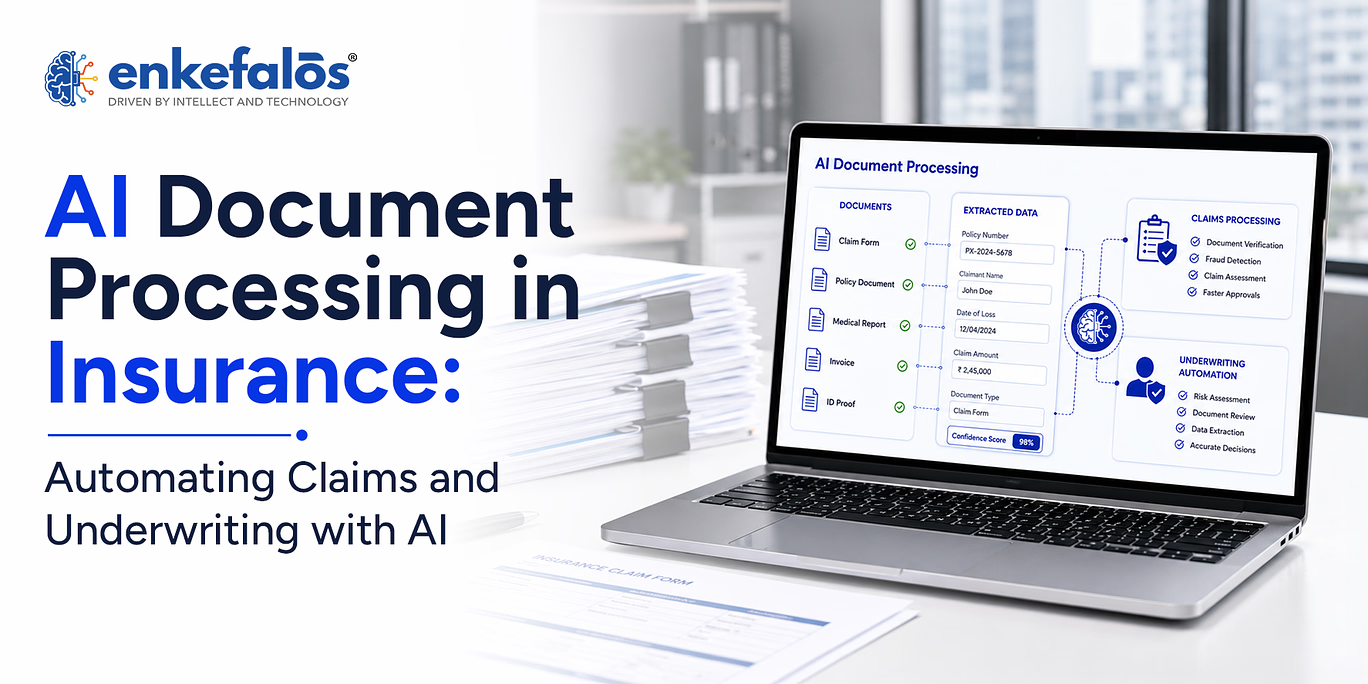
Artificial intelligence is becoming increasingly relevant across insurance operations, including claims, underwriting, fraud detection, and document processing. Insurance does not have a document shortage. It has a document intelligence problem.
According to the National Association of Insurance Commissioners (NAIC), 54% of surveyed home insurers reported using AI or machine learning in claims and 47% in underwriting, highlighting growing adoption across core insurance workflows.
This article explores how AI document processing in insurance can automate document intake, classification, extraction, validation, and interpretation across claims and underwriting. It also examines enabling technologies, insurance use cases, implementation considerations, governance requirements, and how AI-powered processing differs from traditional document handling.
What Is AI Document Processing in Insurance?
AI document processing in insurance uses artificial intelligence to extract, classify, validate, interpret, and organize information from insurance documents for use across claims, underwriting, policy, and compliance workflows.
Traditional OCR primarily converts scanned text into machine-readable data. Intelligent document processing adds contextual understanding, classification, business-rule validation, and workflow automation. Enkefalos DocuSure, for example, supports document ingestion, extraction, classification, interpretation, configurable rules, and integration with downstream enterprise systems.
This allows insurance documents to become structured sources of information rather than static files requiring repeated manual review.
Why Insurance Companies Need AI-Powered Document Processing
Insurance information often moves between underwriting, claims, compliance, policy administration, and other systems. When processes remain disconnected, manual handoffs can make it difficult to use the full context available across the organization.
AI-powered document processing can help address these challenges by:
- Reducing repetitive document review and data entry
- Structuring information from unstructured files
- Identifying missing or inconsistent information
- Applying predefined validation rules
- Connecting extracted data with downstream workflows
- Escalating uncertain cases for human review
The objective is not only faster processing. It is to create connected, traceable document intelligence that can support insurance decisions.
How AI Document Processing Works in Insurance
AI document processing typically follows a sequence from document intake to enterprise integration.
|
Stage |
Role in Insurance Document Processing |
| Ingestion | Receives documents from email, APIs, portals, storage, or enterprise repositories |
| Classification | Identifies document type and intended workflow |
| Extraction | Captures relevant fields, tables, entities, and text |
| Interpretation | Applies AI to understand document context |
| Validation | Checks data against business rules and available records |
| Exception handling | Flags uncertain or conflicting information |
| Integration | Sends processed information to downstream systems |
DocuSure follows this end-to-end approach while keeping document processing within a private environment when deployed on-premises or in a private cloud.
AI Document Processing for Claims Automation
Claims processing involves documents from policyholders, adjusters, brokers, repair providers, medical providers, and internal insurance systems. AI can help organize this information earlier in the claims lifecycle.
FNOL Intake and Document Classification
AI can extract information from First Notice of Loss submissions, identify the document type, organize supporting files, and prepare claim information for downstream processing.
Claims Validation and Triage
Claim forms, invoices, reports, and supporting evidence can be checked for missing information, inconsistencies, or defined risk indicators.
Fraud Investigation Support
AI can flag unusual patterns, duplicate information, conflicting values, or anomalies that may require further investigation.
Enkefalos ClaimFlow is positioned around claims workflows including FNOL intake, triage, risk assessment, and fraud detection.
AI Document Processing for Underwriting
Underwriting submissions can contain applications, ACORD forms, loss runs, schedules of values, financial records, inspection reports, and supporting documents.
AI document processing can help transform these files into structured underwriting information.
Submission Data Extraction
Relevant risk information can be identified and extracted without requiring an underwriter to manually locate every field.
Cross-Document Validation
Values, locations, exposure details, loss history, and other information can be compared across multiple documents.
Underwriter Decision Support
Structured information can be presented with source references, allowing underwriters to review the evidence behind extracted data.
Enkefalos UnderwriteIQ is designed for insurance-specific underwriting workflows, while InsurancGPT connects underwriting intelligence with document processing and other insurance operations.
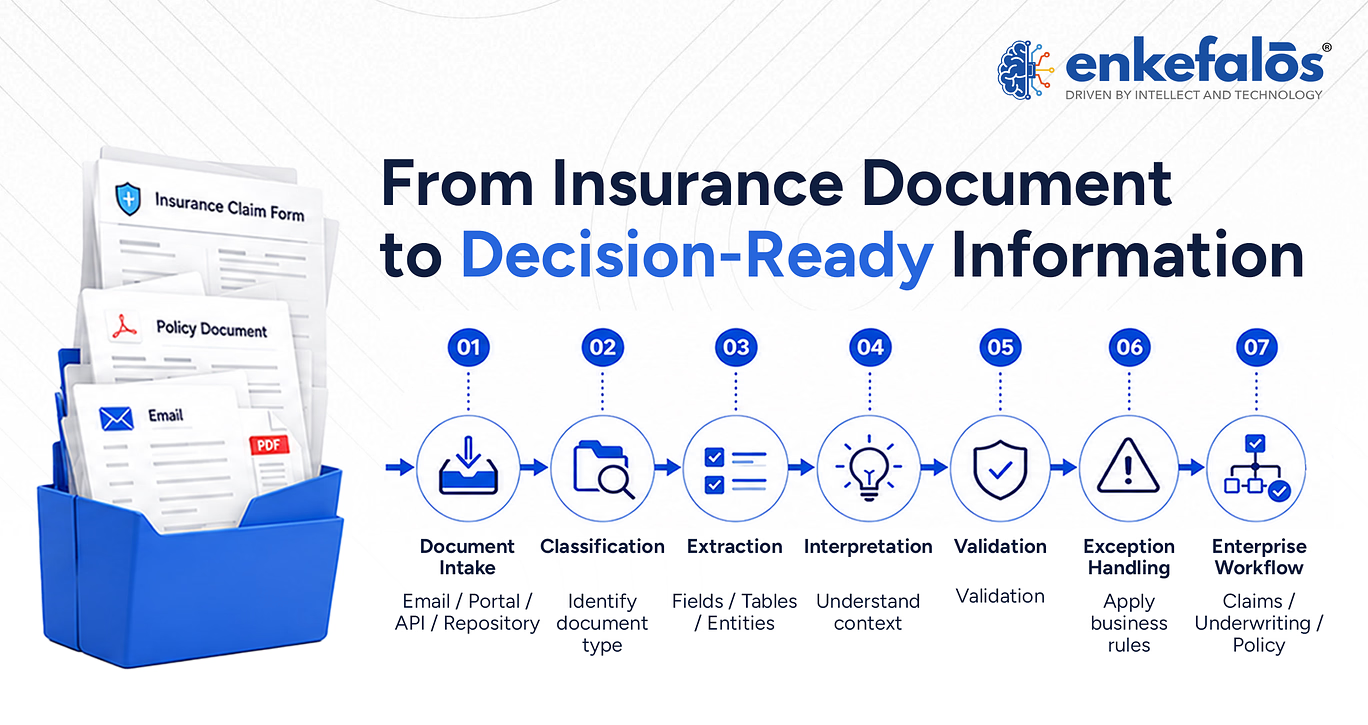
AI document processing converts unstructured insurance documents into validated, structured information that can support downstream claims, underwriting, and policy workflows.
Key Benefits of AI Document Processing in Insurance
AI document processing can support several operational improvements:
- Reduced manual effort: Repetitive extraction and classification tasks can be automated.
- Faster document handling: Information becomes available earlier in claims and underwriting workflows.
- Improved consistency: Business rules can be applied systematically.
- Source traceability: Extracted information can remain linked to its originating document.
- Scalable processing: Larger document volumes can be handled without equivalent increases in manual review.
- Better exception management: Uncertain or unusual cases can be routed for human attention.
- Stronger governance: Audit trails, monitoring, and explainability can support controlled AI adoption.
Enkefalos positions traceability, auditability, private deployment, governance, and human-controlled evaluation as core requirements for insurance AI.
See How DocuSure Automates Insurance Document Processing
Turn complex insurance documents into structured, validated, and traceable information for claims and underwriting workflows.
Common Insurance Documents AI Can Process
AI document processing can support documents across multiple insurance functions.
| Insurance Workflow |
Common Documents |
| Claims | FNOL forms, invoices, receipts, repair estimates, incident reports |
| Underwriting | Applications, ACORD forms, loss runs, schedules of values |
| Policy Operations | Policies, endorsements, renewals, coverage documents |
| Commercial Insurance | Exposure schedules, property information, financial statements |
| Compliance | Regulatory forms, identity records, audit documentation |
| Customer Operations | Emails, correspondence, forms, and attachments |
Enkefalos identifies ACORD forms, policies, compliance documents, and other insurance records as document types suitable for automated ingestion, extraction, classification, and validation.
AI Technologies Powering Document Processing
Several AI technologies work together to support intelligent insurance document processing.
Optical Character Recognition
OCR converts scanned or image-based content into machine-readable text.
Natural Language Processing
NLP helps interpret insurance terminology, entities, clauses, relationships, and document context.
Machine Learning
Machine learning can support classification, pattern recognition, extraction, and anomaly identification.
Retrieval-Augmented Generation
RAG connects AI responses with selected enterprise documents and approved data sources, helping systems generate answers based on relevant organizational information. Enkefalos includes RAG within its insurance AI architecture.
Generative and Agentic AI
Generative and agentic AI can support document interpretation, contextual question answering, workflow coordination, and interaction with enterprise systems. InsurancGPT is positioned as a private, agentic AI platform built specifically for insurance workflows.
Challenges of Traditional Insurance Document Processing
Traditional insurance document processing can require employees to:
- Open and classify documents manually
- Search files for relevant information
- Re-enter data into multiple systems
- Compare information across documents
- Validate incomplete submissions
- Route files between departments
- Maintain separate records for review and audit
These manual handoffs can create disconnected workflows where claims, underwriting, and compliance teams operate with only part of the available information.
Challenges and Considerations When Implementing AI
AI document processing also requires careful implementation.
Privacy and Data Ownership
Insurance documents can contain sensitive business and customer information. Private deployment can help keep documents, models, interactions, and processing workflows within an organization’s controlled environment. DocuSure supports deployment on-premises or within a private cloud.
Accuracy and Exceptions
Poor-quality scans, inconsistent layouts, missing fields, and unusual document structures can affect extraction results. Confidence thresholds and human-review workflows remain important.
Explainability and Traceability
AI outputs should be connected to supporting sources, so users can understand where information came from and why an exception was raised. InsurancGPT emphasizes traceable outputs and auditable decisions.
Enterprise Integration
Document intelligence becomes more useful when connected to underwriting platforms, claims systems, policy administration tools, and enterprise repositories.
AI Document Processing vs. Traditional Document Processing
|
Traditional Document Processing |
AI Document Processing |
| Documents are typically classified manually by operations or claims teams. | AI can classify documents automatically, with human review for ambiguous or low-confidence cases. |
| Information is often re-entered across multiple systems. | AI can extract structured data from documents and pass it into connected workflows, reducing repetitive entry. |
| Validation depends heavily on manual checks and predefined procedures. | AI can combine automated extraction with business rules, cross-document checks, and human validation. |
| Documents are often reviewed individually or across separate systems. | AI can connect information across multiple documents to provide a more consolidated view of a case. |
| Exceptions are usually identified during manual review. | AI can flag missing, inconsistent, or unusual information for specialist review. |
| Processing capacity may depend on available staff and document volumes. | AI can support higher document volumes while routing complex or uncertain cases to human reviewers. |
| Tracing information back to its original source may require manual effort. | AI systems can maintain source references, document links, and audit trails when designed for traceability. |
| Employees spend significant time on repetitive document handling. | AI can shift human effort toward exceptions, complex cases, and decisions requiring professional judgment. |
AI document processing does not eliminate the need for insurance professionals. It shifts attention from repetitive documents handling toward cases requiring expertise, contextual interpretation, or business judgment.
Real-World Use Cases of AI Document Processing in Insurance
Commercial Submission Processing
Applications, ACORD forms, schedules of values, and loss runs can be classified, extracted, and normalized before underwriting review.
Claims Triage
Incoming claims documents can be categorized and checked for completeness, risk indicators, or defined exceptions.
FNOL Processing
Initial loss information can be structured and routed into claims workflows.
Fraud Detection Support
AI can identify document anomalies, duplicate records, or inconsistencies requiring investigation.
Compliance Review
Document information can be validated against configured rules while retaining audit-ready records.
Conversational Document Intelligence
DocuSure also supports conversational interaction with processed documents, allowing information to be retrieved from enterprise records using AI-based document understanding.
How to Implement AI Document Processing in an Insurance Workflow
A practical implementation can follow seven stages:
- Identify the workflow where manual document handling creates measurable friction.
- Map document sources including email, portals, repositories, and APIs.
- Define extraction requirements for fields, tables, entities, and insurance-specific information.
- Configure validation rules and exception thresholds.
- Integrate downstream systems such as claims, underwriting, and policy platforms.
- Maintain human oversight for uncertain, complex, or high-impact cases.
- Monitor performance using extraction quality, exception rates, processing time, and workflow outcomes.
Privacy, data sovereignty, explainability, auditability, and governance should be considered from the beginning rather than added after deployment.
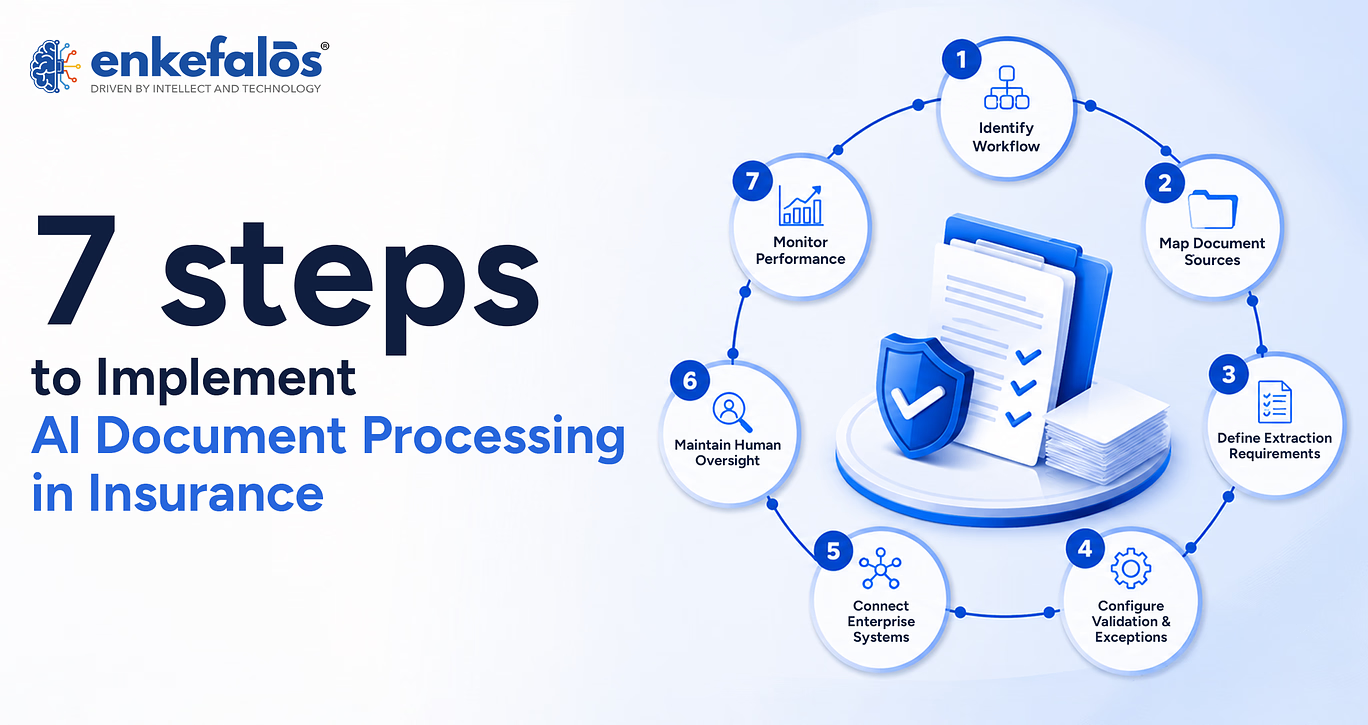
Successful AI document processing requires a structured implementation approach that connects document intelligence with validation, enterprise integration, human oversight, and continuous monitoring.
The Future of AI-Powered Document Processing in Insurance
Insurance document processing is moving beyond standalone extraction toward connected enterprise intelligence. The next stage combines document understanding with agentic AI, underwriting, claims, compliance, analytics, and enterprise data.
Instead of only extracting information from a document, AI systems can increasingly interpret context, apply business rules, identify exceptions, retrieve related information, and initiate the next workflow while maintaining human control.
Enkefalos positions InsurancGPT as this type of insurance-native intelligence layer, connecting DocuSure, UnderwriteIQ, ClaimFlow, and other capabilities while keeping AI deployment private, governed, explainable, and traceable.
Bring Document Intelligence into Your Insurance Workflows
See how InsurancGPT connects document processing with claims and underwriting intelligence in a private, governed AI environment.
Conclusion
AI document processing can transform insurance documents from static records into structured, traceable information that supports claims, underwriting, compliance, and operational workflows. Its value extends beyond faster extraction to improved data usability, workflow connectivity, exception management, and decision support.
When evaluating AI document processing, insurers should consider document accuracy, insurance-domain understanding, integration capability, source traceability, data privacy, governance, exception handling, and human oversight. A private, insurance-focused AI environment can provide the foundation for scalable document intelligence while keeping critical data and decision processes under enterprise control.
FAQs
- What Is AI Document Processing in Insurance?
AI document processing in insurance uses artificial intelligence to extract, classify, validate, and organize information from claims, underwriting files, policy documents, invoices, and other structured or unstructured insurance records automatically.
- How Does AI Automate Insurance Claims Processing?
AI automates claims processing by extracting data from forms and supporting documents, validating information, identifying missing details, routing cases, and flagging exceptions for human review across claims workflows.
- How Is AI Used in Insurance Underwriting?
AI supports insurance underwriting by extracting and organizing submission data, reviewing loss runs, financial records, and risk documents, identifying inconsistencies, and helping underwriters evaluate information more efficiently and consistently.
- What Types of Insurance Documents Can AI Process?
AI can process claim forms, policy applications, loss runs, invoices, medical records, inspection reports, schedules of values, correspondence, identity documents, and other structured or unstructured insurance files.
- How Does AI Improve Claims Processing Accuracy?
AI improves claims accuracy by extracting data consistently, validating information across documents, identifying missing or conflicting details, reducing manual entry errors, and flagging uncertain results for human review when needed.
- Can AI Document Processing Help Detect Insurance Fraud?
Yes. AI document processing can help detect insurance fraud by identifying duplicate claims, inconsistent information, unusual document patterns, altered records, or mismatched details that require further investigation by insurance specialists.
- What Are the Benefits of AI Document Processing for Insurance Companies?
AI document processing can reduce manual work, accelerate data extraction, improve consistency, support faster claims and underwriting workflows, strengthen traceability, and help insurers manage high document volumes more efficiently.
- Is AI Document Processing Secure for Sensitive Insurance Data?
Yes, when appropriate controls are in place. Secure AI document processing can use private deployment, encryption, access controls, audit trails, data isolation, and governance to protect sensitive insurance information.
- What Challenges Do Insurers Face When Implementing AI Document Processing?
Insurers may face challenges including inconsistent document formats, legacy system integration, data privacy requirements, model accuracy, governance, change management, and ensuring uncertain AI outputs receive appropriate human review.
- How Can Insurance Companies Implement AI Document Processing?
Insurance companies can implement AI document processing by identifying high-value workflows, assessing data and integration needs, piloting targeted use cases, establishing governance, and monitoring accuracy, security, and human oversight continuously.