


Blog
Responsible AI in Regulated Industries: What Business Leaders Need to Know

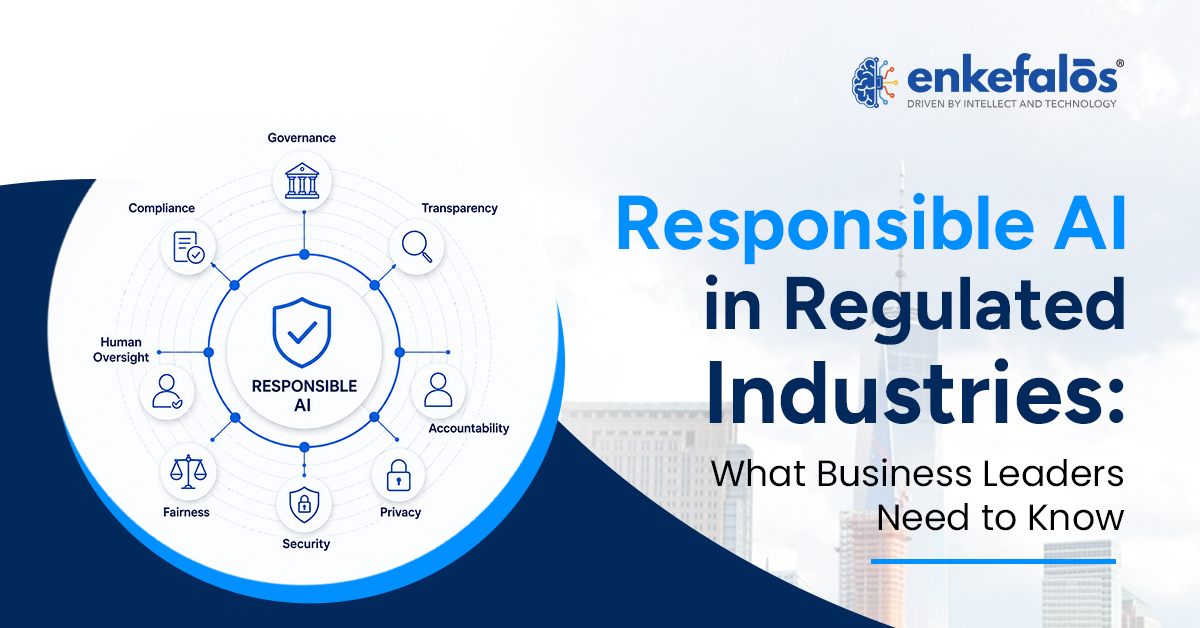
What does it take to deploy AI responsibly in regulated industries? As artificial intelligence becomes integral to sectors such as banking, healthcare, insurance, manufacturing, and pharmaceuticals, organizations must balance innovation with governance and compliance. AI systems can influence decisions involving sensitive data, financial outcomes, and public services, making structured oversight essential. Responsible AI provides a framework for transparency, accountability, fairness, privacy, security, and continuous monitoring throughout the AI lifecycle. This guide explains why Responsible AI matters, the regulations shaping its adoption, the risks business leaders should understand, and the best practices for building effective enterprise AI governance.
Responsible AI is no longer an ethics discussion. It has become an operational requirement. The question is no longer whether AI can produce answers. It is whether enterprises can govern those answers, explain them, and remain accountable for their consequences.
What Is Responsible AI?
Responsible AI refers to the principles, policies, governance practices, and technical controls used to design, develop, deploy, monitor, and manage artificial intelligence systems throughout their lifecycle.
Rather than focusing only on model accuracy, Responsible AI considers how AI systems affect people, organizations, compliance obligations, and operational outcomes.
Most Responsible AI programs are built around several core principles.
| Responsible AI Principle | Purpose |
| Fairness | Reduce unintended bias and promote equitable outcomes |
| Transparency | Explain how AI systems reach decisions whenever appropriate |
| Accountability | Define ownership and governance responsibilities |
| Privacy | Protect personal and sensitive information |
| Security | Safeguard AI models, infrastructure, and data |
| Reliability | Maintain consistent performance under expected conditions |
| Human Oversight | Enable appropriate review and intervention where necessary |
| Compliance | Align AI usage with applicable laws, regulations, and organizational policies |
Responsible AI is an ongoing governance process rather than a one-time technical implementation.
Why Responsible AI Matters in Regulated Industries
Organizations operating in regulated sectors face higher expectations regarding decision-making, documentation, risk management, and regulatory compliance.
Many enterprise AI applications influence important business processes such as:
- Credit assessments
- Insurance claims processing
- Healthcare decision support
- Fraud detection
- Anti-money laundering monitoring
- Employee screening
- Financial forecasting
- Customer verification
- Regulatory reporting
These use cases often involve personal information, financial records, healthcare data, or legally significant decisions.
Without appropriate governance, AI systems may create risks including:
- Inaccurate outputs
- Data privacy concerns
- Inconsistent decisions
- Regulatory non-compliance
- Security vulnerabilities
- Limited explainability
- Poor documentation
- Operational disruptions
Responsible AI helps organizations establish structured governance throughout AI adoption rather than addressing risks after deployment.
The Biggest AI Risks Business Leaders Must Understand
Understanding AI risks enables organizations to develop effective governance strategies before enterprise deployment.
Bias and Fairness Risks
AI models learn patterns from training data. If historical data contains imbalances or incomplete representation, model outputs may produce inconsistent outcomes across different groups or scenarios.
Organizations should evaluate datasets, monitor model performance, and regularly review outputs for potential bias.
Data Privacy Risks
Enterprise AI often processes customer, employee, operational, or healthcare information.
Organizations should establish controls for:
- Data collection
- Data minimization
- Access management
- Encryption
- Retention policies
- Consent management
- Secure storage
Explainability Challenges
Some AI models produce highly accurate outputs but provide limited visibility into how results are generated.
In regulated industries, explainability may be important for:
- Internal governance
- Regulatory reviews
- Audit documentation
- Customer communication
- Risk investigations
Model Drift
AI performance may change as business conditions, customer behavior, regulations, or datasets evolve.
Continuous monitoring helps organizations identify when retraining or recalibration is necessary.
Cybersecurity Threats
AI systems may face risks such as:
- Model manipulation
- Data poisoning
- Unauthorized access
- Prompt injection
- Adversarial attacks
- API misuse
Security should be incorporated throughout the AI development lifecycle.
Governance Gaps
Without clearly defined ownership, organizations may struggle to determine who is responsible for:
- Model approvals
- Risk assessments
- Documentation
- Incident management
- Compliance reviews
Enterprise AI governance establishes accountability across business, technology, legal, compliance, and security teams.
Note: Organizations evaluating different deployment models should also consider the trade-offs discussed in our Private AI vs Public AI: What Enterprise Leaders Must Consider Before Deploying AI in Production article.
Key Regulations Shaping Responsible AI
AI regulation continues to evolve globally. Organizations should monitor applicable laws based on their industry, geography, and business operations.
Some of the major regulatory developments include:
| Regulation or Framework | Primary Focus |
| EU AI Act | Risk-based governance for AI systems |
| GDPR | Personal data protection and privacy |
| NIST AI Risk Management Framework | AI risk identification and governance guidance |
| ISO/IEC 42001 | AI management system standard |
| OECD AI Principles | Responsible AI recommendations |
| Industry-specific regulations | Financial services, healthcare, insurance, telecommunications, and public sector requirements |
Business leaders should understand that Responsible AI extends beyond legal compliance. Internal governance often includes additional organizational policies covering ethics, risk management, documentation, and operational controls.
Organizations operating across multiple regions may need governance frameworks that address varying regulatory expectations.
Building an Enterprise Responsible AI Framework
Responsible AI requires structured governance across the entire AI lifecycle.
A practical enterprise framework typically includes the following components.
AI Governance Committee
Establish a cross-functional governance team involving:
- Executive leadership
- Risk management
- Legal
- Compliance
- Data science
- Information security
- IT operations
- Internal audit
The committee oversees AI strategy, governance policies, approvals, and risk management.
AI Inventory
Maintain a centralized inventory of AI systems, including:
- Business purpose
- Model type
- Data sources
- Owners
- Risk classification
- Deployment status
- Regulatory considerations
An AI inventory improves visibility across the organization.
Risk Assessment
Evaluate each AI system based on:
- Business impact
- Regulatory impact
- Privacy considerations
- Security requirements
- Operational dependency
- Human oversight requirements
Higher-risk applications generally require stronger governance controls.
Model Documentation
Comprehensive documentation supports governance throughout the model lifecycle.
Documentation may include:
- Business objectives
- Training methodology
- Validation results
- Performance metrics
- Known limitations
- Version history
- Approval records
Continuous Monitoring
Responsible AI continues after deployment.
Organizations should monitor:
- Accuracy trends
- Model drift
- Data quality
- Security events
- Compliance issues
- Operational performance
- User feedback
Regular reviews help identify emerging risks before they affect business operations.
Is Your Organization Ready for Responsible AI?
Responsible AI requires more than policies. It requires governance, operational controls, documentation, and continuous oversight.
Assess your organization’s AI governance readiness before moving AI into production.
Responsible AI Best Practices for Business Leaders
Business leaders play an important role in establishing enterprise-wide AI governance.
Consider the following practices.
Develop Responsible AI Policies
Create organization-wide policies defining:
- Acceptable AI usage
- Risk management expectations
- Governance responsibilities
- Documentation requirements
- Human oversight processes
Classify AI Systems by Risk
Not every AI application requires the same level of governance.
Organizations often classify AI systems into categories such as:
- Low risk
- Moderate risk
- High risk
- Critical risk
Governance controls can then be aligned with the level of business impact.
Improve Data Governance
High-quality AI depends on well-managed data.
Organizations should establish processes for:
- Data quality
- Metadata management
- Data lineage
- Access controls
- Retention policies
- Privacy protection
Maintain Human Oversight
For high-impact decisions, organizations should define when human review is required before final outcomes are finalized.
This approach helps strengthen governance while supporting accountability.
Conduct Independent Reviews
Periodic internal or external assessments can evaluate:
- Governance effectiveness
- Documentation quality
- Compliance readiness
- Risk management processes
- Technical controls
Independent reviews provide additional assurance for enterprise AI programs.
Industry Use Cases
Responsible AI principles apply across many regulated industries.
| Industry | Example AI Applications | Responsible AI Focus |
| Banking | Fraud detection, credit analysis | Fairness, explainability, governance |
| Healthcare | Clinical decision support, medical imaging | Privacy, documentation, oversight |
| Insurance | Claims processing, underwriting | Transparency, fairness, auditability |
| Pharmaceuticals | Drug research, manufacturing analytics | Data integrity, validation, compliance |
| Manufacturing | Predictive maintenance, quality inspection | Reliability, cybersecurity, monitoring |
| Telecommunications | Network optimization, customer service | Privacy, security, governance |
| Public Sector | Citizen services, document processing | Accountability, transparency, compliance |
Each industry may require governance controls tailored to applicable regulations and operational risks.
Checklist Before Deploying Enterprise AI
Before deploying AI into production, organizations should evaluate the following areas.
Governance
- AI ownership clearly defined
- Governance committee established
- Risk classification completed
Data
- Data quality validated
- Privacy requirements reviewed
- Sensitive information protected
Model
- Performance evaluated
- Limitations documented
- Validation completed
Security
- Access controls implemented
- Security testing completed
- Incident response procedures defined
Compliance
- Regulatory obligations identified
- Documentation prepared
- Audit evidence maintained
Operations
- Monitoring strategy established
- Model review schedule defined
- Change management process documented
Completing these activities helps organizations strengthen AI governance before operational deployment.
The Future of Responsible AI
Responsible AI will continue evolving alongside advances in generative AI, foundation models, autonomous agents, and industry-specific AI applications.
Several trends are expected to shape enterprise AI governance.
- Increased regulatory oversight across global markets
- Greater emphasis on AI transparency and explainability
- Expansion of AI governance platforms
- Stronger model monitoring and lifecycle management
- Increased adoption of AI management standards such as ISO/IEC 42001
- Greater integration between cybersecurity, privacy, and AI governance
- More structured enterprise AI risk management programs
Organizations that establish governance early are often better positioned to adapt as regulations and technologies evolve.
Responsible AI is increasingly becoming part of enterprise risk management rather than being treated as a standalone technology initiative.
Conclusion
Responsible AI is an essential component of enterprise AI adoption, particularly in regulated industries where governance, accountability, privacy, security, and compliance play a central role. Business leaders should view Responsible AI as a continuous governance framework that spans planning, development, deployment, monitoring, and ongoing improvement. Establishing clear policies, maintaining high-quality documentation, implementing risk-based controls, and monitoring AI systems throughout their lifecycle can help organizations manage operational and regulatory responsibilities more effectively.
As AI technologies continue to advance, organizations that invest in structured governance, cross-functional collaboration, and transparent AI practices will be better prepared to manage evolving regulatory expectations and integrate AI into critical business processes. Responsible AI is not solely about meeting compliance requirements; it is about creating reliable, well-governed AI systems that align with organizational objectives while maintaining appropriate oversight and accountability.
Build AI That Your Business Can Trust
Responsible AI is not just about compliance.
It is about creating AI systems that are governed, auditable, explainable, and ready for production.
If your organization is evaluating AI governance, enterprise deployment, or compliance readiness, Enkefalos can help you assess your current maturity and identify practical next steps.
Frequently Asked Questions
1. What is Responsible AI?
Responsible AI is the practice of developing, deploying, and managing artificial intelligence systems using governance principles such as fairness, transparency, accountability, privacy, security, reliability, and human oversight throughout the AI lifecycle.
2. Why is Responsible AI important for regulated industries?
Regulated industries often process sensitive information and operate under legal and compliance requirements. Responsible AI helps organizations establish governance, documentation, risk management, and oversight for AI-enabled business processes.
3. Which industries need Responsible AI the most?
Responsible AI is particularly relevant for banking, financial services, healthcare, insurance, pharmaceuticals, telecommunications, manufacturing, energy, and public sector organizations that use AI in business-critical operations.
4. What is AI governance?
AI governance refers to the policies, processes, roles, and controls that guide how AI systems are designed, approved, monitored, documented, and managed throughout their lifecycle.
5. How does Responsible AI improve compliance?
Responsible AI establishes governance practices such as documentation, risk assessments, monitoring, audit readiness, privacy controls, and policy management, helping organizations align AI initiatives with applicable regulatory requirements.
6. What are the biggest risks of enterprise AI?
Common enterprise AI risks include biased outputs, privacy concerns, cybersecurity threats, limited explainability, model drift, data quality issues, governance gaps, and regulatory non-compliance.
7. How can organizations implement Responsible AI?
Organizations can implement Responsible AI by creating governance policies, establishing cross-functional oversight, classifying AI systems by risk, improving data governance, documenting AI models, monitoring performance, and conducting regular reviews.
8. What regulations govern AI systems?
AI governance may be influenced by regulations and frameworks such as the EU AI Act, GDPR, the NIST AI Risk Management Framework, ISO/IEC 42001, OECD AI Principles, and industry-specific regulatory requirements depending on the organization’s jurisdiction.
9. How does Responsible AI build customer trust?
Responsible AI promotes transparent governance, consistent decision-making, privacy protection, security controls, and accountability, helping organizations demonstrate responsible management of AI systems and business processes.
10. Who is responsible for AI governance in an organization?
AI governance is typically a shared responsibility involving executive leadership, business owners, IT, legal, compliance, risk management, security, and data science teams. High-impact AI systems benefit from cross-functional oversight rather than ownership by a single department.