


Blog
Private AI vs Public AI: What Enterprise Leaders Must Consider Before Deploying AI in Production

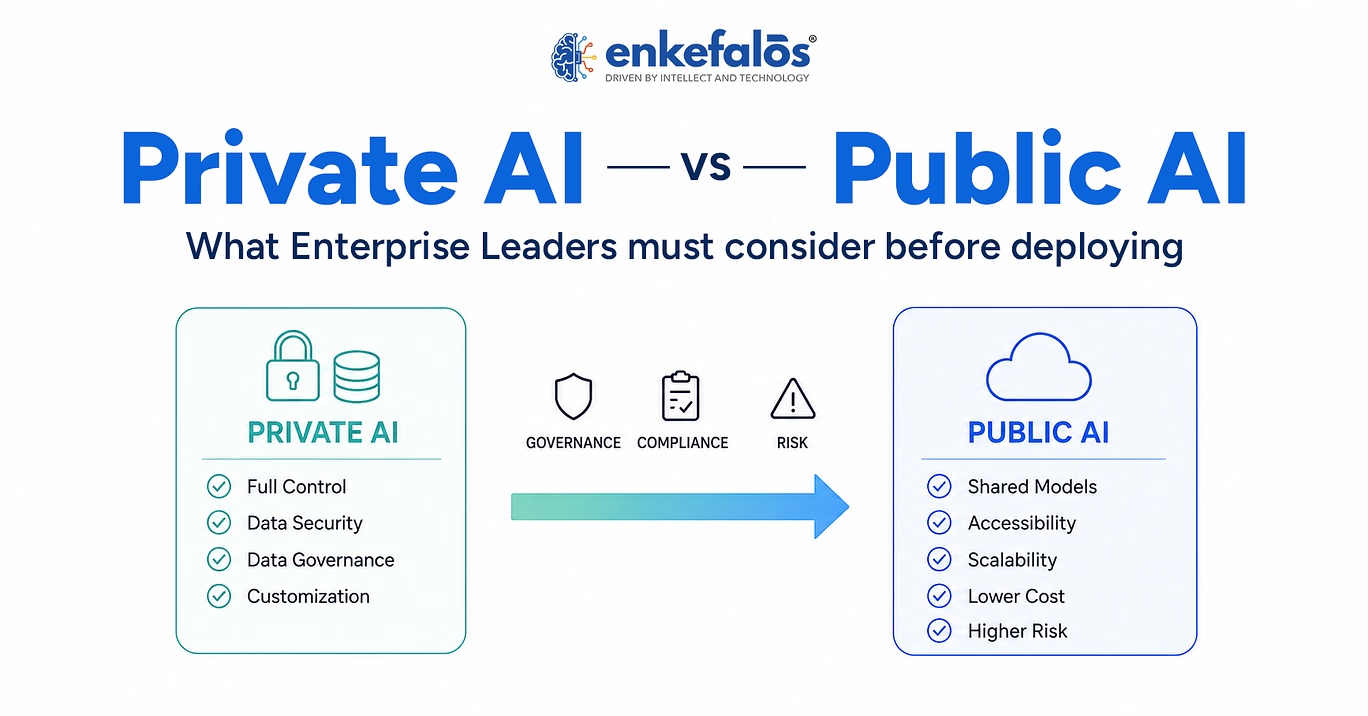
Artificial intelligence has leaped well past experimentation. In industries, organizations are implementing AI to automate processes, enhance decision making, drive faster customer service, and discover operational efficiencies. However, with the increasing adoption of enterprise, a question persists that should be asked:
Is it worth using Public AI platforms or investing in Private AI infrastructure in case an organization depends on it?
It is no longer a technology choice. It has an impact on data governance, compliance, intellectual property protection, operational risk and long-term business value. Although public AI services can allow quicker innovation, a number of businesses find that scale deployments need a degree of control, security, and governance unavailable in the public platforms.
This article unveils the truth about Private AI vs Public AI and assists CIOs, CTOs, CISOs, and leaders of enterprises to make the right decision before transferring AI out of the pilot project into mission-critical production systems.
Understanding Private AI and Public AI
Before comparing deployment approaches, it is important to define both models.
What is Public AI?
Public AI is AI services that are hosted and run by third parties. Models are delivered by APIs, SaaS platforms or cloud services to organizations.
Examples include:
- Public large language models (LLMs)
- Cloud-based AI APIs
- Generative AI assistants
- Shared multi-tenant AI platforms
Public AI has the benefit of being deployed quickly, requiring little infrastructure, and being able to access state-of-the-art models without requiring in-house expertise in AI.
What is Private AI?
Private AI The AI systems that are installed in a controlled setting of an organization such as:
- On-premises infrastructure
- Private cloud environments
- Virtual private clouds (VPCs)
- Hybrid architectures
The benefits of having a private AI include enabling a business to own and control:
- Data
- Models
- Training processes
- Governance policies
- Security controls
In contrast to the public services, the Private AI is tailored to the needs of the enterprise instead of being generalized in the consumer use.
Why AI Pilots Succeed but Production Deployments Fail
The results that many organizations present during AI pilots are impressive. Nevertheless, in practice, deployment of production can bring to the fore issues that were not evident during experimentation.
Common reasons include:
Limited Governance
Small datasets and a small number of users are a typical characteristic of pilots. The environments of production should have strong governing systems to monitor, audit and enforce policies.
Data Quality Issues
In controlled environments, AI models work well, but when it comes to deployment, enterprise data is inconsistent, incomplete, or fragmented.
Security Concerns
Sensitive customer, monetary, healthcare, or operational information can find its way into AI processes without adequate protection.
Regulatory Constraints
Compliance requirements are often overlooked in many pilot projects and only become mandatory before rolling out enterprise-wide.
Lack of Operational Controls
Production AI requires:
- Version management
- Performance monitoring
- Rollback capabilities
- Human oversight
- Continuous evaluation
In the absence of such controls, organizations find it hard to grow past proof-of-concept projects. Studies on the implementation of AI in enterprises emphasize the need to manage AI model risk and observe model behavior prior to incorporating AI into business-critical applications.
Public AI Risks in Regulated Industries
In highly regulated industries, Public AI presents special risks.
Healthcare
Medical institutions should take care of patient data and adhere to privacy laws.
Unprotected health information:
- Exposure of protected health information
- Inadequate audit trails
- Cross-border data processing
Financial Services
Banks and insurers are subject to strict requirements in respect of:
- Customer data protection
- Explainability
- Risk management
- Regulatory reporting
Government Agencies
In public-sector organizations, there is often a need to see everything about:
- Data storage locations
- Processing activities
- Access controls
Legal Services
Client data is sensitive and poses serious problems when handled by third-party AI applications.
Accuracy of models is not the only aspect of AI adoption in these industries. It is concerned with establishing compliance, accountability, and traceability.
Data Sovereignty and Compliance Requirements
The concept of data sovereignty is one of the largest differences between the Private AI vs Public AI debate.
What Is Data Sovereignty?
Data sovereignty is the need to have data under the laws and regulations of the country in which it is stored.
Regulations that many organizations must adhere to include:
- GDPR
- HIPAA
- SOC 2
- ISO 27001
- CCPA
- Industry-specific standards
Why It Matters
Questions that leaders of enterprises all need to have an answer to include:
- The location of AI data is where?
- Who can see it?
- Is there any possibility of data going out of the country?
- Information retention period?
- Is data used for model training?
Public providers of AI might provide compliance controls, and organizations typically have minimal visibility of underlying infrastructure.
AI environments with access to more control over:
- Data residency
- Encryption
- Access policies
- Audit logging
- Regulatory reporting
These capabilities are now becoming strategic necessities and not just a feature to enterprises that operate in the global market.
The Cost Myths of Public AI
One of the most widespread assumptions is that Public AI is less expensive.
The truth is not this simple.
Myth 1: No Infrastructure Means it is cheaper
Whereas public AI does not involve hardware investments, it can quickly become expensive by:
- API consumption fees
- Token-based pricing
- Data transfer charges
- Premium model access
Myth 2: AI in the Community Needs Less Governance
Organizations still need:
- Security reviews
- Compliance oversight
- Vendor management
- Risk assessments
- Governance programs
Myth 3: AI Goes Public, and the Economy of Scale Endures
Operation costs tend to be high every time it is used, unlike when the frequency of use is low.
A large number of businesses have found that predictable, high-volume AI workloads are less expensive when implemented with Private AI infrastructure.
The real comparison needs to be made in terms of the total cost of ownership (TCO), rather than initial deployment cost.
Private AI Deployment Models
Private AI is not a single architecture.
Organizations can choose deployment models based on business objectives and compliance requirements.
On-Premises AI
AI infrastructure resides entirely within organizational data centers.
Benefits include:
- Maximum control
- Strong data protection
- Complete ownership
Challenges include:
- Higher capital investment
- Infrastructure management responsibilities
Private Cloud AI
AI workloads operate within dedicated cloud environments.
Benefits include:
- Scalability
- Enhanced security
- Controlled access
Hybrid AI
Hybrid architectures combine public and private environments.
Organizations can:
- Keep sensitive workloads private
- Use public AI for lower-risk applications
This approach balances flexibility with governance.
Industry-Specific Private AI Platforms
Some vendors offer purpose-built private AI platforms designed specifically for regulated industries, enabling organizations to deploy AI while maintaining governance, auditability, and compliance controls.
Governance Requirements for Production AI
AI governance is often the deciding factor between successful deployment and operational failure.
Enterprise AI governance should include:
Model Monitoring
Organizations need continuous visibility into:
- Accuracy
- Drift
- Bias
- Performance degradation
- Audit Trails
Every AI decision should be traceable.
This includes:
- Inputs
- Outputs
- Model versions
- User interactions
Human Oversight
Critical decisions should maintain human review processes where appropriate.
Explainability
Leaders must understand how AI systems arrive at recommendations.
Explainable AI has become a foundational component of responsible enterprise AI adoption.
Risk Management
Governance frameworks should identify and mitigate:
- Security risks
- Compliance risks
- Operational risks
- Reputational risks
Organizations that treat governance as an afterthought often face significant deployment delays.
Private AI vs Public AI: Side-by-Side Comparison
|
Factor |
Private AI |
Public AI |
|
Data Control |
Full ownership | Limited control |
|
Security |
Enterprise-controlled | Provider-controlled |
| Compliance | Easier customization |
Dependent on provider |
|
Data Sovereignty |
High | Variable |
| Infrastructure Cost | Higher upfront |
Lower upfront |
|
Operating Cost |
Predictable | Usage-based |
| Customization | Extensive |
Limited |
|
Governance |
Fully configurable | Provider constraints |
| Deployment Speed | Moderate |
Fast |
| Scalability | Controlled scaling |
Rapid scaling |
The right choice depends on organizational priorities, regulatory obligations, and workload sensitivity.
A Decision Framework for CIOs and Enterprise Leaders
Before deploying AI in production, enterprise leaders should evaluate five areas.
1. Data Sensitivity
Ask:
- Does the AI process confidential information?
- Is customer data involved?
- Are intellectual property assets exposed?
2. Regulatory Exposure
Consider:
- Industry regulations
- Geographic requirements
- Audit obligations
3. Business Criticality
Determine:
- What happens if the AI system fails?
- Is human intervention required?
4. Cost Predictability
Evaluate:
- Long-term operational expenses
- Growth projections
- Usage patterns
5. Governance Readiness
Assess whether the organization has:
- AI policies
- Monitoring capabilities
- Audit processes
- Risk management frameworks
Enterprise AI initiatives succeed when technology decisions align with business objectives rather than chasing short-term experimentation.
Signs Your Organization Needs Private AI
Organizations should strongly consider Private AI if they experience the following:
Sensitive Data Processing
Customer records, healthcare data, financial transactions, or proprietary intellectual property are involved.
Strict Compliance Requirements
The organization operates under industry or government regulations.
High-Volume AI Usage
Long-term usage patterns make API-based pricing increasingly expensive.
Need for Full Auditability
Every AI decision must be documented and explainable.
Intellectual Property Protection
The organization wants ownership of:
- Models
- Training data
- Outputs
- AI workflows
Long-Term AI Strategy
The organization views AI as strategic infrastructure rather than a short-term productivity tool.
Conclusion
Public AI offers a rapid way to experimentation and innovation. But with organizations shifting AI to production, issues related to governance, compliance, security, auditability, and cost predictability become much more critical.
In businesses dealing with regulated industries or working with sensitive data, Private AI is a more promising basis of sustainable AI adoption. Instead of using only the external AI computing services, organizations are now interested in the solutions that will allow them to have full control over their data, models, governance policies, and deployment environments.
Enkefalos provides its own AI execution platforms that are regulated industry-specific. We emphasise the controlled use of AI, constant monitoring, auditing, readiness to comply, and the ability to flexibly provide infrastructure in on-premises, private cloud, and hybrid models. Also, we focus on enterprise control, data sovereignty, and production-grade AI governance and not experimentation only.
FAQs
1. What is the difference between Private AI and Public AI?
In private AI, the organization is in charge of data, models, and governance mechanisms and it is deployed on the infrastructure controlled by an organization. Public AI is offered by third-party vendors and can be obtained as cloud services or APIs.
2. Is Private AI more secure than Public AI?
The private AI usually offers more influence on the security policies, access control, data residency, and compliance needs. Nevertheless, the security finally remains on the quality of implementation as well as governance practices.
3. Which industries should consider Private AI deployments?
Some of the most common applications of Private AI are in industries that deal with sensitive or regulated information, such as:
- Healthcare
- Financial services
- Insurance
- Government
- Legal services
- Critical infrastructure sectors
4. Can enterprises use both Private AI and Public AI together?
Yes. A common strategy used by many organizations is to use a hybrid approach in which sensitive workloads are stored on private clouds and less-risky use cases use public AI services.
5. What are the hidden costs of Public AI platforms?
Some of the hidden costs may be:
- API consumption fees
- Scaling expenses
- Compliance management
- Security reviews
- Vendor dependency
- Data transfer charges
- Governance and monitoring overhead
Total cost of ownership is one of the factors that should be considered by organizations and not initial deployment costs only.