


Blog
How to Measure ROI in Enterprise AI Deployments?

Artificial Intelligence has moved from experimentation to enterprise infrastructure. Organizations are investing heavily in AI to automate operations, enhance decision-making, improve compliance, and unlock new revenue streams. But as budgets grow, so does scrutiny —especially in 2026, when recent Forrester research reveals only 15% of enterprises effectively link AI initiatives to profitability. Executives want clarity on one essential question: how to measure ROI.
Understanding how to measure ROI in business, especially in the context of enterprise AI, is not always straightforward. Unlike traditional investments, AI systems evolve, learn, and influence multiple business functions at once. Their impact may appear in cost savings, revenue growth, productivity gains, risk reduction, or even strategic agility.
To effectively measure performance, organizations must adopt structured ROI measurement methods that go beyond basic accounting formulas. Measuring AI success requires financial analysis, operational metrics, adoption tracking, and long-term value assessment.
This guide explains how to measure return on investment in enterprise AI deployments using practical frameworks, key metrics, and advanced evaluation models. Whether you’re deploying predictive analytics, intelligent automation, or enterprise AI infrastructure, this structured approach will help you quantify impact confidently and make informed scaling decisions.
What Is ROI in Enterprise AI?
Return on Investment (ROI) measures the profitability of an investment relative to its cost. In enterprise AI, ROI reflects the value generated by AI systems compared to the total cost of implementation and maintenance.
At its core, the formula to measure return is:
ROI (%) = [(Net Benefit – Total Cost) ÷ Total Cost] × 100
However, understanding how to measure ROI in enterprise AI requires expanding beyond this basic calculation.
AI investments generate value in several ways:
- Operational cost reductions through automation
- Revenue growth via personalization and predictive insights
- Risk mitigation through fraud detection or compliance monitoring
- Productivity improvements across teams
- Strategic advantages such as faster innovation cycles
When organizations explore how to measure ROI in business, they often focus only on direct financial gains. But enterprise AI delivers both tangible and intangible values.
Tangible ROI includes:
- Reduced labor costs
- Increased sales conversions
- Lower error rates
Intangible ROI includes:
- Better decision quality
- Enhanced customer experience
- Improved employee satisfaction
Effective ROI measurement methods for AI must account for both immediate financial impact and longer-term strategic outcomes. Because AI systems improve over time through learning, ROI often increases after deployment, making measurement an ongoing process rather than a one-time calculation.
Ultimately, enterprise AI ROI represents measurable business value created through intelligent systems that improve performance across the organization.
Measure the ROI of Enterprise AI with Enkefalos
Understand the true impact of your AI investments. Track performance, optimize costs, and unlock measurable business value with enterprise-grade analytics and governance using the Enkefalos GenAI Foundry.
Why Measuring ROI in AI Is Different from Traditional IT Projects?
When organizations research how to measure return on investment, they often rely on traditional IT project frameworks. However, enterprise AI introduces complexities that make ROI evaluation different.
- AI Is Adaptive
Traditional IT systems execute predefined rules. AI systems learn from data and improve continuously. Early ROI may appear modest, but as models refine, returns often increase.
- Impact Is Cross-Functional
AI deployments rarely affect just one department. A predictive model may influence operations, finance, marketing, and compliance simultaneously. This distributed impact complicates attribution.
- Benefits Are Partly Behavioral
Adoption matters. Even a powerful AI system fails to deliver ROI if employees do not use it effectively. Measuring usage rates and workflow integration becomes essential.
- Outcomes Are Probabilistic
AI outputs are based on probabilities rather than certainty. Performance varies depending on data quality and real-world conditions, requiring continuous performance monitoring.
Because of these factors, organizations must apply structured ROI measurement methods tailored to AI, not simply reuse traditional IT ROI templates. Measuring AI ROI demands baseline analysis, iterative tracking, and cross-functional coordination.
Understanding how to measure ROI in business in an AI-driven environment means accepting that value realization is dynamic and often compounding over time.
Key Metrics to Measure Enterprise AI ROI
To understand how to measure ROI, organizations must track metrics across four primary categories: financial, operational, customer, and strategic.
Financial Metrics
Financial metrics provide the clearest ROI signals.
Cost Savings
- Labor reductions from automation
- Reduced error remediation costs
- Lower infrastructure usage
Revenue Growth
- Increased conversion rates
- Improved customer retention
- Upselling and cross-selling impact
Profitability Improvements
- Margin expansion
- Optimized pricing models
These metrics directly support calculations when determining how to measure return on investment.
Case study:
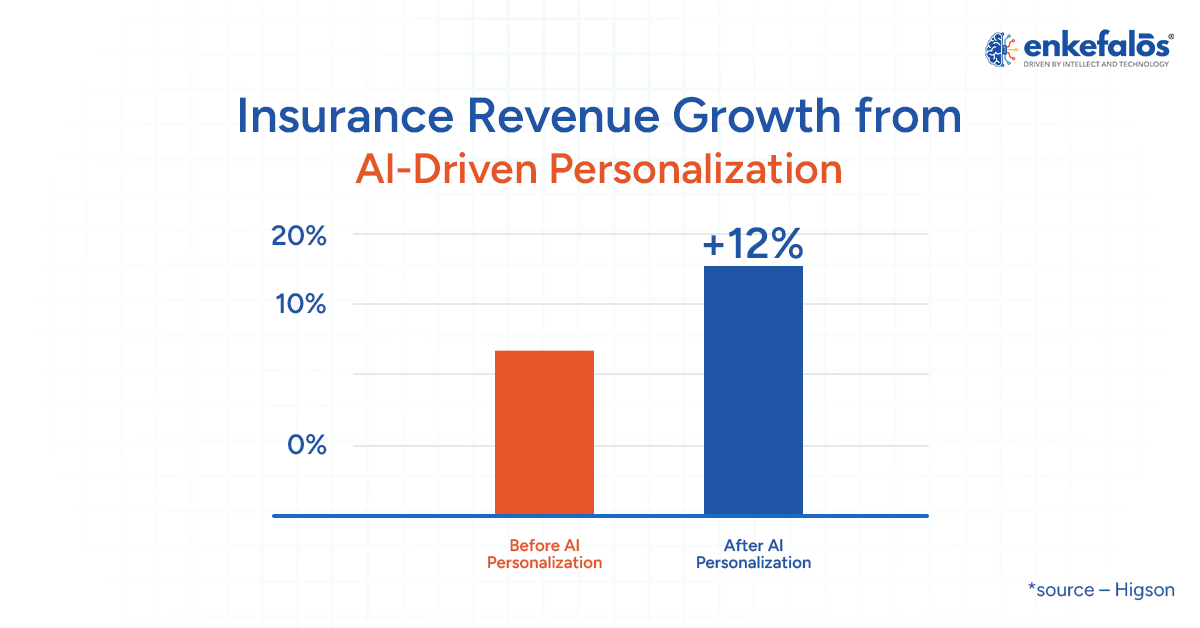
- AI-driven personalization allows insurers to tailor policies, pricing, and recommendations using behavioral and risk data – driving revenue increases of10–15% while improving retention and customer satisfaction. [source – Higson]
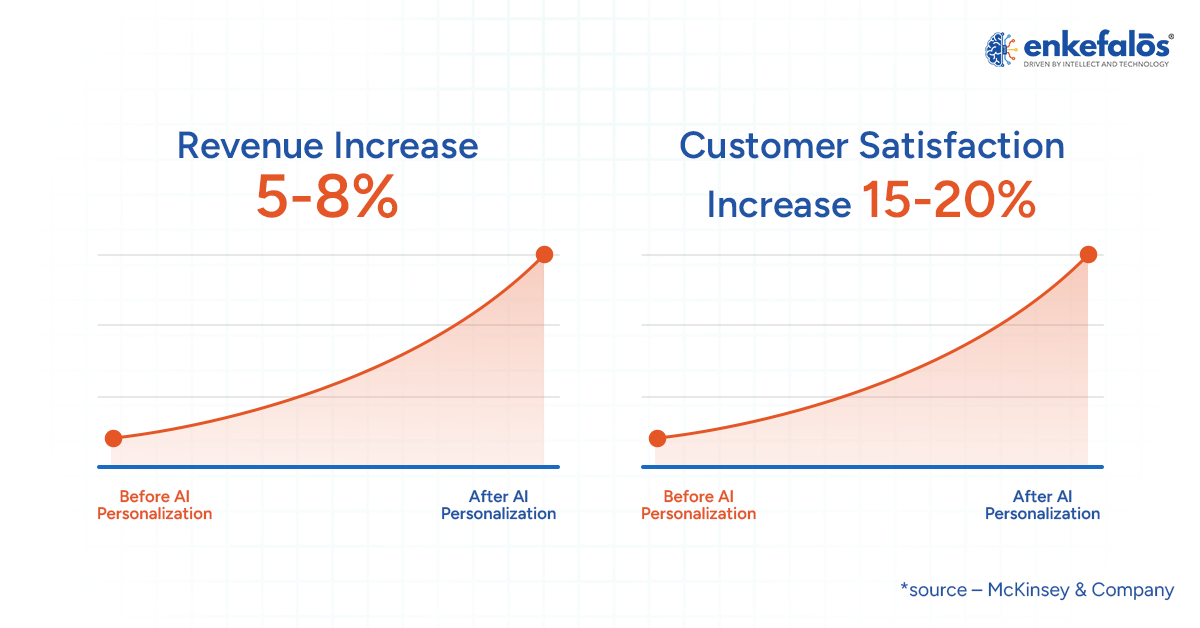
- AI-driven personalization can increase revenue by 5–8% and improve customer satisfaction by 15–20%. [source – McKinsey &Company]
- Operational Metrics
Operational performance often drives financial results.
Cycle Time Reduction
- Faster processing times
- Shorter approval cycles
Throughput Improvements
- Increased case handling capacity
- Higher transaction processing volume
Error Rate Reduction
- Fewer manual mistakes
- Improved data accuracy
Operational gains can be translated into monetary value using salary and efficiency benchmarks.
Customer-Centric Metrics
AI often enhances customer experiences, which impacts long-term revenue.
- Net Promoter Score (NPS)
- Customer Retention Rate
- Customer Lifetime Value (CLV)
- Average Resolution Time
While these metrics may not immediately show revenue changes, they influence long-term ROI significantly.
Strategic Metrics
Strategic metrics reflect enterprise-wide transformation:
- Time-to-market acceleration
- AI adoption rates
- Innovation velocity
- Risk reduction levels
Organizations that want comprehensive ROI measurement methods must include these indicators to capture full business value.
A balanced measurement framework ensures you are not underestimating AI’s true contribution.
Enterprise AI ROI Calculation Framework
To effectively understand how to measure ROI in business, follow this structured framework:
Step 1: Define Objectives
Establish measurable goals:
- Reduce operational costs by 20%
- Improve forecast accuracy by 15%
- Decrease fraud losses by $1M annually
Clear objectives align with stakeholders and prevent ambiguous ROI claims.
Step 2: Establish Baselines
Before AI deployment, document:
- Current costs
- Productivity levels
- Revenue performance
- Error rates
Baseline data is critical when learning how to measure return on investment accurately.
Step 3: Calculate Total Investment
Include:
- Development costs
- Infrastructure expenses
- Licensing fees
- Data engineering costs
- Change management and training
- Ongoing support
Underestimating costs is one of the biggest mistakes in ROI analysis.
Step 4: Track Post-Deployment Performance
Measure improvements against baselines using dashboards and financial reporting systems.
Step 5: Apply ROI Formula
ROI (%) = [(Total Benefits – Total Costs) ÷ Total Costs] × 100
For example:
If AI saves $800,000 annually and costs $400,000:
ROI = [(800,000 – 400,000) ÷ 400,000] × 100 = 100%
This structured process ensures consistent ROI measurement across initiatives.
Ready to calculate your AI ROI? Use our free ROI Calculator to input your baselines, costs, and metrics for instant results. Try it here
Advanced Models for Measuring AI ROI
Basic ROI formulas are useful, but advanced organizations adopt enhanced ROI measurement methods:
- Total Economic Impact (TEI)
Includes direct financial benefits, risk adjustments, and strategic advantages.
- Incrementality Testing
Use control groups to isolate AI’s direct impact, ensuring causal measurement rather than correlation.
- Real Options Valuation
Accounts for future strategic opportunities enabled by AI investments.
- Scenario Modeling
Best-case, worst-case, and expected-case financial modeling to understand risk-adjusted returns.
These advanced methods help enterprises measure AI ROI with greater precision and credibility.
Industry-Specific AI ROI Applications
Different industries apply ROI principles differently.
Healthcare
- Reduced readmissions
- Faster diagnostics
- Lower administrative costs
Retail
- Personalized recommendations increasing basket size
- Inventory optimization reducing waste
Manufacturing
- Predictive maintenance reducing downtime
- Quality control automation lowering defect rates
Financial Services
- Fraud detection savings
- Automated underwriting efficiency
Each industry must adapt to how to measure ROI in business according to its operational priorities and risk profiles.
Tools and Systems to Track AI ROI
Measuring AI ROI requires integrated systems:
- Business Intelligence dashboards
- Model monitoring tools
- Data observability platforms
- Financial forecasting software
Automated reporting ensures ROI measurement becomes continuous rather than periodic.
Common Mistakes in Enterprise AI ROI Measurement
Organizations often miscalculate ROI by:
- Failing to establish baselines
- Ignoring ongoing costs
- Measuring too early
- Overestimating projected benefits
- Not tracking adoption
Effective ROI measurement methods demand discipline, cross-functional collaboration, and continuous evaluation.
Conclusion
Understanding how to measure ROI in enterprise AI deployments is not just about applying a formula. It requires structured planning, clear objectives, baseline tracking, and ongoing measurement across financial, operational, and strategic dimensions.
Organizations that master how to measure return on investment gain more than financial clarity; they gain strategic control. By using disciplined ROI measurement methods, enterprises can validate AI investments, prioritize high-impact use cases, and scale initiatives confidently.
Enterprise AI delivers value over time. When measured correctly, it becomes not just a technology initiative, but a measurable business asset driving sustainable growth and competitive advantage.
FAQs
1. How do you measure ROI in enterprise AI deployments?
You measure ROI by comparing measurable value (cost savings, revenue gains, risk reduction) against total AI investment costs using structured ROI frameworks and performance tracking.
2. What formula is used to calculate AI ROI?
ROI (%) = [(Net Benefits – Total Costs) ÷ Total Costs] × 100
This formula helps determine profitability relative to investment size.
3. How do you establish baseline metrics before measuring AI ROI?
Document current operational, financial, and performance metrics before deploying AI. Baselines provide a benchmark for post-deployment comparison.
4. What financial metrics are used to evaluate AI ROI?
Common financial metrics include:
- Cost savings
- Incremental revenue
- Gross margin improvement
- Return on capital
5. How do you measure cost savings generated by AI?
Track reductions in labor hours, process inefficiencies, downtime, and error correction costs compared to baseline values. Convert these improvements into monetary terms.